Video
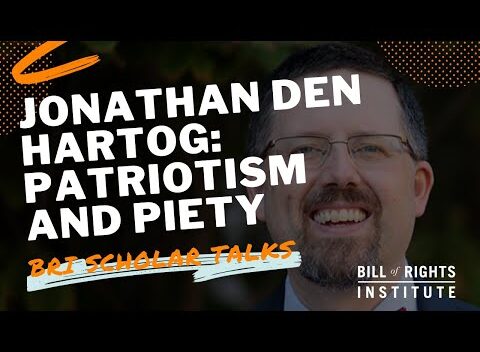
Patriotism & Piety with Jonathan Den Hartog | BRI Scholar Talks
Watch
Founding Principles
About this video
Religion was at the heart of the founding of the American colonies, but did you know that it played a major role in political life? In this episode of Scholar Talks, BRI Senior Teaching Fellow Tony Williams is joined by Jonathan Den Hartog, Professor of History at Samford University, to discuss how religion influenced politics in the early Republic. How did religion affect the growing partisan divide between Federalists and Democratic-Republicans? What lessons can we learn from the political division of the late eighteenth-century Republic?
0:00 to do so you need to enter that public arena uh to persuade people not simply to demean those who disagree with you but to persuade them and it turns out that persuasion happens much better when you’re using accessible arguments
0:21 um accepted reason and some amount of civility right you catch more flies with honey than with vinegar it’s true the early republic was not always a very civil time it was a time of great incivility but you have to find common ground to discuss it
0:47 hi this is tony williams the senior fellow with bri and we are very honored to welcome you to another episode of scholar talks for this episode we’ll have jonathan den hartog joining us and he’s going to discuss politics in the early republic the guiding question for this conversation
1:07 is how did the ties of religion and politics shaped the american founding and the politics of the early republic so by way of introduction jonathan den hartog is a professor of history and department chair samford university in birmingham alabama he’s a specialist in american political and religious history
1:30 and he has written essays for the bri textbook life liberty and the pursuit of happiness he’s the author of several books including patriotism and piety federal federalist politics and religious struggle in the new american nation which is the basis for today’s discussion so jonathan thank you for
1:50 joining us well thank you so much it’s a it’s a delight once again uh to be with you and and to support this excellent programming right yeah you you did an excellent uh previous scholar talk that everyone should check out on on your essay related to the early republic um and one of the reasons why i really love your book patriotism and piety
2:11 is that it it really provides some some really interesting character sketches biographical sketches and and a really interesting history of the early republic on on a topic i hadn’t thought as much about uh and and how that that confluence of politics and and religion kind of plays out especially for the
2:32 federalist party and a lot of our viewers should be very familiar with that uh that first party system uh between the federalists and and democratic republicans i know most students talk about that in their classrooms uh and so this will be very relevant uh for for uh those classrooms so if you’re ready let’s jump into the first question
2:53 now almost all the founders especially those in in the federalist party believed in this idea that that religion was the basis of morality and virtue and then morality and virtue was the basis for a healthy republican government and it’s also closely tied to this idea
3:13 of covenant theology in in the founding and early republic so can you explain uh these beliefs and maybe the logic behind it right a couple pieces there and let’s just underline again that we are talking about that link between uh the american revolution the period of the constitution then into the first
3:35 first party era or system uh i find that the drama of the 1790s to be really interesting because there’s a lot going on as the people involved didn’t know what was going on so as i went to investigate that i was really asking questions about what about religious commitments and did that structure how the early political
3:58 parties especially the federalists developed and how they also set themselves over against their democratic republican opponents so that was really the driving question for my investigation so then to think about several uh theological commitments the the first one that you talked about was that uh
4:18 linkage that got articulated in many points between uh religious belief religious commitment uh and then morality or virtue and the language that they used was really virtue and virtue was seen as necessary for supporting a republican government so in fact this
4:39 this idea of virtuous citizens in a republic mattered quite a bit and of course many people at the time would argue about that and they would say well we know we need virtue there might be multiple ways to get it you might naturally be virtuous you might find some people who are just generally upright but really the best support for
5:01 that is religious belief that they formed the best most virtuous citizens and of course uh many pastors would preach that the only way you could get that true virtue was through faith and let’s point out for for most of the people this was this was christian and even protestant christianity
5:23 now within that structure of beliefs the the piece you pointed to was was a type of covenant theology uh that type of idea really has the really carries the connotation that god deals with collective bodies or corporate bodies um and makes agreements with them now
5:43 that that really arises from the protestant reformation especially the heirs of john calvin and the and the reformed protestant tradition um the way place i see it in america most strongly is in puritan new england so thinking back to the 1600s uh
6:03 and it’s articulated in places like uh john winthrop’s model of christian charity which is a great primary source i’m sure many of our viewers know but but in the end of model christian charity winthrop talks about the way god is making a covenant with new england um now
6:24 as as you get into the american revolution and afterwards there are still some new englanders who are talking in those terms i think you can see a continuity uh there but many others would not buy into all of those theological presuppositions but they would still see a corporate nature
6:44 of god’s dealing with with nations right god definitely deals with individuals but also with nations not in a exact parallel to the way he dealt with perhaps ancient israel but that there are both blessings and consequences for nations and they they might say well that’s that’s because
7:04 obviously individuals will face a final judgment after death but nations don’t have that and so both blessings and curses come to nations uh and this would be any nation this isn’t that america is special in that way but any nation uh will receive either blessings or curses
7:25 and the reason for that might be special right god might direct a special blessing or curse but i think they’d also say that the corporate nature of things is that uh in divine providence and they talk a lot about providence there will be moral outcomes that if there is virtue um there things
7:46 will just go better and if there is immorality and lack of virtue uh things will just naturally go poorly i was i was thinking about this take any any kind of vice line right well suppose you generate lots of liars in your civilization your culture
8:06 um you know there might be a special divine curse to that but you’d also have the kind of normal course of things where if people are lying to each other they don’t trust each other right there’s a breakdown of reliability there’s mistrust between the governed and the governing right and you might have poor relationship between your fellow citizens
8:26 and that’s a curse even if it’s not a miraculous curse right great so so looking more at the early republic um americans really divided over politics right you know what many ways much like our our society uh and they’re particularly divided over foreign policy right with
8:47 the federalists by and large supporting a relationship with great britain the democratic republicans more favorably inclined to support france uh and and the federalists extremely suspicious of france uh and so how do the how does the federalist religious view how does it really religiosity inform their their view of
9:10 foreign policy and and us to split with the democratic republicans right that that that is important and i would i would also probably add that federalists themselves are somewhat split between that very pro-british stance some people describe the high federalists or some of the uh really strong new england federalists as being pro-british which is true uh but you also have many who are just
9:31 trying to walk a neutral path right that they’re endorsing washington’s policy of neutrality either way that does not uh incline them to support france right it may make britain somewhat more appealing because you know no matter what even though we just fought for our independence and we we mistrust england
9:53 yet they’re still officially protestant right and so so at least they’re not trying to uh attack religious belief now the situation is different in france because the kind of uh model or of course this is the moment of the french revolution and as the french revolution stretches
10:14 through the 1790s of course it radicalizes and the touchstone uh for this radicalism is the french jacobin party right who are specifically in power 1793-94 uh under someone like robespierre right if you want to connect that to the to the french revolution and the jacobins
10:34 are not just violent and revolutionary using the guillotine and enforcing the terror they’re also supporters of a policy of de-christianization and so in the in france during this period what happens well they they change the calendar right we’re not going to date it to uh
10:54 ono domini the year of our lord we’re going to date it to the coming of the french revolution we’re going to rename streets we don’t want to have saints named on our streets we want to give them political names and we don’t want to even just leave the churches alone we want to repurpose
11:14 them for political purposes the cathedral of notre dame in paris is used to for a festival of reason which is a civil kind of theological event um and then catholic priests are persecuted greatly as our as our nuns so there’s
11:34 this policy of de-christianization that sets the french revolution very much dramatically against any expressions of christian belief and so many of the federalists say we don’t want that right that for religious reasons we must oppose the french revolution and we also must oppose it
11:55 if there’s the danger that it might be imported to our shores so it’s both a foreign policy and then it ties into how they view domestic politics as well okay great uh and and in that time period that moving forward into the early 1800s there’s a severe criticism of jefferson
12:16 especially during the election of 1800 uh and and they opposed the jefferson uh presidency but but then they also oppose what will eventually become a very popular uh war of 1812 once we once we win and you know you seem to argue that that the federalists are bent on preserving
12:36 their religious beliefs and and religious beliefs throughout society and and then maybe at times they became a little too righteous uh became maybe a little too rigid in their beliefs a little bit too much you know in terms of attacking their opponents or demonizing their opponents uh is that an accurate portrayal of things
12:56 i i think that’s that’s on the right track um this connects in with what i was just saying because those those terms so one is if you call your opponents a jacobin it doesn’t mean that they just have slightly different political views it means they’re trying to be revolutionaries to tear down the republic you know do do you know random
13:19 democratic republican uh in virginia do they really want to bring a guillotine out right and set it up in richmond or set it up in philadelphia um now there are a few who do but probably most don’t so when you accuse your opponent of harboring those you know
13:39 political views that would attack religious belief that’s a very serious charge so they they accuse their opponents of being jacobins another term they they throw at them as infidels right they don’t have faith um in fact they’re maliciously opposed to public faith and so so yes it’s at
14:00 times we can say the the rhetoric gets overheated and of course um jefferson is tarred with that jacobin label that from the federals perspective uh jefferson who of course has spent time in france had appreciated the early french revolution was that dangerous and i think we can say that is an
14:21 overreading um one of my favorite moments comes in the election of 1800 when a newspaper editorial asked you know or said the choice in this election is between god and a religious president by which they mean john adams right or jefferson dot dot
14:42 dot and know god right so let here here are the choices it’s really easy if if you love god vote for john adams if you hate him vote for jefferson go ahead um and so you might say that’s that’s an example of things getting too much overheated one more point of overheating uh occasionally i
15:03 think some of the federals do listen to conspiracy theories right and so in our days we’re talking about conspiracy theories one of the earliest ones happened 1798-99 when the federalists say oh there’s another plot by this shadowy group called the illuminati um and so they’re the first ones to say
15:23 there’s maybe even a conspiracy and now the evidence is not there shall we say but the fact that they believed it was there is really interesting um so yeah maybe maybe one of the warnings is uh you need to you know be have eyes wide open even as you’re bringing religious
15:43 commitments into into politics right so the federalists decline as a party i mean they disappear not too much of an exaggeration to say almost overnight i mean uh very very quickly uh after their opposition to the war of 1812 and the hartford convention but many actually still engage in civil
16:06 society right that they start bible societies that they start or or join anti-slavery movements uh and so forth and it it seems that they’re still involved in public life and and trying to preserve that healthy republican society even as they’re perhaps less engaged in politics that’s a that’s a major point uh in my
16:29 book is that even though they’ve many uh religious believers have really added a lot of energy to the federalist party as the federalist party begins to lose after jefferson’s election in 1800 many of them redirect their energies elsewhere and it’s it’s a it’s a dual process
16:50 there’s the push they’re being pushed out of politics they say there’s less opportunity in politics but also there’s a pull that they’re more and more engaged or interested in what we might call voluntary endeavors and so yes they still see a commitment to serve the good of the nation preserve
17:11 the republic but the way they see they’re going to do that is not just by winning elections but by shaping culture so there’s there’s a sense that uh the there’s a public realm that is not political that they can shape culture literary culture the culture of morals uh the the
17:32 culture of discourse uh the culture of gender even uh in ways that will preserve the republic even if if they’re on the out politically so there’s an important shift there that they say this is a better way to go um so a culture of volunteerism uh i like to what i one thing i find so
17:54 fascinating about this is these cultural developments are led by federalists um someone like elias boudinot who’s a federalist and then is the first president of the american bible society uh john jay is involved and others the structure of these voluntary societies is often what i would call federalist
18:15 because it has a national organization a national headquarters but then allows a lot of liberty in kind of a decentralized activity to state and local bodies and so you almost see that same federal structure in the organizations they create like
18:36 like the american bible society by putting energy into this they’re actually uh developing this kind of ecosystem of a volunteerism and public engagement that will come to characterize the jacksonian and antebellum period so
18:58 when we think of someone like alexis de tocqueville who comes into america in the 1830s and looks around he sees all of these public organizations that are giving kind of a shape or a channel to democratic society where do those come from my argument is that they come from federalists who are working in the decades before that to
19:20 help and shape shape society shape the american experiment great uh final question uh are there any lessons or perhaps cautions uh that we can draw from the early republic and and this federalist politics uh maybe about the you know maybe some of the the some
19:40 hazardous nature of religion and politics uh or maybe just the need for civility in in politics right so maybe i’ll i’ll come up with three uh three takeaways my the first point i always like to make with this is this is good evidence that americans have a long tradition right going back to the revolution the
20:02 founding era and the early republic of bringing religious commandments into the public square so my first point would be as americans we don’t need to be concerned about that that is very valid that’s within the american tradition it’s not an american tradition to create a secular sphere a naked public square in which religious
20:24 commitments are not welcome right instead this is another example of a time when people of faith have let that faith shape their political commitments however then to those people who would who would bring those commitments in i think the word is but to do so you need to
20:45 enter that public arena to persuade people not simply to demean those who disagree with you but to persuade them and it turns out that persuasion happens much better when you’re using accessible arguments
21:06 accepted reason and some amount of civility right you catch more flies with honey than with vinegar it’s true the early republic was not always a very civil time um it was a time of great incivility but you have to find common ground to discuss it and to go along with that my my final
21:28 point would just be to have that awareness avoid conspiracy thinking that if that that’s a danger to be avoided and so then we need open-eyed uh some open-eyed reason as we go into our public discussions you know jonathan those are are really
21:48 uh useful and and thoughtful um suggestions for for how to how to create a more civil world today um and and and enhance the quality and nature of our deliberations and and discussions in public well the book is patriotism and piety i recommend everyone uh go out and read it and uh i
22:10 want to thank you for joining us very much today i’d even encourage them to purchase it uh not not just read it but purchase it read it maybe even gift it to several of your friends for sure um but yes thank you so much wonderful conversation today great thank you well and thank you all for joining us uh please be sure to check out our recent
22:30 series on the cold war and the presidency with several uh leading scholars and also be on the lookout for our upcoming series on pivotal battles in american history and also black intellectuals and the african-american experience thank you for joining us
Standards
Related Resources

20+ minute interviews with modern authors and scholars on topics of U.S. History and Civics.

What is the importance of religious liberty in America? How does the Constitution protect it and what is the reason it is significant today? Examine these questions with students so they can see the model religious liberty in America has become for other nations and is an ongoing experiment.

In this lesson, students will learn about James Madison's fight to promote and advance religious freedom in the State of Virginia. They will explore how his actions conformed to the idea of justice and through his example, learn how they can pursue justice in their own lives.

How did leading Founders and religious dissenters contribute to religious liberty in America? Analyze primary source documents concerning the relationship between church and state, assess arguments for and against an established religion and a public role for religion in civic life and gain an appreciation for the philosophical and political process of the American experiment in religious liberty.