Video
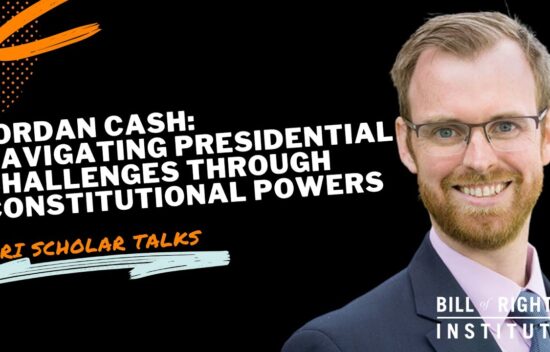
Navigating Presidential Challenges Through Constitutional Powers with Jordan Cash | BRI Scholar Talks
Watch
Founding Principles
About this video
How can presidents, who face significant challenges exercise their constitutional powers vigorously? In this episode of Scholar Talks, Jordan Cash, Professor of Political Theory and Constitutional Democracy at Michigan State University, joins BRI Senior Fellow Tony Williams to discuss the concept of the "isolated presidency" as detailed in Cash’s book, The Isolated Presidency.
This episode examines how presidents such as John Tyler, Andrew Johnson, and Gerald Ford used constitutional authority to navigate significant obstacles like divided government, a lack of party support, and questions of legitimacy. Cash explores the unique ways these presidents upheld their executive powers, setting historical precedents in both domestic and foreign policy, and sheds light on what these cases can teach us about the presidency's role in modern American politics and governance.
0:05 For this episode of Scholar Talks, the guiding question is , how can presidents who face significant challenges exercise their constitutional powers vigorously? Jordan Cash, our guest, is a professor of political theory and constitutional democracy at Michigan State University and the author of several books, including The Isolated Presidency, which we will discuss today,
0:30 and Adding The Lonestar, John Tyler, Sam Houston, and the Annexation of Texas in the excellent new University Press of Kansas Landmark Presidential Decisions series. I am Tony Williams, senior fellow at the Bill of Rights Institute, and I want to welcome you to another episode of Scholar Talks
0:50 in the topics in American Government and Civics series. Jordan, I want to thank you very much for joining us. Thank you for having me. Great. .Sure. You know, I love your book. Just such an important topic. Isolated presidency. I know some some recent events which we may get into, sort of seemed just
1:10 just remarkably relevant to, a president that faces some challenges in office, even from his own party and so forth. But it really struck me because I was like, you know, usually you get Lincoln and Washington, Reagan, Roosevelt as sort of some of the big presidents to study in a lot of these presidential books. But you are going to tackle John Tyler,
1:34 Andrew Johnson, and Gerald Ford. Right. So we’re eager to hear about those, those interesting presidents and what they can teach us. So my first question is going to be, what are isolated presidents, as you call them? And how can the constitutional logic of presidential powers help them overcome obstacles
1:57 to a successful presidency? Yeah. So the I studied presidents, the way I define it anyway, are presidents who are unelected, face divided government, and were opposed by major factions of their own political party. And I look at these cases and of course, the cases, as you said, John Tyler, Andrew Johnson and Gerald Ford, these are the guys who hit all three of these criteria, more than any other president.
2:20 And I look at these guys because I do think they give us the clearest view of the underlying, the underlying constitutional authority of the presidency. Really? What’s the baseline that every president is able to have and utilize? So you mentioned earlier, usually we talk about Washington, Lincoln, Jefferson, FDR, Theodore Roosevelt, all worthy of study.
2:41 Of course, they tell us a lot about the presidency. But when we look at their success, you know, and often sometimes we’ll look at them and say, oh, look at how they use their constitutional powers. That must be a demonstration of the Constitution presidency. Well, maybe, but they’re also generally fairly popular. Or they have party control. They’re all elected. Right. Or,
3:02 they certainly have unified control of Congress in many cases. So when we look at their success, it obstructs our view of what is actually driving their success. Is it their popularity is that legislative support is a part of support? So my idea was let’s strip away all of that, those things that political scientists usually look for to argue makes a president successful.
3:26 Strip it all away. Look at guys who are unpopular, who have no legislative support, have no party support. What they left with, just their constitutional authority. Okay, so this is why I say they give us the clearest view, not just of constitutional powers, but I would say that the constitutional logic of the presidency. And when I say constitutional logic, what I mean specific is that the structure,
3:48 duties and powers of the office as created by the Constitution orient the people in the office or in the presidents themselves, to act in certain ways to utilize their powers in certain ways. So just to break it down briefly, we have a single president that’s going to encourage them to be more energetic, more decisive,
4:10 but also be more responsible. He’s elected with a nationwide election that we’re going to have here very soon, but that orients candidates first to have a nationwide perspective. They need to build a national coalition in order to win. And so then once they get into office, they’re going to keep that national perspective, hopefully, and then having a longer four year term, having the possibility of reelection,
4:32 these things also encourage the president to have a longer temporal horizon to think over the long term, not just 1 or 2 years, four years, eight years or so thinking about their legacy. Even beyond that, as well as have a certain amount of stability in the office. So all these institutional attributes then are utilized by presidents. Orient them towards certain modes of behavior,
4:56 and then the powers fit in with that. Right. So having for example, a nationwide perspective. Oh, we also want that nationwide perspective and legislation. So we require the president to give state of the Union. And then we require him to either sign or veto any bill that Congress passes. So he can bring that perspective, bring that longer temporal horizon
5:16 to the legislative process. So again, just how the structure, duties and powers all fit together to create an effective executive to facilitate an effective and efficient national government. So that’s the constitutional logic that I think is at the heart really the baseline that all presidents have. The question is, well, how can we see it?
5:37 Where do we see it in operation? And that’s where the isolated presidents come in. When we strip away all other institutional supports, they have nothing else to rely on. We can most clearly see that constitutional logic at play, how it both orients and empowers presidents to be successful. Right. Yeah. Very interesting. So let’s jump in to those isolated presidents. So John Tyler faced a lot of obstacles when he succeeds.
6:02 President William Henry Harrison. And, Tyler is actually thrown out of his own party. The Whig party faces a hostile Congress. People are not even sure if he’s a legitimate successor. They call him an accidental presidency. How does he then succeed as president? Yeah. So, Tyler, the first isolated president. You’re right. He succeeds William Henry Harrison after Harrison dies in 30 days.
6:26 That’s what Harrison is probably most famous for. And you’re right. There’s this legitimacy question that Tyler faces right up front. Is he the acting president? Is he the president? He’s called His Accidentcy And then six months later, he uses presidential power. He uses his veto to block the Whig economic program. That because Tyler actually was opposed to a national bank, the Whigs won
6:49 a national bank that I guess didn’t vet him quite properly as VP and they throw him out of the party. So not only is he the first accidental president, he’s a president without a party. He’s this unique figure in American history. So you would think if we’re just going to say, oh, well, presidential power is based on popularity, legislative support, party support,
7:09 Tyler was out of luck, and he can’t do anything. That’s not what we see. We see that Tyler is able to utilize his constitutional powers extremely effectively. So with vetoes, yeah, he blocks National Bank. He blocks the entire Whig economic program. So it’s a negative domestic policy. But if you’re Tyler and the main thing you want to do is prevent what you see is bad policy.
7:31 That’s very successful. Just blocking. He doesn’t get what he wants. He doesn’t have a positive legislative program. So there are limitations here. But he can stop what he doesn’t want, which is very significant. And then through the administration. So Harrison has a lot of Harrison appointees, Whig lower level bureaucrats and the Whigs kind of do Tyler a favor because
7:53 when they kick him out of the party, most of Harrison’s cabinet resigns. So Tyler doesn’t have to remove them. He avoids that. But then he gets to bring in all of his own people. He’s able to reorient the administration in a way that suits him and is in alignment with his constitutional, political, and policy vision. So when he gives an order, it’s not going to be obstructed by the bureaucracy.
8:14 And that’s again, the constitutional control of the executive branch of the administration. I think where we see Tyler being most successful and again, it’s grounded in constitutional powers. And I think we see this with the other accidental presidents, too, is in foreign policy. Tyler is able to expand the Monroe Doctrine out into the Pacific. He extends a protectorate over Hawaii, which at the time is an independent
8:36 kingdom. He opens up diplomatic relations in Asia, specifically with China. The first bilateral Chinese American treaty signed by President John Tyler, and most significantly, he annexes Texas. Of course, brings the Republic of Texas into the Union, which faces enormous opposition from both parties initially,
9:00 where he even submits a treaty to the Senate, and the Senate rejects it. They reject it by two thirds vote. You need two thirds vote to ratify. It’s rejected by a two thirds vote. So it’s completely opposite. But Tyler, because as president, his position to really set the agenda, he’s able to continue pushing for Texas makes it an issue in the 1844 presidential campaign,
9:22 a campaign, actually, that he’s not even a candidate. And because he’s so unpopular, he can’t even run for reelection. He tries nobody’s interested. But he sets the agenda. So when a pro Texas candidate is elected in James K Polk, Tyler can say, see, I told you was popular. We need to do this. And he’s able to push annexation through Congress in his last day in office.
9:45 There’s even a slight issue where some members of Congress say, well, he’s going to wait for Polk to do this. And Tyler said, no, no, no, I’m still the president. I initiate. So he’s the one that sends a messenger to Texas to annex it and pushes it through all the way through, just pure presidential prerogative and constitutional authority.
10:07 Right? So through a resolution rather than the original treaty he got. Yeah. Which is a very interesting thing. So, Tyler, in a way, reinterprets the, admissions clause of the Constitution to say, no, we don’t need a treaty and we can’t annex an entire nation. Right? It’s not just some territory, but an actual nation.
10:28 And we’re going to we can bring it in as a state under congressional resolution. So just means a majority of both houses of Congress. So yeah. So that’s an innovation that then later presidents draw upon. Most notably, I mentioned Hawaii earlier, William McKinley. That’s pretty much the exact same thing. He follows Tyler’s playbook to a tee in annexing Hawaii. Very interesting.
10:48 So now, Andrew Johnson is a very interesting case study, because you argue that he defended the constitutional prerogatives of the presidency, even if he did so at the expense of moral principle. How did he use his constitutional authority to defend the presidency, to fight what you call
11:10 a brawl with Congress during reconstruction? Yeah, I think Andrew Johnson is probably up there as a president with maybe the most difficult institutional situation. So not only is he thrust into the presidency after Abraham Lincoln is assassinated, but he’s put in the presidency at the end of the Civil War, where now he has to do with reconstruction, right?
11:32 These monumental constitutional crises to bring the country back together. And what doesn’t help in a war between the North and the South is that he’s a Southern Democrat with a cabinet in Congress dominated by northern Republicans. So he’s so many disadvantages that Johnson is facing, but he’s able to
11:53 uphold the president’s constitutional authority, because we have to remember to Congress at this point, since Lincoln had really aggressively used executive authority for the war effort, Congress now with the war over, wants to kind of put that back in the box. They want to establish themselves as the dominant branch in government. And Johnson doesn’t think that’s a good idea.
12:14 So he’s going to defend the prerogatives of the president and defend it from encroachment. And so he’s able to do this first through vetoes. But then it turns out Congress is united enough. They can override his veto. So really, Congress nullifies Johnson’s veto power fairly early, I think 71% of Johnson’s veto, regular vetoes are overridden, which is still the record.
12:36 You can imagine. But again, we can see how Johnson’s able to do this through administration. So in particular, Johnson takes advantage of the structural elements of the presidency, that the executive is a continuously operating branch. So Congress and the courts, they can take time off. They can go into session, go out of session. You don’t need somebody.
12:56 Always make the laws. You don’t need to always have court cases. But you do need somebody always executing the laws. So when Congress goes out of session, Johnson, utilizing his office’s structural energy control over the administration, is able to remove those figures in the South that he doesn’t like administratively put in those who agree with his vision of reconstruction.
13:18 And so he really forms his own reconstruction before Congress can do anything. So by the time Congress comes back into session, they’re reactive. The playing field has been completely changed by Johnson, and they just can really nibble at the edges of what Johnson has done. And even when they try to impeach him, it doesn’t quite go through.
13:38 He’s acquitted by a single vote, and Johnson’s able to keep doing what he wants to do. And I should add too as part of that, Johnson uses his power of pardons that he pardons all these former Confederates in line with his lenient policy of reconstruction and Congress and the courts can’t do anything. The pardon power.
13:59 There’s no override clause to override a presidential pardon. So when Johnson does that unilaterally, that goes a long way to getting what he wants out of reconstruction, even though Congress doesn’t like it. Right. And as you say, sort of lacking moral principle, a lot of it sort of, is defending the office, but sort of at the service
14:20 of unfortunately, tragically, sort of white supremacy. Yeah. And that’s something I think we need to remember here is when we look at these presidents, there’s a constitutional logic, as I say, but there are certain ambiguities that have to be resolved by political actors. And so in this case, the main ambiguity that Johnson is faced with is, okay,
14:41 at the end of the Civil War, we have all these free African Americans. or now free African-Americans, formerly enslaved, but now free. How do we protect their rights? But on the other hand, the kind of older tradition of federalism, of states rights, Johnson being kind of a traditional Jacksonian Democrat, chooses to prioritize federalism at the expense of individual rights.
15:04 So it’s a conflict between two legitimate constitutional values. And Johnson as president, is positioned to help resolve that conflict. But he resolves it, like I said, in favor of federalism as opposed to individual rights and partially on the basis of his own racism and in doing so, his reconstruction entrenches
15:26 some of the white supremacist structures that then contribute to Jim Crow later on. So, again, thinking over the long term, he has a longer term temporal horizon. It’s Johnson’s reconstruction that really lasts and shapes the South for the next 100 years. So it’s it’s an example of the constitutional presidency at work.
15:49 But and this is something we have to remember too the Constitution, presidency or the Constitutioal logici, isn’t prescriptive, right. It’s rather a method. It’s a way presidents can act and behave. But it’s not policy prescriptive or even policy dependent. So Johnson can use that authority for policies that we would rightly today
16:10 find immoral and repugnant and see the terrible consequences of. But that’s really what it gets down to the person as we go into election. Who the president is matters a lot because it can use that authority. And the way they resolve these ambiguities, the way they resolve these questions, is it going to have a large
16:31 downstream impact on our politics and just on the United States in general? Right, right. So, Johnson faced some terrific challenges, but I would, you know, I think you point out, you know, Gerald Ford faced some really big challenges himself. I mean, he comes to the president, he’s after the scandal of Watergate.
16:54 Nixon resigns. You know, he’s coming from Congress. And there’s there’s a resurgent Congress after this sort of imperial presidency of Watergate, and, and there’s the end of the Vietnam War. You know, he faces, a hostile, sort of resurgent Democratic Party, and even a resurgent conservative movement under Reagan.
17:18 So he’s facing a lot of obstacles. And so how does he preserve the presidency during these, against these challenges? And again, in a very sort of difficult moment, dark moment for the presidency? Yeah. And the one thing I would add for Ford and you kind of alluded to this, and he came from Congress, is we have to remember, too, Ford wasn’t even elected vice president.
17:40 Right. So Nixon’s first vice president, Spiro Agnew, had resigned due to corruption charges. Ford is appointed to the vice presidency under the 25th amendment. Then less than a year later, he’s president. So he became president without ever facing a national electorate. And I think that this gives at least some members of Congress the idea that they basically that Congress had selected the president. So House Speaker Carl Albert has a line where he says,
18:04 we that is, Congress made Gerry Ford, president. So he’s got that perhaps even a a different institutional wrinkle to his isolation. He’s even more unelected, we could say, than the other two. But yeah. So he’s was a very a lot of the similar problems, a Congress that once,
18:24 really put the president back in a box, restrain its authority. Like you said, he’s got primary challenges from Ronald Reagan. Conservative Republicans are, very upset with Ford. So Ford but like with the other presidents, we see Ford acting using his constitutional powers in similar ways but for different policies. Right. Again, seeing how the Constitution logic operates, and it’s kind of neutral
18:48 to which policies it’s used for, Ford is able to use his vetoes to first defend the presidency, right to veto legislation that Congress is trying to encroach on the office, which then the veto that’s its primary role to protect the presidency and allow the president to defend the constitutional system generally from congressional encroachment. Ford does that. Absolutely.
19:10 But nothing Ford does that really we don’t see with Tyler Johnson is the way he uses the veto strategically and with a visionary capacity. Right. So when Ford vetoes legislation, he’ll send his veto messages back and tell Congress where they where they could improve the legislation. So he opens a dialog with it’s not just a simple blocking mechanism,
19:34 but Ford uses it in a more positive way to come to some compromises with Congress. Nobody’s happy about it. There’s no landmark legislation, but there’s incremental compromise. And Ford and this perhaps reflects his long time in Congress since he wanted to be speaker of the House rather than president. That was his lifelong ambition.
19:55 I guess president’s consolation prize. But he’s able to use the veto to make a positive impact on legislation in addition to using it to protect the presidency. Another thing, again, like we saw with Tyler, like we kind of saw with Johnson using the appointment power to control his administration, Ford in particular,
20:17 or fairly early in his presidency, he had what was called the Saturday Morning massacre, where he removes all these Nixon appointees in his cabinet. He restructures it, gets his own guys in there. And that’s suggestive of another constitution security I talked about in the book between political responsibility and administrative stability. All three of these guys, if they wanted administrative stability
20:38 as the highest value, would have just kept their predecessors appointees. None of them do. They all try to get their own guys because they want the executive branch to be responsible to them. And that’s what we see with Ford, and that enables him to pursue his policies more aggressively. Than he would have when he had some Nixon appointees who really, really doubted
20:59 his capabilities and who were just opposed to some of his initiatives. So Ford gets his own guys in there. Combine that with his vetoes, and he’s able to, at the very least, protect and preserve the constitutional presidency from congressional encroachment and still find some success in policy. Right. And very I don’t think we can, not talk about the.
21:21 Pardon. Right. Of Nixon then that’s sort of how controversial that is, how he does it sort of very courageously and sort of secretly, as you say, but takes a real hit, in his popularity. Yeah. Massive hit. And this is something we see with all three, but it’s mostly with Ford. None of them come in isolated, right? They all come in
21:42 and there’s some hope, like, okay, maybe Congress can work with them. This is what Ford says to Congress. I want a good I don’t want a relationship. I want a good marriage. Good Midwestern man seeking to have a good relationship with Congress. But then at a certain point, they all do something that isolates them further. Tyler vetoes a national bank, so he gets kicked out of the party.
22:04 Johnson vetoes the Civil Rights Act. And so the Republicans in Congress unify against him with Ford. It’s the partner Nixon. But here again, the constitutional issues, because on the one hand, yes, it’s Ford seeking to move the nation past Watergate. And that’s the primary thing. And the fact that Congress and the courts can’t really do anything about it.
22:24 There is an amendment proposed in Congress that would allow that would have allowed Congress to override pardons like the override vetoes. That doesn’t go anywhere. So this is getting unilateral authority in pardoning Nixon. But one of the things that Ford says, and it shows the president’s orientation to consider constitutional questions,
22:44 is that Ford makes the case that Nixon’s constitutional rights, his individual rights, might be jeopardized if he went to a criminal trial, that he doesn’t think that Nixon would be able to get a fair trial in the United States in 1974, that politics had inflamed things too much.
23:04 So he’s worried about the individual constitutional rights of Richard Nixon. And that’s another reason for invoking the pardon. So it’s an interesting way that the president is oriented to have these larger constitutional questions in hand, but that includes a defense of individual rights, in this case from the judiciary, which might not be able to uphold proper judicial process.
23:29 Right. So we’ve looked at a few historical examples. Very interesting, very important. And so how can you know. But but your topic, you know, your take on these isolated presidents certainly has a lot of relevancy, to, to today and going forward. So, so how can presidents who generally face these kinds of significant challenges
23:49 exercise their constitutional powers vigorously, and especially since, you know, even the recent elections in the 2024 election have shown, that these are still very relevant. Yeah absolutely. I think in some ways, the contemporary presidents Trump and Biden in particular, they look more like isolated presidents than they do like
24:11 FDR or Reagan or somebody like that. You know, sometimes when people ask you about this and they say, well, what would you say if you were advising Joe Biden right now? I would say, well, Mr. President, with all due respect, stop trying to be FDR. Stop trying to be Lyndon Johnson, because your political circumstances are completely different.
24:31 Instead, take your model as Gerald Ford, look at John Tyler, look at these presidents who are facing isolating conditions because both Biden and Trump, you know, they’ve had their electoral legitimacy questioned. Trump went into the Electoral College that causes legitimacy questions. Their parties have been fractured with major factions opposing them.
24:51 They both have divided government, with divided government. Every president since 1969, except for Jimmy Carter, had divided government at one point or another. So I think the idea of presidents is so important because they give us these examples of what presidents can do when they are facing these constraining institutional circumstances, which is the norm.
25:12 Now, you know, unless there’s a major breakthrough in this election, which I don’t see happening or an election coming up, I also don’t see that happening. But unless it’s a major breakthrough, we’re going to be in this down system of gridlock. And so presidents are going to need to fall back on their constitutional authority based on constitutional authority, which primarily, as we’ve talked about, at least in legislating the veto,
25:36 is a very powerful power if Congress isn’t giving them what they want. I think you’re going to see more administrative actions. And in some way, you see presidents doing this already when they act through the administration, when they act more in foreign policy, you might say, well, why are they doing that? I would say it’s a constitutional logic because the tools in their toolbox allow them to do more in those areas than in others.
25:58 So that’s that natural orientation, the natural way that they’re oriented and incentivized by the constitutional logic to pursue policies in those areas, because that’s where they have control, that’s where they have power. When they interact with Congress, it’s going to be more conflict, gridlock, negative domestic policy.
26:20 So looking at Tyler Johnson and Ford, where are they successful in administration, especially in foreign policy. And that’s grounded in the Constitution. That’s what we should expect. And so when we see contemporary presidents doing that in systems of divided government, we shouldn’t be surprised. We should say it. Well, it’s almost to be expected due to the constitutional logic.
26:43 But once we understand that, we can understand why presidents behave the way they do, especially in contemporary circumstances. And I would just add, if there is concern about, oh, well, the presidents are too powerful in these areas and that, you know, maybe we need to fall back. They’re doing too much. Then I would say, well, then we need to look at the constitutional logics of Congress and the courts and even say the states.
27:07 How are they pushing back? Which is my next project, to see how these things intersect, how, but we shouldn’t expect the president to pull back himself. He’s not incentivized to do that. That’s not how the office is structured, but rather trust the system, separation of powers to keep things under control. So again, there’s a minimum baseline of power that presidents have.
27:29 We need to understand where it is if we’re gonna understand how presidents actually behave and operate effectively. Right. Well, your brilliant book, The Isolated Presidency, is going to be a great guide, for us, to think about these things going forward. So, Jordan, I want to thank you very much for joining us to discuss this very important topic. Thank you so much for having me.
27:50 It’s been a pleasure. Great. And thank you all for, joining us on this episode of Scholar Talks. Please check out the other videos in our topics in American Government and Civics series. Thanks.