Video
National Civics Teacher of the Year | Veronica Pitts
Watch
Founding Principles
Equality, Natural/Inalienable Rights, Justice, Consent of the Governed
Virtues
About this video
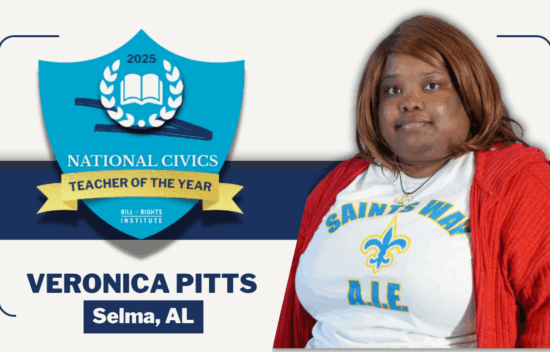
The Bill of Rights Institute is proud to present Veronica Pitts, a Selma High School teacher and winner of the National Civics Teacher of the Year Award.
Veronica shares her journey growing up in a military family, her experiences teaching in Selma and her mission to empower students through civic education. From guiding tough conversations to showing students how history connects to their lives today, Veronica’s dedication to her students and community shines through. Her recognition as National Civics Teacher of the Year not only honors her commitment to teaching but also highlights the importance of civic education in shaping future leaders.
0:06 My name is Veronica Pitts. I am a proud military brat and I grew up in a military family, and both of my parents were the military. I am a proud graduate of Selma High School. That is where I currently teach. I moved to Selma in middle school and I’ll be honest, it was very much a culture shock.
0:28 I was born in Germany, we say some time in Colorado. So to go from Germany, Colorado to Alabama was definitely a culture shock. It was also a personal shock because I went from being one of the only African-American students to being a predominantly African-American community. So there was definitely some,
0:49 you know, self awareness and stuff that I developed along that time. I went to the prestigious Tuskegee University and received my Bachelor of Arts and History. I have the honor of working on Selma to Montgomery National Histoic Trail. Primarily housed at the Selma Interpretive Center. And I was responsible for telling the Selma
1:09 voting Rights Movement and its impact on American history and its impact again on the legendary Voting Rights Act of 1965. After graduation, I accepted a job at Selma High School, and I have been there ever since, completely immersed in the school culture and climate.
1:29 These children are on some of the most important grounds in American history. Not only are we history makers and the civil rights movement, but also the Civil War as well. And so I feel unfortunately, because of trauma maybe some other things that are going on in the community
1:50 that have things that children in marginalized communities deal with, they really don’t understand their power. And I really don’t understand their voice. And as teenagers, I think sometimes you’re kind of stuck and like what’s in front of them. And they don’t realize that the world is so much more than just black and white. I’m not saying color white, I’m just saying it’s more of a black and white.
2:11 It’s red, yellow, blue, green in that reverse world. But I have to make the room comfortable. So we can have those tough conversations. And then I have to use tools to guide certain conversations, especially now, because I’m just really big on not wanting them to feel a way
2:32 because they were told to feel that way, or they saw something and that’s how they felt, or we got to be able to talk through that. So sometimes there’s conversations that I myself maybe a little bit uncomfortable having, but I’m I still often have those conversations. We have them, but I have to reach out to credible organizations that have the resources to help me facilitate those type of conversations and that type of content.
2:54 And I just want to make sure that they have the tool that I need to have to be world changers. And I think civic engagement is the way to get there. I have to bring the content to them. I got to bring the world to them. So when I’m talking about whether it’s the Eighth Amendment, the Fifth Amendment,
3:15 what I’m talking about, other things that are well attached to them so that they can see, like, okay, I see how this applies to what I’m currently going on going on in my current community. I tell my students that, and I want my students to arrive at their own response to all men are created equal.
3:36 I don’t want to put anything on my students. And so when my students then begin to say, well, they say that, but then my people are still enslaved. So how am I still supposed to take this particular document and feel like it was made for me?
3:59 In 2025, it was made for me. And how am I still supposed to feel like? I should proud to be American. And so that is one of the first tough conversations that I do have with my students. However, I also teach my students that.
4:26 When you have those type of feelings. That you still have to go about a productive way to come up with the solution that you may have been able to see the world have been grateful enough to see the world. And so my students will never be able to, but I feel like it is my tool to show them the world
4:48 and also make them be proud of the community that they’re in. And then, so I feel like I wear a heavy crown. And also of these times, sometimes it’s challenging on how and what I teach, but it is still my responsibility to help these students be productive global citizens.
5:11 And for them to learn about the history that is in their backyard. I hope my students will be adults that advocate for themselves and their community. I hope that my students learn to question
5:33 and not just take things at face value. I hope my students don’t leave Selma, or if they do leave Selma, that they come back and make it even better. I’m here with the Bill of rights Institute. We work with tens of thousands of teachers and millions of students all across the country. And each year we seek nominations
5:55 for the National Civics Teacher of the year. We get hundreds of nominations every year. And this year, one of the ten finalists was from right here at your school. This year’s winner, this year’s recipient of a $5,000 prize and a travel scholarship to the National Council of Social Studies, is your miss Veronica Pitts.
6:19 I think the most remarkable thing about recipients is her commitment. Dedication to her craft. She’s very much all in to education, and then sharing what she knows with our students. And so this is just a way that she can get recognized for the hard work and dedication that she does. But she is definitely all about Selma High School and Selma, Alabama.
6:42 I’m just completely grateful and thankful, for this opportunity to, in the words of the kids, to put my city on a map again. There is some great things in Selma, and Selma is greatness that not stop in 1965.
7:03 All over the place emotionally and verbally. Because I know that this is a big deal and I don’t feel worthy of this beautiful honor, but I’m just so grateful that not only am I acknowledged, but my content is acknowledged because I don’t care what nobody says.
7:23 Civic and civic education is the most important thing that these students will learn. And I’m so happy that Alabama requires us to teach government in the 12th grade, because it is my last chance to get them to understand. That even though.
7:44 All men we’re not created equal. I want you to fight for that equality.
Standards
Related Resources
Honoring the vital role civics teachers play in educating our students and future generations of American leaders, The Bill of Rights Institute’s National Civics Teacher of the Year Award recognizes teachers who are inspiring and serving their students in outstanding ways.

