Video
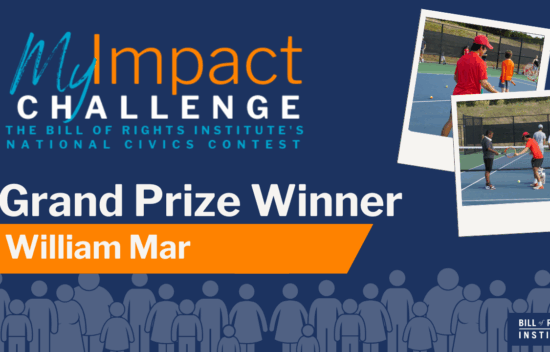
MyImpact Challenge Grand Prize Winner Willam Mar | MyImpact Challenge 2025
Watch
Founding Principles
Virtues
About this video
Meet William Mar, the 2025 MyImpact Challenge Grand Prize Winner. In this interview with the Bill of Rights Institute, William shares how his project Reach Through Rackets uses tennis to create free clinics for children with disabilities.
0:00 I’m Emma Grahn, senior project lead at the Bill of Rights Institute, and I’m thrilled to be joined by William Mar, the 2025 My Impact Challenge Grand Prize winner. My Impact Challenge is our national civic engagement contest that highlights students taking real, tangible action in their communities through service, entrepreneurship, advocacy and more,
0:21 all while connecting their work to the foundational civic virtues and principles. This isn’t just about ideas, it’s about action. And William’s project, Reach Through Rackets is an inspiring example of how young people are stepping up to lead with purpose. William, congratulations and welcome. Thank you, miss Grant, I appreciate it.
0:41 First off, tell us a little bit about yourself. I just graduated from Lake Travis High School and I am currently going to go into UT Austin for Electrical and computer engineering. I’m very, very excited. Going into the next chapter of my life. But obviously I am I am sad to say goodbye to the school.
1:04 I had so many memories in. And tell us a little bit about your project reach Through Rackets. What was your goal and what inspired you to take it on? My goal through for Reach Through Rackets was basically to share my love of tennis to as many people as possible.
1:26 And the reason that I was so inspired or in the first place to do the club, was I attended a summer camp that was meant to give equal opportunity for kids with disabilities. And my camper, his name was Ricky. Seeing how much he thrived in such a welcoming environment and how much
1:48 little actions actually made an impact on him, really pushed me to try and create that sort of environment in my community. Can you tell us a little bit about Reach Through Rackets? What is your project and what does it do in your community? Yeah so Reach the Rackets is a tennis community
2:08 and club where we host bi monthly tennis sessions that provide free times clinics to children with disabilities. And the goal of this is to obviously, improve their athletic ability. But with that, foster a sense of self-confidence and allow them to socialize with peers.
2:29 And also the volunteers in our group. So how did you bring your idea to life? How did you move, towards something that could really make a difference for kids? Yeah, well, a lot of that was I was just so lucky to meet people, like many people who wanted to make an impact and their community.
2:49 And one of the big inspirations for that was my tennis coach. She was very, welcoming of the idea and really wanted me to to get this off the ground. So she helped with, all of the supplies and, and teaching me how to, how to. Best effectively communicate with these kids.
3:11 And also, I was lucky enough to be in such a great tennis team where so many of the kids were willing to volunteer and and willing to make an impact in their community. Were there any unexpected challenges you faced as you started to get this project off the ground, and how did you overcome them?
3:34 That’s a that’s a great question. I would say that one of the unexpected challenges was definitely finding a way to effectively communicate goodwill. Because in many situations, some things that we do might come across
3:55 a little differently for, for everyone. And in that we always have to find a way to be constantly positive, constantly pushing these kids in a positive way. And in doing so, they reciprocate. And it really shows through their smiles.
4:15 The My Impact Challenge competition asked students to embody the founding principles and civic virtues. Which of those principles are virtues most influenced your project and how did you apply them in real life? I think one of the biggest ones was definitely responsibility. Responsibility as a leader, not only to make sure the sessions
4:38 were as productive and fun for the students, but also to make sure that every volunteer in our group was accounted for and every of them was was willing to show up every day with a positive attitude. Which ties into that is compassion. Obviously, this is a very
4:59 emotional, emotionally charged project for me. I have a lot of ties, and I really felt motivated, every day. And with that, you have to understand that every action, everything that you do directly impacts different members of the community. And it has ripples, it can impact not only the the students that you help, but also the families.
5:23 Now, let’s talk about your project’s impact and the ripple effects that it had. How has reached through rackets grown since its founding? Well, we started initially with, you know, all my close friends. It was around five kids and I remember our first meeting, we sent fliers out to all the communities, reached out
5:44 to a bunch of teachers, and three people showed up. And even though it was three people, I still had the same passion and drive, to make sure every, kid’s needs were met and they were having a great time. And as word of mouth spread, as parents talked to others and and really
6:08 put in a good word, in the community. Not only did the members in the amount of students grow, but also the the volunteers were more motivated. And more people joined as they realized how much their actions can make an impact on others. How did people in your community respond to your work?
6:29 Was there a moment that made you feel especially proud? Yes. I think one moment that that really sticks with me was, the end of year meeting, and one of the parents came up to me and said, how much of an impact they’ve made, like our clinic has made, on their child over the year, and they would constantly
6:55 talk about how much they are looking forward to the next session. And they also detailed how they could see throughout the year their the level of self-confidence grew and that that really made a a big impression on me. I’m very glad to to have been able to be a part of of these kids lives.
7:18 Have there been any lasting effects from your project, either for your community or for you personally? Yes, I think certainly for for my community. These.
7:38 They’re just really grateful. And I feel like not only do the children grow from this, the family also gets a sense of knowing that there’s always space for their children. And, before this club, there wasn’t really opportunity for these kids to play a lot of sports.
8:01 And now, even especially that I graduated, it’s going to get passed on. And these kids will know that they always have a place, always have a place for sports or friendship. And long. Thank you. William.
8:22 It sounds like this is a really impactful experience, both for the student participants and for the facilitators. Okay, now let’s zoom out and reflect a little bit on your experience with the competition. What drew you to enter the nine Pack challenge? But what drew me initially to the Mind Pack Challenge
8:43 is how much I really align with the the program and I really felt that I love to share and spread my project with others. And also in that sharing my story, I hope to inspire others to know that these small actions, what
9:03 what you don’t think will affect people, can really make a lasting difference in the lives of others. I was participating in my impact challenge. Shape the way you see your role as a citizen or a change maker. What have you learned as you’ve reflected on the civic virtues and founding principles?
9:24 I think. Especially being the grand prize winner for this scholarship, it it really makes me feel seen. And I’m and I’m really lucky and grateful that I was recognized and, and have a team behind me
9:46 that supports my college career and also recognizes, the beauty of the club that I hold so dearly. And I think really having time to write through these essays, writing these project reports,
10:06 I had. I realized that these virtues when you when you go like throughout the process of making a club, these virtues are just, integral part of, of doing so. And I really allow me to, to put into words,
10:30 the aspects of the club that align with my impact. Was there a moment during the application process, perhaps when you were writing your reflection or selecting your examples of virtues and action, when you saw your work through a new civic lens? Yes. As previously said, I felt like.
10:53 By by writing my project report, by writing my essays, I, I really found a way to verbalize the way I felt, because there’s a lot of instances where you you have the feeling and you can’t really word it. And then by, by taking your time and, and doing your research and writing things out,
11:16 it really. It really like. In a way, maybe you have greater appreciation for, for not only the people that helped me for this journey, but also how much the virtues stated in my impact are a part of my life.
11:39 What advice would you give to next year applicants as they’re grappling with those questions? I would say really take the time to reflect on your your answers. And also with that, just apply. I mean, I, I remember I was watching the YouTube video
12:00 and I saw all of these amazing projects and I was like, wow, that I mean, compared to them, I don’t even know if I’m even going to get mentioned or anything like that. And I watched like the last like, oh, like, so the final person and it was like it was me. And I was like, what the heck? I mean, these, these people, they were
12:22 they’re also passionate, with what they’re doing. And I felt like they made such a big impact. And to, to see myself, in the position where I was being recognized as, like, the best person, I felt like at the end of the everyone deserved it just as much as me.
12:43 So even if you think that your project may may not be the most impactful or in the scholarship, eyes may not be the most important. Just apply regardless, because there’s always people who see the beauty in what you’re doing. Before we wrap up, I’d like to hear what’s on the horizon.
13:03 What’s next for you? And reach through rockets. Yeah, the next thing for me is obviously passing down the reins as it is, to the to the next generation, the next class of seniors. And with that, I, I know we’re, our club as a whole or in good hands
13:25 because the people that are willing to volunteer, willing to put the time in. They really show their passion. And it’s evident in the way they carry themselves and the way they show up to meetings every day with constant positivity and energy to, to make an impact on these students lives going forward.
13:46 How all the principles and virtues you explored through this contest continue to influence the way you engage with your community, or even your career path? I believe, especially as I head towards, a computer engineering, software engineering field all of these virtues, such as civic
14:06 responsibility and sacrifice, will not only push me to create products in mind with the greater good of everyone. It will also motivate me to to work even harder knowing that the solutions that create and the problems that I tackle
14:29 will directly impact people a lot more than than I or anyone else realizes. William, thank you so much for sharing your story, your insights, and your impact. You’re showing exactly how young leaders can bridge civic ideals with real world actions. And that’s exactly what my impact challenge is all about.
14:49 We can’t wait to see what you do next. Thank you so much. This opportunity. I can’t wait you.
Standards
Related Resources
$50,000 in total prizes for students and their teachers for Civic Engagement projects. Open to 13-19 year olds.