Video
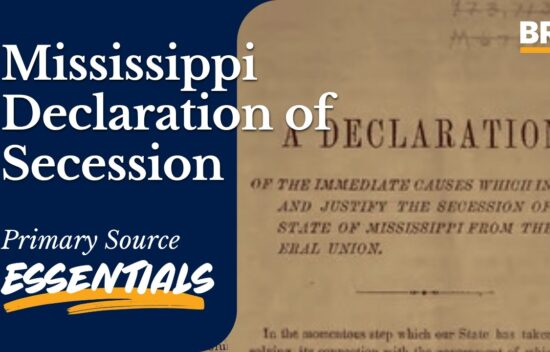
Mississippi Declaration of Secession | Primary Source Essentials
Watch
Founding Principles
Virtues
About this video
In this episode of Primary Source Essentials, explore Mississippi’s 1861 Declaration of Secession, a primary source that openly identifies slavery as the central reason for the state’s break from the Union. Mississippi argued that its “position is thoroughly identified with the institution of slavery” and claimed that Northern efforts to halt slavery’s expansion, resist the Fugitive Slave Act, and support abolitionist movements left the state with a choice between “submission to abolition and ruin” or secession.
The declaration insisted that the Union was a compact among states that Mississippi could dissolve, a view strongly opposed by Abraham Lincoln and many in the North, who maintained that the Union was perpetual and rooted in the sovereignty of the people. As Mississippi and other Southern states withdrew to “secure slavery and maintain our rights,” the nation moved toward a civil war fought to preserve slavery, yet one that ultimately destroyed the institution through the Emancipation Proclamation and the Thirteenth Amendment.
0:00 Welcome to Primary Source Essentials.
0:02 In this episode, we are going to briefly
0:04 examine the cause of secession leading to the Civil War.
0:08 The United States had experienced sectional divisions
0:10 over slavery from the time of the founding.
0:13 The debates were especially fierce over the expansion of slavery to the West.
0:18 As the country expanded and added new territories,
0:22 the debates from the Missouri Compromise through the compromise of 1850
0:27 and after demonstrated how divided Americans were over the question.
0:33 Abraham Lincoln’s election as President in November of 1860
0:38 convinced the South that the institution of slavery
0:41 and their way of life was hopelessly threatened.
0:45 The southern states believed that they had a right to secede
0:48 from the National Union, because they thought it was a compact
0:52 of states, rather than a constitutional union of we the people.
0:57 This was strongly opposed by northerners, including president elect Lincoln,
1:03 who asserted that there was no constitutional right
1:06 to secession because of its ratification by the people, not the states.
1:11 But this debate over the legality of secession was secondary
1:15 to its purpose, which was the perpetuation of the institution of slavery.
1:21 South Carolina held a convention and declared its secession
1:25 in late December 1860.
1:27 Along with other states of the Deep South, Mississippi quickly
1:31 followed in early January and was forthright
1:34 that it was defending slavery as a cause for secession.
1:38 The Mississippi Declaration makes clear its purpose for attempting to secede.
1:44 It stated that it was, quote, dissolving its connection
1:47 with the government of which we so long formed a part.
1:52 It claimed the North had long aim to blow it.
1:55 Slavery.
1:56 The state could either submit to abolition and ruin, as it said,
2:00 or it could dissolve the Union.
2:03 The reason, it admitted, was clear
2:06 our position is thoroughly identified with the institution of slavery.
2:11 The declaration then went on to enumerate that northerners had consistently
2:15 sought to halt the expansion of slavery in the West,
2:19 impeded the execution of the fugitive slave Act,
2:23 and formed abolitionist societies working against the institution.
2:29 For those reasons, the declaration asserted, the state refused to consent.
2:33 Subjugation, degradation, and the end of slavery.
2:38 It was withdrawing its consent from being a member of the Union
2:41 in order to, quote, secure slavery and maintain our rights.
2:47 Abraham Lincoln stated in his first inaugural address
2:50 that the Union was perpetual, and that he would fulfill his constitutional duty
2:55 to preserve the Constitution and the country.
2:59 He promised to suppress an insurrection or rebellion against the government.
3:05 The South choose to go to war to protect the institution of slavery.
3:09 Ironically, that war destroyed slavery
3:12 with the emancipation Proclamation and the 13th Amendment.
3:16 Lincoln thereby affirmed self-government rooted
3:19 in the principles of the Declaration of Independence
3:22 and the constitutional rule of law.
3:26 Thanks for watching, and check out the other videos in Primary Source Essentials.
Standards
Related Resources

Use this Lesson with The Election of 1860 Narrative and the South Carolina Secession Debate, 1860 Primary Source to allow students to analyze the motivations of South Carolina to secede from the United States.

Why did some individuals chose to join the secession movement?
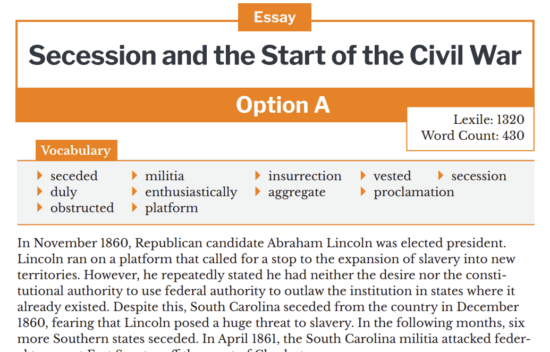
Understand the reasons why some individuals chose to join the secession movement.