Video
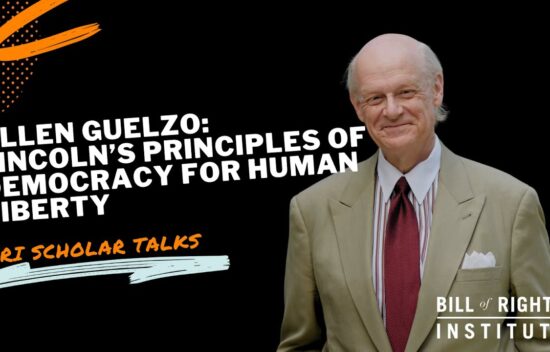
Lincoln’s Principles of Democracy for Human Liberty with Allen Guelzo | BRI Scholar Talks
Watch
Founding Principles
Consent of the Governed, Majority Rule/Minority Rights, Liberty
About this video
What was Lincoln’s understanding of the principles of democracy for human liberty? In this episode of Scholar Talks, Allen Guelzo, Distinguished Research Scholar at Princeton University and three-time winner of the prestigious Lincoln Prize, joins BRI Senior Fellow Tony Williams to discuss his recent book, Our Ancient Faith: Lincoln, Democracy, and the American Experiment
0:05 On this episode of Scholar Talks, the guiding question is what was Lincoln’s understanding of the principles of American democracy to human liberty? Our honored guest Allen Guelzo a distinguished research scholar at Princeton University and three time winner of the prestigious Lincoln Prize. He’s the author of nearly 20 books and including his most recent book, ancient Faith Lincoln, democracy and the American Experiment. He has generously appeared on scholar Talks Before to discuss his books on the Lincoln-Douglas debates, and also on the Battle of Gettysburg. I’m Tony Williams, senior fellow with the Bill of Rights Institute, and I’d like to welcome you to another episode of the Scholar Talks American Civil War series.
0:53 Allen, I want to thank you very much for joining us. Tony, it’s very fun to be with you again. Thank you very much for for appearing. I think we were talking a little bit before, and, I really love your book. It’s, a really readable, reflection, I think, on American democracy, through the eyes of Lincoln. I was expecting it to sort of be a book, on Lincoln and with some thoughts about America and his thoughts about American democracy. But it’s really a profound and I think much needed reflection on, on democratic ideals today and what they might mean for us and maybe our increasingly fractured, culture. So why don’t we go ahead and jump in and get started?
1:38 So, Allen, my first question is, what was Lincoln’s understanding of the principles of democracy and of the human experiment for human liberty? Well, Tony, I wish I could take you to one speech or one thing or one lecture or one letter of Lincoln wrote in which he lays all of that out easily. He doesn’t. He is able to take the idea of democracy somewhat for granted. He understands that the people he is speaking to in the 19th century also understand what is meant by democracy and are in favor of it. So he doesn’t actually feel like he has to start out with a dictionary definition of democracy.
2:24 So he’s not giving what we call a classroom, instruction in how to define how to recognize democracy. But that much said, I think there are several things which do stand out in Lincoln’s discussion of democracy, which give us a pretty clear idea of what he believed the basic principles of democracy were. The first of these, pretty plainly, is that sovereignty, political sovereignty, political authority rests in the people generally. And this is different from a monarchy where sovereignty is with the king and flows downwards. In a democracy, sovereignty is with the people, and it moves upwards if it moves at all.
3:09 Lincoln himself said that the country belongs to the people who inhabit it. They are the rightful owners of this American republic, and they are the ones who have the power. They can delegate it, but they can also take it back. So let’s understand from the very beginning, Lincoln says sovereignty resides in the people themselves. Anything that departs from that, anything it departs from their concern. It stops being a democracy. And about the closest he ever comes to a definition of democracy. Captures that because he writes as a note to himself at the beginning of the Great Debate campaign with Stephen Douglas in 1858, he says, my idea of democracy is very simple.
3:54 It’s very straightforward, as I would not be a slave, so I would not be a master. This expresses my idea of democracy. Whatever differs from this to the extent of the difference is no democracy. So for him, what that expresses is the notion of consent, the thing which sets slavery apart from democracy is that slavery means that the slave cannot give consent. The slave belongs to the owner has to do what the master says. In a democracy, it’s different. In a democracy, anyone who has the responsibility for ruling can only do it with the consent of those who are ruled. That’s what we mean when we talk about sovereignty, being and the people. All right. That’s principle number one.
4:41 Principle number two, our elections. Because how does the people express and exercise that sovereignty? They do it through electing those who are going to have the responsibility to give oversight for public affairs. For Lincoln, elections have to be free. There can’t be any element of compulsion that enters in, or else it’s really not an election. They have to be fair. One has to agree to abide by the results of elections, and they have to be frequent, above all frequent. Because as far as he is concerned, what elections are really ultimately about is accountability. Elections are the moment when people who have been given responsibility for leadership, for execution of policy.
5:29 That’s the moment when they have to go back to the voters and say, here’s how we did. Did we do it right? Did we do it wrong? And the people make a judgment at an election? That’s called accountability. Apart from elections, Lincoln said, you cannot have free government. You can’t have a democracy without elections. A third thing for Lincoln that gives us what a democracy really isn’t hard concerns majorities because you’re never going to get at any election, ever, any place, any time. You’re never going to get unanimity, especially in a democracy of the scale that the United States had achieved by the time he became president in 1861.
6:15 You’re simply not going to get unanimity, all right, when if you’re not going to get unanimity, then the decision making responsibility has to lie with a majority. So majorities rule sovereignty of the people. You move to elections. When elections take place, what do you discover? You discover who the majorities are. So the majorities hold the right to rule. But and here’s what’s the connection to majority rule. Majorities don’t suppress minority majorities don’t take a minority. The losers in the election put them up against a barn wall and shoot them. That’s not that’s not a democracy as far as Lincoln is concerned. Lincoln’s definition, Lincoln’s idea of a democracy
7:01 is what we would call a liberal democracy. It respects individuals, the free individual, the liberal, to use the latter, the free individual. That’s different from some other ways that people have defined democracy in the past. Rousseau, for instance, define democracy is something which expresses a general will. In Rousseau’s definition of democracy, you discover who a majority is, and of that. After that, a minority agrees to go away. The minority agrees to submit to the general will and be absorbed into it. That’s not Lincoln’s notion of a majority or majority rule. Lincoln believes in a liberal democracy where majorities don’t suppress the minorities. Now, by the same token, minorities are allowed to dissent.
7:49 And that’s healthy for a democracy, because, look, sometimes majorities make mistakes. Sometimes they go in the wrong direction. Sometimes the minorities had the right idea. After all. And at that point, you’re glad that the minorities had the right to dissent, because then they can give some measure of correction. But while they’re allowed to dissent, they’re not allowed to subvert the rule of the majority. They have to wait for the next election. And Lincoln said very candidly, if a mistake is made, if a particular majority goes down the wrong road, the solution to that is the next election. And if the minorities have been correct and if they’ve been persuasive, then at that point, then they can become the majority,
8:36 but they don’t subvert the process. And then the fourth thing that goes into the making of a democracy is law. And law is important in a democracy because democracies are about reason. Democracies are about people coming together, discussing issues, coming to conclusions, being convinced, being logical. Well, what else is law except and an instrument of logic. So in a democracy, law is what keeps reason central. If law does not serve that purpose, then a democracy. And this was the great fear that many of the founding fathers of the American Republic had democracy that does not abide by law
9:23 can easily descend into a mob, and a mob leads to anarchy. And where there’s anarchy, people look for a solution, usually in the form of despotism. And this is what Lincoln talks about in his first great public speech in 1838. If, in fact people set aside law, they break law. If they yield to impulse, if they yield to passion. And for him, passion was a bad word. If they yield to passionate impulse, then what we call the Democratic majority really begins to behave like a mob. It resorts to lynching, it reverts to violence, it reverts to oppression. After a while. People, by and large, get sick of that, and they turn to an Alexander, or they turn to a Caesar.
10:10 They turn to Napoleon Bonaparte to sort things out for. So Lincoln’s thinking about democracy is if you allow these basic operating rules to prevail, then you will see democracy flourish. And when it does, democracy can become really the most natural, the most the most direct means of allowing people their natural rights and the full expression of those natural rights. So that’s where you really get human flourishing. So for him, that’s the description of the basic operating system of a democracy. Right. wonderful. Very important. And building upon that and that last, idea of principle, maybe a little bit more on
10:58 why we’re reason and prudence, moderation, reverence for the rule of law. Are they so important to the democracy? in in Lincoln’s view? Well, for Lincoln and understand that Lincoln, even though he’s a man of the 19th century, he’s still very much a man of the 18th century enlightenment in terms of how he thinks all the great writers that he subscribed to were people who partook of the enlightenment’s respect for reason. for law. And he himself is a great devotee of that great document, politically speaking, of the enlightenment, which is the Declaration of Independence. So he understood that if war is necessary to a democracy,
11:44 then reason is necessary to law. And why? Because law is an exercise of reason. Law is the equitable, the balance, the thought through the thoughtful application of the means for human flourishing. Law can’t be impulsive. It can’t be one thing, one moment, another thing, another moment. It can’t be Partizan. It can’t just favor one group of people over another group. Within that democracy. It can’t be unwise. It can’t be foolish things. Because if it’s any of those, those things, then it’ll be overcome by disaster. A democracy which is impulsive.
12:32 This is democracy which is constantly yielding to the pressure of the moment. A democracy which is Partizan is relentless and resorts to violence. A democracy which is unwise is a democracy which isn’t going to last very long. How do you prevent those kinds of disasters from overcoming a democracy? You do it by law and submission to law. In that respect, as soon as you put law that far forward, then you can see how the qualities you were talking about prudence, moderation, reverence for the rule of law, you see how they follow naturally, because something like prudence, prudence is, is intrinsic to the operation of law. Why? Because prude prudence is the moment when you think through the consequences
13:21 of adopting a certain policy or a certain law, you’re thinking several jumps ahead and you’re thinking, if we decide to sanction this, or if we decide to forbid that, what’s going to be the result as what’s going to happen a few weeks, a few months, a few years afterwards? When you think in terms of law that calls for the operation of prudence, and the same thing is true in talking about partisanship or impulsiveness, it law protects you from those things. And in that respect, this is why law is so central. An affair for Lincoln in a democracy, right? And thinking, Lincoln had a lot to say about economics and Democrats
14:08 government and so. So why we’re free labor, free enterprise, national economic development, self-improvement, even, central to Lincoln’s thinking about a healthy democracy. Well, for one thing, that was the story of Lincoln’s life. He was not a person who liked to do a lot of, shall we say, autobiography. He was very hesitant to open up a discussion of his past in 1858, when he is part of that great debate series with Stephen, a Douglas, an editor of the Chicago Tribune, Charles Ray writes to Lincoln and says, asking a question
14:53 theoretically says, I have the suspicion that Abraham Lincoln was not born with a silver spoon in his mouth. Is that right? Now that’s how you chew things. It tells you, first of all, that people could make guesses about Lincoln. But the other thing it tells you is very often it was not more than guesses that Lincoln did not like to talk about his past. He didn’t like to glorify his origins. So he’s very reluctant, generally speaking, that way, to talk about himself. And you can easily see why, when he looks to his own past, what he sees as someone who is born to a father that he doesn’t get along with. He’s born in rural poverty.
15:39 He was born in a log cabin. He born in a frontier society, which is pretty rough and ready, and one person who really got after him to try to find out details about his early life, Lincoln responded and said, hold on. I have seen a great deal of the back side of the world, so he he did not in the way that we sometimes, cast this legendary aura around Lincoln. He didn’t glorified those those very humble backwoods origins. He was afraid people would try to use those origins to gain political advantage over him, to embarrass him, to make him look like he was just simply the product of the crude frontier. So most of the time, almost all of the time, he would not want to talk about himself.
16:27 But there is one aspect of his life that he does talk about, and that is that he started poor well behind the economic eight wall, but by sheer dint of application, by working hard, by seizing every opportunity as it came to him, he made of himself something very different. He was giving a speech in the 1850s, and he saw a friend of his in the audience, a man named John Roll, and he pointed to roll and said, now there is my friend. Roll. He started out the same way. He started out no better than a slave. And now look how successful he’s become. Then Lincoln added, I used to be a slave, but now they let me practice law so free.
17:16 What he meant by that was not that he had literally been in slavery. It’s that growing up, his father put him out to work at a very early age, and everything he earned went to his father. It wasn’t until he turned 21 and could strike out on his own that he was able to keep anything that he had earned for himself, so he looked back on that as a way of showing how, in the democratic environment of America, people could start out well behind the line and yet make of themselves something that everyone had to respect as successful. And he would say, basically, if I can do it, everyone can do it. And anything which would have prevented me from doing it,
18:01 that is a conflict with democracy. That, in fact, is why he is so opposed to slavery, because slavery says to the slave, you’re born a slave. And not only are you born that way, you’re always going to be a slave. You’ve got no incentive to make yourself better. You can’t make yourself better because in the eyes of the law, you don’t even exist as a as a human being. So his notion of a democracy is a democracy in which people can transform themselves. And in that respect, what a democracy does, it gives that opportunity for self transformation, that opportunity to exercise liberty or the opportunity to exercise other natural rights. And for him, that opportunity is what his whole life was about.
18:51 And he will say very frankly to people that at least in terms of economics, you’ll say, 25 years ago I was a penniless, friendless young man, a stranger working on a flatboat. And now you see how I how I been able to advance. And I want that opportunity, Lincoln says. I want that opportunity for everybody. He wants as open an economic society as he wants an open political society. Now, that meant for Lincoln, the government had a significant role to play in, in the lives of citizens, but it was a role which was geared towards enablement, he said in notes that he made in the 1850s.
19:40 Government should look to do only the things that people cannot do for themselves in their individual capacities. So he’s not a libertarian. He’s not an enemy of government, but he is suspicious of power. So for Lincoln, whenever the government does act, what it should do is it should act for the enablement and especially the economic enablement of people, not for their manipulation, not for their repression. Government should, for instance, guarantee a free and level playing field. It can do things which will enable commerce to flourish. This is why Lincoln becomes a Whig
20:25 in his earliest political years. He joins the Whig Party as it was founded by Henry Clay. And what are the three great, objects of the Whig Party? First of all, it’s infrastructure. But they called internal improvements than infrastructure because infrastructure helps people get the goods that they have on the farm to market. And they’re they can turn them into cash and buy things. So infrastructure is important for enabling people to interact with with markets he wants, as the Whig party always agitated for a national banking system. Why you need a national banking system so that everyone is dealing with the same currency that speeds up commerce, that enables people.
21:13 And then you want protective tariffs. You want protective tariffs because the United States is a young republic, and it’s going to have to compete with the established economies of other nations and especially Great Britain. So in order to enable your people, you protect them from the British dumping cheap goods on the American economy and continuing to make the American economy dependent on the British Empire, even though we get independence politically speaking, from the British in the end of the of the American Revolution. What Lincoln was worried about was, are we going to get political independence? But nevertheless still be economically dependent on Great Britain? Tariffs are going to move us in that direction. All three of those have as their common denominator
22:00 the idea that the purpose of government, especially in the economy, is to enable people enable people to rise from whatever position they become, whether they’ve been born in, to become something entirely new, if they wish it to be right. And what mores, habits, character did, Lincoln believed that were necessary for free government to thrive and had to exist among the people? Well, you use the term mores, which is an interesting term, because it was the term that Alexis de Tocqueville used when he was doing his famous tour of America early in the 1830s. Tocqueville, of course, is a Frenchman. He very sympathetic to the American experiment in democracy,
22:50 and he feels that he has to explain and defend and justify it to his fellow countrymen in France and to other Europeans. And one of the things he discovers is that in this American democracy and the book he writes, of course, he entitles Democracy in America as one of the things which makes the wheels of democracy go, which makes those rules I was talking about makes them move the way they move the oil for them, so to speak, are these mores, these habits, the kind of character that Americans had and as far as he’s concerned, the mores of Americans can really be distilled down to four things in terms of supporting democracy.
23:40 One is an assumption that property and the ownership of property is a good thing, he believed, and this is one of the foundation elements of his objection to slavery. He believed that the person who works by the sweat of their brow to produce the bread that that work is, is going to lead to, has also the right to eat that bread that you simply do not say to someone, you work in toil that are in bread, and I’ll eat it. That he said that was no different from the tyranny of kings. You can do in a free society, whatever you can make of yourself by your own work, and what you do in that society is you.
24:29 You acquire property. And for him, that’s that’s part of the the overall development of a free society. And he says that, a young, penniless beginner starts out working for somebody else, or at the very first thing is they do earn some property, they earn some wages, and they use the wages to feed themselves. But if they’re really diligent about what they’re doing, they’ll also find a way to save some of those wages. They’ll save them up. That becomes another kind of property. And then over a period of time, having saved enough, they will go out and buy the means to produce things themselves and work independently on their own. And they’ll do that on the basis of the property they own. And if they become successful on that, then they’ll turn around
25:17 and hire and employ other workers to earn wages. And in that respect, Lincoln said, then that whole process just keeps on going and replicating itself. But the assumption is property and the ownership of property is a good thing. He was very clear and he said, we do not advocate any system that prevents people from acquiring property. To the contrary, we want people to acquire more property and this once again marches against the idea of slavery, because one thing a slave cannot do is acquire property. All that a slave does is to generate the value for the property that someone else appropriates for themselves. So respect for property religion is another, more that is important for Lincoln,
26:02 which is interesting because Lincoln was not visibly very religious himself. He’s the only president who has never joined a church, never participated in any significant or noticeable way in religious functions. And yet he does appeal, often frequently, to the direction of divine providence, to God. And especially as you move into the years in the 1850s when he advances to the forefront of opposition to slavery in America, he will appeal to natural law as given by God as a way of saying, no, you. You don’t simply enslave someone.
26:48 There is something that is wrong with that, morally wrong with that. And the reason that it’s morally wrong is it violates natural law. Well, if natural law exists, then logically speaking, somewhere along the line there is a law giver. Over the course of the Civil War, we will find Lincoln appealing more and more to Providence, to God. And finally, in his second inaugural, which he delivered some six weeks before his assassination, he will talk about the judgment of God in a way that no other American president has, has ever done in any in any public speech. So there is an interesting movement in Lincoln. This way.
27:33 And yet even there it’s not a formal, recognizable theological interpretation of God that he speaks of in the second inaugural. And yet he’s recognizing that there is an important element of religion, part of these mores, these habits to which he should appeal a third kind of more is his respect for toleration, because this is a man who, in part because he does not have any very closely defined religious commitments, is willing to indulge the religious commitments of others. In 1844, he defends immigrants from Catholic countries who are coming to America. He’s not a Catholic himself, but he defends their right
28:19 not to be lynched and mobbed as they were in 1844 during the Civil War. He warns his officers it’s not the business of the government to meddle with the churches. He appoints the first Jewish chaplains for the U.S. Army. He revokes Ulysses Grant’s infamous General Order Number 11, which was supposed to expel Jews from Grant’s camp. He revokes that order like George Washington, writing to his famous letter to the New Great Synagogue. Lincoln believed that the American democracy she gave to bigotry no sanction, and he extends that sense of tolerance
29:05 even over slavery. What I mean by that is this he does not dim southern people as evil for being slaveholders. He says, if we of the North lived in the South, we probably be doing the same things that Southerners do. If Southerners lived in the North, they’d be opposed to slavery just as we are. He doesn’t stand apart and and point his finger and say, you are beyond the pale. He will in fact say in 1862, I shall do nothing in malice. What we are dealing with is too great from malice. And then at the very end of the second inaugural, he’ll talk about having malice toward none and charity for all. So he’s a man for whom toleration is yet another democratic habit.
29:54 And finally, I have to say that elections. I said elections were part of the operating rules. Well, yeah, they are, but elections are even more than that for Lincoln. Elections are a kind of long for democracy. Elections are how democracies breed. And he’s always interested in elections. All through his political career. He is involved in electoral politics right down to the precinct level, and he’s writing instructions as to what precinct captains are to be doing and what their responsibilities are. And even while he’s vice president, he’s keeping detailed records of how people are liable to vote and how their states are liable to vote. He thinks that elections are
30:42 just this incredibly important aspect of a democracy. And for him, they’re almost, a matter of cultural enthusiasm and celebration. So he really does he really does love elections. And yet, I’ll say this, having said these things about Lincoln, the mores, Lincoln sees and democracy, as much as he understands these and as much as he works within them, he also realizes there are limits to when he talks about religion. People sometimes have the idea that they could cash in on that. One organization went to Lincoln asking him to endorse an amendment to the Constitution that would explicitly recognize the authority of Christianity,
31:28 and Lincoln reads books as nodding sympathetically. But he declined to do anything about it. He as much as he respects religion, he is not going to enshrine it legally in the American Constitution, so he understands these mores. At the same time, he is also not dictated to by them. He manages them, he lives within them, he inhabits them, he works with them. All right. Thanks a lot. And you mentioned slavery. And we’d be remiss not to talk about that because, you know, how did Lincoln’s views and actions regarding American democracy and race actually support human equality?
32:15 Well, pinning Lincoln down on race is not an easy thing to do, right? Or slavery. Oh yeah. I mean, Lincoln has and has for a very long time had this great reputation as the Great Emancipator. And I’m not going to be the one to question that. He is the Great Emancipator, but he’s also some other things as well. And it has become, I’m afraid to easy to cherry pick quotations throughout his life that that can make him sound pretty bad. On the subject of race, I mean, remember, this is a 19th century person,
33:00 and at their very worst, those cherry picked quotations can make him sound just like another garden variety white supremacist. At the very beginning of the fourth of the Lincoln Douglas debates in Charleston Illinois he says very candidly, I am not in favor of the social or political equality of the black and the white races. And there there are many people who have latched onto that statement to say, gee, he really doesn’t believe in any kind of human equality, and he’s not committed to that. So we shouldn’t be lauding him as a great emancipator. And that and that’s of the worst at the best, at the best. The cherry picking will get you things like the citations
33:49 of the so-called Greely letter from August of 1862, in which Lincoln responds to criticism from New York Tribune editor Horace Greeley that he’s not moving fast enough toward emancipation. And Lincoln writes back to Greeley in August of 1862. And he says, well, what I am doing as president of the United States during this Civil war is I am trying to restore the Union. Whatever I do about slavery is always a means to the end of restoring the Union. And if that means I emancipate all the slaves, I’ll do that. And if it means I emancipate some and leave some in slavery, I’ll do that. If it means that I emancipate no one anything which will help me reunite the country, that is what I am going to do.
34:35 When people look at the Greeley letter and they say, well, he wasn’t really all that enthusiastic about emancipation, was he? He’s just simply using emancipation as a lever for reunifying the country. And the result is that Lincoln can emerge from this cherry picking looking like an emancipator. I mean, what you can’t deny is, all right, he is an emancipator. It’s his signature. At the bottom of the Emancipation Proclamation of January 1st, 1863. But people will look at him and say, yeah, he’s an emancipator, all right. Is he a great emancipator, or is he an emancipator? Who really is handicap by his own regressive thinking on race?
35:22 Well, I think that is a question that many people ask today, and I don’t think that’s a question that should be dodged either. I think it’s a legitimate question. The way I would respond to it would be to say that that’s not the way his contemporaries saw him. When Lincoln at that debate in Charleston, Illinois, says, well, I don’t believe in the social and political equality of the races. He goes on from there to say, however, and I’ll always be careful when Lincoln turns on that word, however, or the word, but because something’s coming, however, he says in the right of the black man to eat the bread which he has earned by the sweat of his brow, he is my equal judge.
36:11 Douglass is equal and the equal of every living man. So Lincoln is saying, even if I’m not talking about social and political rights or social and political equality, I am talking about natural rights and natural equality. Steven Douglass, Lincoln’s opponent, latches onto that right away. He says, you think that Lincoln is making some important distinction here? None. None. No no, no. If you vote for Lincoln, given what Lincoln has just said about natural rights, it won’t take very long at all before we’re talking social and political equality. And you people in Illinois don’t want that, do you? Douglass saw it right away. That Lincoln’s logic, starting from natural equality, was sooner or later going to wind up with social and political equality.
36:58 And he and he calls Lincoln out on it. And I have to say, for once in his life, Steven Douglass was right. He saw exactly what was going on. And not only Stephen Douglass, there was another Douglass, and that is the black abolitionist Frederick Douglass. Frederick Douglass, for the first two years of the Civil War, had been a very severe critic of Lincoln. Like Harvey Greeley, he wanted Lincoln to move and to move forward dramatically on the subject of abolishing slavery. And Lincoln doesn’t seem to get the memo. And that that frustrates Douglass. Finally, in 1863, summer of 1863, Douglass is invited to meet with Lincoln, and when he does, it is an epiphany.
37:46 Douglass comes away from that meeting with Lincoln, telling people, I went to see the president of the United States, and he spoke to me as one gentleman speaks to another gentleman. He didn’t make any allusion to race or color. He treated me just as though he would treat just the same way that he would treat anyone else coming into his office for a discussion of political matters and Douglass’s respect for Lincoln only grows exponentially after that, until finally, after Lincoln’s death. Douglass gives this this great eulogy at the Cooper Institute in New York on the 1st of June, 1865. He speaks of Lincoln as as Preeminently, the black man’s president.
38:35 And Douglass, in fact, isn’t the only one who will speak that way. Lincoln welcomes this, really this this procession of the black leadership of America to the white House. And he’s doing things on a scale and in a in a fashion that is simply without any kind of precedent from the previous 15 presidents who had occupied the executive office. So I think rather than Lincoln being an emancipator who’s handicapped by the way he thinks about race, what I think is that Lincoln is a limited thinker on race, but he’s a limited thinker whose limitation are overthrown or cast down by his passion for emancipation.
39:23 Emancipation is what governs. He wants people to be free. And if that means he’s got to set aside whatever prejudices his culture equipped with on the subject of race. All right, he’ll set them aside right. Excellent. And so, our final question, in a nutshell, maybe, you know, what? What civic virtues can Lincoln maybe offer us? in thinking about our own citizenship, maybe introducing a little bit more moderation? Decency? I know a lot of people talk about our increasingly fractured culture, our divide. you know what can Lincoln teach us, if anything? Well, I think there are several things that Lincoln might suggest to us
40:09 as ways of healing. Some of the raw places in democratic exercise today. One thing, one thing I feel certain he would exhort us to do is to understand the issues. Don’t just don’t just react to them. Don’t resort to passion. Don’t resort to caricature. Understand the issues. One of the things that made Lincoln the the statesman that he was, was that he excelled at seeing right to the core of a problem, and it’s something he works very hard at. He says to his secretary, John here in May of 1861, the Civil War has been going on now for a little more than a month.
40:55 And Lincoln says that, hey, you know what the fundamental issue in this war is? It’s not just about the two sections, north and south. It’s not even just about slavery. It’s about whether democracies are damned to fly to pieces. The first time they hit a really divisive problem. And of course, slavery was a really divisive problem. He understood the Civil War as being a kind of referendum, kind of final exam for Americans on whether they could really make this democracy thing work. And he sees right away that’s the fundamental issue that is at stake in this war. And that’s something that he comes back to again in the Gettysburg Address, because in at the opening of the Gettysburg Address, what does he do?
41:42 He takes us back to 1776 four score and seven years ago and he says that at that time, this nation was founded on a proposition that all men are created equal. Well, what is happening now? We’re in a civil war, and the Civil war is the test of that. And having passed the test thus far, especially at the Battle of Gettysburg, he exhorts people to go on to a new dedication, a new birth of freedom. He really understands what the fundamental issues are about, and we should do that. Take some time. It takes some work. You might say that it takes some research, but that labor is necessary to the functioning of a healthy democracy.
42:29 I think we could also say that Lincoln would like us. He would like you would like us to love democracy, not just to say, all right, it’s nice. Yes. It’s okay. That’s what we’ve got here. He would like us to love it. one, one member, the Lincoln administration in the War Department made a comment about Lincoln. That Lincoln, night after night, would work late and hard without being wielded by it. This was a man named Charles Dana. And Dana said that Lincoln always seemed as ready for the next day’s work, as though he’d done nothing the day before. He loved the labor of democracy.
43:14 We should too. We shouldn’t regard it as an imposition on our private lives. It’s our public life. We should embrace it. We should learn, I think to the organization we should learn how the democracy is structured, how it operates. John. Hey. His secretary wrote in his diary in 1863 that he was just amazed at how Lincoln understood the organization of the government, which is really remarkable when you consider the fact that Lincoln had never been a U.S. senator, never been a governor of a shoe, never been the governor of his home state of Illinois. He never even been the mayor of his hometown of Springfield. But when he becomes president, he really learns the organization.
44:01 And he said that Lincoln Lincoln would sit there like a backwoods trumpeter and manage this war, manage foreign relations, plan reconstruction all at once, he said, I never knew with what authority he rules the cabinet, the most important things he decides, and there is no disagreement. Like he learned how democracy operates and how it how it functions, how well the wheels turn. And we should too. I think perhaps the most important thing we can learn from Lincoln that that way is about resilience, the resilience of democracy and the resilience
44:47 of ourselves in a democracy. Lincoln did not think he was the most important character on the stage. There was a certain humility here. This is a man who gets criticism all the time, and he has to deal with some recalcitrant figures. During the Civil War, maybe the most recounted, General George McClellan. But at one point Lincoln once said, I, I would hold McClellan’s horse if only he would give us victories. He’s he is willing to abjure punishment. That’s what resilience is. You know, he’s willing to absorb punishment on behalf of democracy. He made a comment on one occasion.
45:34 This is in 1863. I have endured a great deal of ridicule without much malice and much kindness. Not quite free from ridicule. I am used to it, and I think it would be a marvelous thing if we understood, first of all, how resilient democracy really is. It’s not fragile, authoritarian regimes, dictatorships, they’re fragile. That’s why they come and go so frequently. Democracy are resilient. They can absorb a lot. And Lincoln is an example of how a Democratic leader is able to absorb challenge and crisis. And that, I think, is a useful example
46:21 for all of us as we go through what is really an age of crisis and anxiety in our own democracy. I think I think the habits of resilience are ones that we can develop for ourselves and be confident of in, in our democracy, and I think those are some lessons that Lincoln can offer us. Some examples, even after 158 years. Well some really, beautiful concluding thoughts to our conversation. And, Allen, you also want to thank you very much for joining us, and congratulations on your new book, Our Ancient Faith. Well, thank you very much. Thank you very much, Tony. It’s good to talk with you and to be able to talk
47:06 about Lincoln for all of your viewers. Indeed. Thank you. And thank you all for joining us on this episode of Scholar Talks. Please check out the other interviews in our American Civil War series on our channel. Thank you.