Video
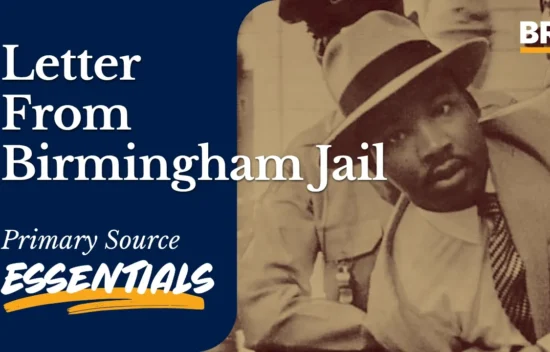
Letter From Birmingham Jail | Primary Source Essentials
Watch
Founding Principles
Virtues
About this video
How does Martin Luther King, Jr. support justice and equality in “Letter From Birmingham Jail?” In this rapid-fire episode of BRI’s Primary Source Essentials and letter from Birmingham jail analysis, learn about the MLK letter from Birmingham jail while he was imprisoned for leading nonviolent civil rights demonstrations in Alabama in 1963. This letter from Birmingham jail summary explains why he thought people had a responsibility to follow just laws and a duty to break unjust ones.
0:00 Hi. Welcome to primary source essentials. In this episode, we will briefly discuss Letter from Birmingham Jail. Now, the central question is how does Martin Luther Luther King Jr support justice and equality in letter from Birmingham jail? Let’s find out King’s answer to this question.
0:21 Black Americans lived under legal segregation in the south during the first half of the 20th century. Because of the decision in Plessy v. Ferguson in 1896 and local law, the civil rights movement sought to use popular demonstrations and political action to overturn segregation laws and achieve justice and equality for black Americans.
0:45 In 1963, King led nonviolent demonstrations of hundreds of people in Birmingham, Alabama and he was jailed for his participation along with many others and composed a public letter explaining why he thought protesting unjust segregation laws was justified. King defends the nonviolent direct action campaign by explaining why Black Americans
1:10 cannot wait any longer, as he says for, quote our constitutional and God-given rights which have been denied for more than 340 years. Now King distinguishes between a just and an unjust law. A just law squares with the natural law. It uplifts the human person indignity
1:33 and it is based upon consent and applies equally to all. The unjust law, on the other hand, is out of harmony with the natural law. It degrades the human person, distorts the soul, creates inequality and is imposed on others. That is why he calls segregation laws immoral.
1:55 In King’s view, one has a responsibility to follow just laws as well as a duty to break unjust laws but to do so openly, lovingly and with a willingness to accept punishment in order to arouse the conscience of the community by exposing injustice and making the laws just.
2:17 He says that oppression cannot live forever and that he seeks a moderate course between the extremes of segregation and injustice on one hand and the more and more radical violent solutions on the other. So the answer in Letter from Birmingham Jail is that King supports nonviolent demonstrations to achieve justice and equality.
2:39 Thanks for watching and check out our other videos in Primary Source Essentials.
Standards
Related Resources

Excerpts of Letter from Birmingham Jail Dr. Martin Luther King, Jr. April 16, 1963


How do you find the strength to stand up for what you believe in? In this Primary Close Read video, Kirk and Rachel are joined by Dr. Anika Prather, Professor in the Classics Department at Howard University and founder of The Living Water School, to read Martin Luther King, Jr's "Letter From a Birmingham Jail." They explore the ways King planned to right the wrongs of injustice, and how he urged others to act. How does King's letter convey hope for the American story?

Use this primary source text to explore key historical events.