Video
Japanese-American Internment During World War II | BRIdge from the Past
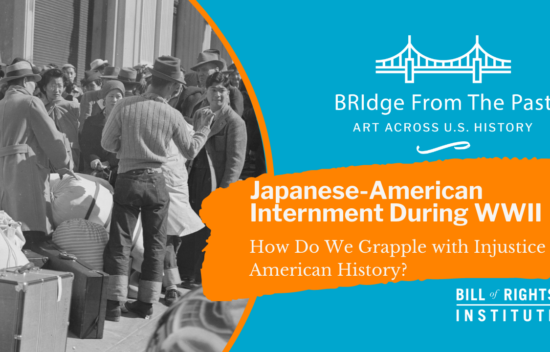
Watch
About this video
Why is a truthful telling of Japanese-American treatment during WWII important for all Americans? In this episode of BRIdge from the Past, Mary looks at images depicting the Japanese-American internment resulting from President Roosevelt's Executive Order 9066 in 1942. Why was Japanese-American internment a betrayal of the founding principles and civil liberties of the United States? What does viewing these images teach us about the importance of upholding these civil liberties today?
0:08 Hi everybody. Welcome back to another episode of Bridge from the Past art across US history. I’m your host Mary, and this series is for students like you to get ahead in your history class by using images as a starting point to explore important topics in American history. Today, we’re looking at the treatment of Japanese Americans during World War II.
0:29 How does this story connect to founding principles of equality and justice? Let’s jump in and see. Once again, we’re thinking about the treatment of Japanese Americans in World War II and how it connects to founding principles of equality and justice. Here’s our starting point. Right away, my eye is drawn to this big sign in the middle of the picture.
0:51 All caps, bold, loud, clear. I am an American. So right away I have some questions. Namely, who put this up there? Where is this and why? Why is there a sign saying I am an American on this store? So I’m assuming it’s a grocery store.
1:13 You have grocery up here, and it says fruits and vegetables, but it looks like it’s empty. It’s kind of hard to tell, but it looks dark. It doesn’t look like there’s anybody’s in here. And again, this is World War Two, and you have this great vintage car right here. So, like, I’m guessing, you know, 1940s.
1:33 How does this connect to Japanese Americans? I told you, we’re thinking about the treatment of Japanese Americans in World War Two, and there are no Japanese Americans in this picture. In fact, there are no people in this picture. So that’s a little perplexing as well. As with any primary source, I definitely need some more context before I can do a better analysis.
1:53 So what do we need to know before we can go any further? We can’t talk about Japanese American treatment during World War II without talking about the attack on Pearl Harbor in December of 1941. This attack was a huge shock to Americans. And after it happens, war hysteria and paranoia, especially towards Japanese American
2:15 people, is escalating throughout the United States. In February of 1942, the President Franklin Delano Roosevelt issues Executive Order 9066, which authorizes military commanders to exclude civilians from military areas. So let me back up for a second. After the attack on Pearl Harbor
2:37 in Hawaii, the many people in the United States feared a Japanese invasion and the entire west coast of the United States. So, Washington, Oregon, California west coast is turned into a military zone. So it’s under basically the administration the control of the military. This Executive order 9066 gives that military commander this power
3:00 to exclude civilians, basically move civilians out of the west coast. Now, it doesn’t name any particular groups of people, but it’s setting a precedent that groups of people can be removed from the military area, which is the entire west coast. Congress follows up really quickly, so this is basically within a month with a law that basically makes
3:24 Executive Order 9066 enforceable in federal courts. So, in other words, if you don’t comply with the law, you can be sent to prison or fined or both. Again, moving very quickly here, later that month, the military issues an order that forces the evacuation and detention of Japanese Americans on a 48 hours notice.
3:49 So, in 48 hours, you’re told you have to leave your home, your business, all of your stuff. And what ends up happening is 112,000 people are going to be sent to assembly centers where they’re going to basically be tagged, processed, and then moved to relocation centers further inland in remote places on the West Coast for the duration
4:12 of the war, many of these Japanese Americans were US citizens. Many of them did not know that they were going to be interned for four years. And again, they had 48 hours to figure out what to do with their homes and their businesses. What’s going to happen is that businesses, homes, cars, all of your possessions are going to be sold quickly.
4:34 And if they could be sold, and often at a really low price. So, people, it’s chaotic, and basically, you’re losing all of these things. So, with all of this in mind, let’s go back into our image. This image is taken in March of 1942.
4:57 So we’re right in that timeline of it’s. Not long after the attack on Pearl Harbor, wartime hysteria is sort of running high, and you’re starting to see this legislation and these orders surrounding the treatment of Japanese American. So this sign, I am an American, was placed on a grocery store owned by the Matsuda family.
5:21 So a Japanese American family. And Tatsuro Matsuda, who was a University of California graduate, commissioned and installed this sign. So his store is closed, or the family store is closed on orders that Japanese Americans have to evacuate the West Coast. So he has placed this sign on his family
5:41 store and he’s making a statement, right, like, I am an American citizen, and I think it’s a statement about this basic denial of civil liberties and prejudice and racism towards Japanese Americans during this time of war. So really, really powerful. Who took this picture is another really great question.
6:04 This picture was taken by Dorothea Lange, and we’ve seen Dorothea Lange on Bridge from the Past before. She’s famous for her photos of the Dust Bowl and rural poverty during the Great Depression, but now she’s working for the government yet again for the War Relocation Authority. So this is an entity that’s overseeing this process of moving, evacuating,
6:25 forcibly Japanese Americans from the West Coast. A note on language here. At the time, this was referred to as Japanese internment. And that’s what sources from the time will describe the process as groups today debate the use of this language. And to learn more, I would encourage you to check out Dencho.org, which is a nonprofit that keeps alive
6:49 these stories of the treatment of Japanese Americans. Let’s explore another picture. Here we have another photograph from Dorothea Lange. And again, this was taken in April of 1942. So we’re still in that tight time frame where Japanese Americans are learning that they’re going to be relocated. And what you have here are a group
7:10 of girls saying the Pledge of Allegiance at a public school. And this photo was also by Dorothea Lange. And again, Dorothea Lange is working for the government. She’s documenting this process. So I think that’s an interesting thing to keep in mind. But what I notice about these girls saying the Pledge of Allegiance, right, they have their hands over their hearts.
7:30 And you have girls. I can see lots of ethnicities. I see Asian Americans. I see what look like Latino Americans, african Americans. I see white children. They’re all saying the Pledge of Allegiance. They all have these wonderful little children faces. They look like smiles, some of them look bored, but they’re all looking up and have their hand over their heart.
7:51 So they’re pledging allegiance to the United States. And this is days before Japanese Americans are notified that they have 48 hours to leave their homes, their businesses. So, a really powerful image of what does it mean to be an American and how are you treated as an American citizen.
8:12 So here, same image, same school. You have the boys saying the Pledge of Allegiance. And again, you have lots of ethnicities. And I just have to say, I love this little one’s face right here. It makes me smile. It’s such a little boy face, maybe the son’s in his face or something. But they’re looking upward and they’re saying the Pledge and again, with the hand over the heart.
8:33 This is the last image that I’m going to share with you. So here you have a group of people. Again, this is an image taken by Dorothea Lange with their baggage, and they are awaiting a bus to be taken to a relocation center. And you can see here you have all these men, women, children, and they have their things with them.
8:56 So you see bags, I see suitcases. I don’t see any children in this particular one, but I see men, women, I see varying ages. Here, people were allowed to bring with them two duffel bags in one suitcase. So if you think about your life, your home, your business, that’s all you can take with you and everything else, if it can’t be sold, you’re going to lose it.
9:19 So just sort of the chaoticness, the loss, the injustice of everything that’s happening here, I think is really profound. Even though we have no words, we just have the image and the historical context in the back of our minds. I do want to leave you with just a quick epilogue to this story. So, later in 1980, Congress appoints a committee to look
9:41 at what happened during this episode of Japanese internment. During world War II, and they acknowledge the injustice of this period in time. They acknowledge the injustice of the treatment of Japanese Americans, and they actually provide cash, payment or reparations to anyone that was interned. So even though this is a heartbreaking story, I think it’s also sort
10:05 of a cautionary tale for us as Americans today. We think about these important principles of liberty, inequality, and justice. And what does it mean to make sure that we remain truthful to them? So now I turn it over to you. Why is a truthful telling of Japanese American treatment during World War II important for all Americans to hear and consider?
10:27 I would love to know your thoughts. You can leave them in the comments below. That’s all we have time for today. As always, there’s so much more to the story. I would encourage you to read more about Japanese internment. You can check out our videos on Fred Koramatsu, who is a courageous Japanese American who challenged Japanese internment at the time.
10:47 There’s so much more to know. There’s so much more to learn. You’ve got to keep asking questions. If you learned something, be sure to like this video and subscribe to our channel for more help with videos resources to help you through the school year. I’ll be back throughout the summer with more images to keep us thinking about important topics in America’s history. Until then, everybody take care.
Standards
Related Resources

Explores the Supreme Court case of Korematsu v. United States.

Use this lesson to have students explore the challenges to civil liberties faced by Japanese Americans in internment camps during WWII.