Video
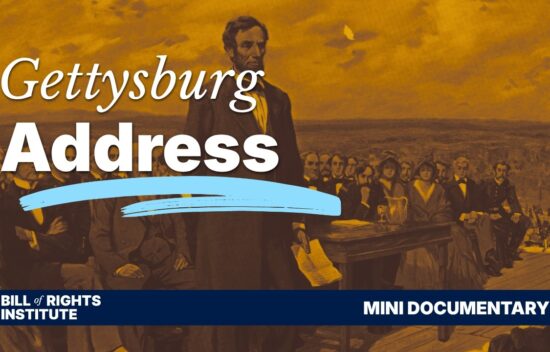
Gettysburg Address Mini Documentary
Watch
About this video
In November 1863, just months after the Battle of Gettysburg left more than 51,000 casualties, a new national cemetery was being dedicated on the battlefield. President Abraham Lincoln was invited to offer “a few appropriate remarks.”
After touring the grounds and reflecting on the sacrifice made there, Lincoln delivered a brief 272-word address that reshaped how the nation understood the war. In the Gettysburg Address, he connected the conflict to the founding promise of equality, honored the soldiers who had fallen, and called Americans to continue the “unfinished work” of preserving self-government so that freedom would endure.
0:05 In July 1863, the invading.
0:08 Confederate army under General Robert E.
0:10 Lee clashed with the Union.
0:12 Forces of General George Meade.
0:14 In the small town of Pennsylvania.
0:16 The two. Armies fiercely.
0:18 Clashed over the fields.
0:20 Orchards, ridges, and hills surrounding the town for three.
0:24 Bloody days.
0:26 After a. Final.
0:27 Disastrous Confederate frontal assault.
0:29 Called. Pickett’s Charge.
0:31 Lee retreated across the Potomac and never invaded Northern Territory again.
0:37 A shocking 51,000 men
0:40 lay dead or wounded on the field of battle.
0:44 While the Battle of Gettysburg was important to the outcome of the Civil War.
0:48 Perhaps its larger.
0:50 Significance came into focus with the 272.
0:53 Word. Speech.
0:55 By President Abraham. Lincoln months. Later.
0:57 When dedicating the new National.
0:59 Cemetery for the interred soldiers.
1:03 In early November, Lincoln received an invitation to say a few appropriate.
1:08 Remarks from David.
1:09 Wills, the. Cemetery.
1:11 Organizer with so many.
1:13 Presidential. Duties related to the war.
1:15 Lincoln was hesitant, but finally accepted about five days before.
1:20 The ceremony. On November 19th.
1:23 You want it to honor the battlefield dead and console the living.
1:27 He sat at his desk in the executive mansion.
1:30 And started drafting his remarks.
1:33 On the evening of November 17th.
1:35 Lincoln spoke with the landscape architect who designed the cemetery layout.
1:40 The president wanted a feel for the place and to understand.
1:44 The larger meaning. Behind its design.
1:48 He also planned his trip to
1:50 Gettysburg for the next day, so that he had time to trod the.
1:54 Hallowed ground.
1:55 Where the soldiers had fought and died.
1:59 On November.
1:59 18th, the presidential.
2:01 Train pulled out of the station.
2:03 Lincoln had a copy.
2:04 Of his rough draft, but the politicians and reporters on the train and the crowds.
2:09 Assembled to greet him along the way prevented him.
2:13 From working on it.
2:15 He arrived.
2:15 In. Gettysburg in the early. Evening.
2:17 And rode a carriage to.
2:19 The will’s. House, where. He was staying.
2:21 He had dinner with. Several.
2:22 Notables and then.
2:24 Greeted visitors for an hour or two.
2:26 You’re serenaded by cheering.
2:28 Crowds and bands all evening, and finally delighted them by saying a few.
2:33 Humorous words.
2:34 You retire to his room to work on the draft.
2:37 He met briefly.
2:38 With.
2:38 Wills for more inspiration and later with Secretary of State.
2:42 William. Seward to review. His speech.
2:46 Lincoln rose early in the morning and toured the battlefield.
2:49 On horseback to get a strong.
2:51 Sense of place.
2:53 The large crowd.
2:54 Welcome Lincoln and the other.
2:56 Dignitaries.
2:57 Warmly renowned Orede, or Edward Everett.
3:00 Gave a powerful and sweeping.
3:02 Two hour speech. Tying Gettysburg.
3:05 To the grandeur of Western civilization.
3:09 President Lincoln then.
3:10 Delivered some of the most moving words in American history.
3:14 Reflecting on the cemetery, the wars, purpose,
3:18 and the American creed,
3:21 Lincoln started with the past.
3:23 He pointed back towards 1776.
3:26 And the aspirational.
3:27 Ideals of a. Free. Society.
3:30 And the Declaration. Of Independence.
3:33 He famously began.
3:34 Fourscore and seven years. Ago.
3:36 Our fathers brought forth on this.
3:38 Continent a new nation, conceived.
3:41 In liberty.
3:42 And dedicated to the proposition that all men are created equal.
3:49 He authored the.
3:49 Declaration. Self-evident Truths.
3:51 For a. Proposition.
3:54 He believed equality was in fact a universal principle,
3:57 but it was being contested.
4:00 Men were fighting and dying, testing whether that nation
4:04 or any nation so conceived and so dedicated
4:08 can long endure.
4:11 Lincoln then moves to the.
4:13 Future and asks for a sacred promise.
4:16 The living have.
4:17 A great task remaining before them.
4:19 They must be here, dedicated to the unfinished work,
4:24 to the cause which they so nobly advanced, and gave their last full.
4:29 Measure. Of devotion.
4:32 That cause was the cause of.
4:33 Self-government.
4:35 Making liberty and equality.
4:37 A reality for all.
4:41 But Lincoln cautions his audience with poetic cadence.
4:44 We cannot dedicate, we cannot consecrate,
4:48 we cannot hallow this ground.
4:51 The brave men, living and dead, consecrated it.
4:54 Far beyond our mere words.
4:57 That the world will little note.
4:59 Nor long remember. He says humbly.
5:03 Lincoln moves to the future.
5:05 He asks for a sacred promise.
5:09 The living have a great task remaining before them.
5:12 They must here be dedicated to the unfinished work, to the cause
5:18 which they so nobly advanced,
5:21 and gave their last full measure of devotion.
5:25 That cause was the cause of self-government,
5:28 making liberty and equality.
5:31 A. Reality. For all.
5:33 That sacred pledges.
5:35 To preserve self-government for posterity.
5:38 For the world.
5:39 That this nation under God shall have a.
5:42 New birth of freedom.
5:44 And that government of the people by the people.
5:48 For the people shall not.
5:50 Perish from the earth.
5:53 The next day, Everett sent a note
5:55 to the president acknowledging the greatness of his speech.
5:59 Permit me to.
6:00 Express my great admiration of.
6:02 The thoughts. Expressed.
6:02 By you with such eloquent simplicity.
6:06 I should be glad if I could flatter myself,
6:09 that I came as near to the central idea of the occasion in.
6:13 Two hours. As you did, and two minutes
6:17 fourscore and.
6:18 Seven years after the Declaration.
6:20 Of Independence.
6:21 The Civil War was putting its saving principles to the test.
6:27 700,000
6:29 Americans died in the contest over there.
6:32 Meaning in the middle of that war, Lincoln spoke poetically to the American people.
6:38 His Gettysburg.
6:39 Address expressed the central.
6:40 Idea of the occasion. But more importantly.
6:44 It expressed the central idea of America.
6:47 He explained that the war had a purpose to save self-government,
6:52 so that all might enjoy liberty and.
6:55 Prosper in a free.
6:58 And equal society.
12:26 Good edition.
12:27 I like that.
12:33 Very last
12:34 book. Yep.
12:51 All right.
12:52 Three to.
12:54 He explained that the. War had a purpose.
12:57 To save. Self-government.
12:59 So that all might enjoy.
13:01 Liberty and prosper in a free.
13:04 And equal society.
13:11 No no
13:12 I didn’t hear you say with a little bit more enthusiasm.
13:15 Please.
13:19 On the mayor.
Standards
Related Resources
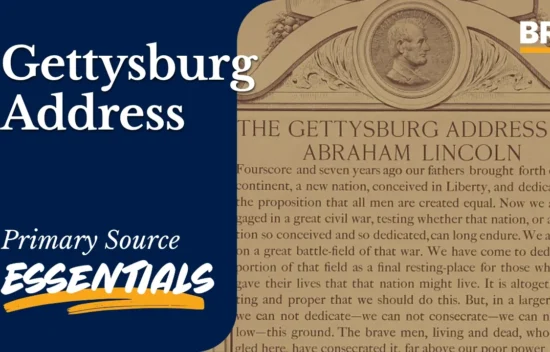
How did President Lincoln outline his view of democracy in the Gettysburg Address? In this rapid-fire episode of BRI’s Primary Source Essentials, learn how President Lincoln appealed to all Americans to preserve and fulfill the ideals of liberty, equality, and self-government. Discover the main points discussed in the Gettysburg Address and how this document showcased President Lincoln's view on democracy.

Explore the impact of the Vicksburg and Gettysburg battles.

How did Abraham Lincoln’s identity as a writer, speaker, and president related to the Gettysburg Address?

In this lesson, students will explore the role Colonel Joshua Lawrence Chamberlain played in the Battle of Gettysburg. Students will specifically learn about his actions on July 2 on Little Round Top and its significance to the Union’s overall victory in the battle.