Video
Founding Principles | Government & Politics: Civics for the American Experiment

Watch
Founding Principles
About this video
What are the founding principles that shape the United States? This video explores the foundational ideas that guide American democracy. Learn about the core principles of natural rights, limited government, and the importance of individual liberty and equality, as described in the Declaration of Independence
Learn how these principles are translated into the framework of the Constitution, including the separation of powers and the protection of individual rights
0:15 The United States of America. What is it? At its most fundamental, it is a country of free individuals organizing themselves according to certain rules that they have historically agreed to follow. Those rules are articulated in the Constitution. But to really understand that document and the government it outlines requires a deeper understanding of certain founding principles and civic virtues
0:38 that shape, guide and maintain our system of government. Understanding these ideas helps us better understand the country, its purpose, and how we can ensure it works for the common good. So what are principles? Principles are fundamental truths upon which other ideas are built. Think about a house, an office building, even a school.
1:00 When they are constructed, they first have a foundation laid. This foundation outlines the footprint of the building and supports the structure that is erected on top of it. Founding principles operate in the same way. They provide an outline for the purpose of government and establish guidelines for its proper use of authority. They’re drawn from an examination of human nature and offer possible
1:23 solutions to the challenges that emerge when people with all their diverse interests and beliefs work together for a common purpose. These founding principles are seen in operation and are two most important founding documents the Declaration of Independence and the Constitution. To better understand them, we’ve broken them out into a few different categories.
1:45 Natural and inalienable rights. Liberty, equality and justice. These principles are laid out in the Declaration of Independence. We are all equal and have equal natural rights, which means we’re equally entitled to liberty and justice. Government is formed to protect these rights because we are all equal and have equal natural rights.
2:08 We can only be governed by our consent, meaning the people control the government and select representatives. This means the government must be democratic and the people self-governance. However, for the government to remain just, laws must be based upon majority rule forged by consensus that preserves the right of the minority. This system of self-government is maintained through the rule of law
2:31 and due process. The rule of law means that all, both citizens and government officials, are accountable to the laws passed by elected representatives. Due process ensures that those laws are applied equally to all and the people’s rights protected. The structure of the Constitution maintains the system of self-government by controlling the exercise of government power to protect liberty.
2:55 The separation of powers and checks and balances work to ensure that no one branch of the government dominate, creating a stable regime governed by the people. Federalism is the division of authority between the national and state governments. Certain rights are explicitly protected from government in the Bill of rights. Freedom of religion. Speech.
3:16 Press, assembly and private property are essential individual rights and liberties. These rights are most fundamentally protected by having a constitutionally limited Republican form of government, But these principles cannot do this work on their own. The maintenance of the system requires habits of civic virtue. But unpacking those virtues will take another video.
3:38 See you there.
Standards
Related Resources

On June 7, 1776, Richard Henry Lee brought what came to be called the Lee Resolution before the Continental Congress. This resolution stated “these United Colonies are, and of right ought to be, free and independent states ...” Congress debated independence for several days.

The Constitution was written in the summer of 1787 in Philadelphia, Pennsylvania, by delegates from 12 states, in order to replace the Articles of Confederation with a new form of government. It created a federal system with a national government composed of 3 separated powers, and included both reserved and concurrent powers of states.
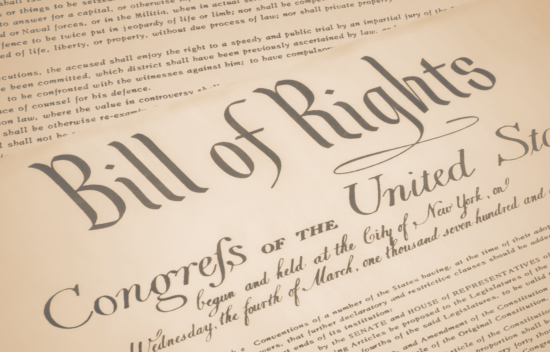
The first 10 amendments to the Constitution make up the Bill of Rights. James Madison wrote the amendments, which list specific prohibitions on governmental power, in response to calls from several states for greater constitutional protection for individual liberties.

Excerpts of John Locke's "Two Treatises on Government" and Baron de Montesquieu's "On the Spirit of the Laws " and Comprehension Questions.
Scaffolded excerpts of The English Bill of Rights, John Locke's "Two Treatises on Government", and Baron de Montesquieu's "On the Spirit of the Laws ".