Video
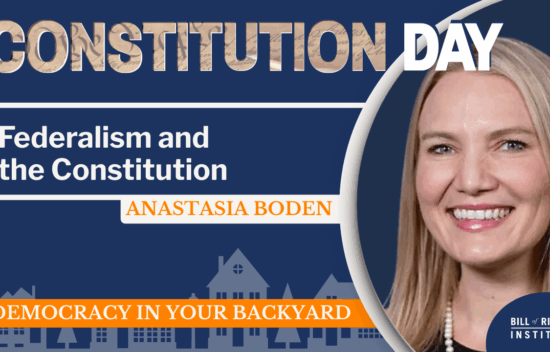
Federalism and the Constitution with Anastasia Boden | Constitution Day Live 2025
Watch
Founding Principles
About this video
How do state governments, federal power, and the courts shape our constitutional rights? In this Constitution Day conversation, Bill of Rights Institute’s Kirk Higgins sits down with Anastasia Boden, Senior Attorney at the Pacific Legal Foundation, to discuss federalism, individual liberty, and the critical role of the judiciary in protecting our rights.
0:00 Hello and welcome to our Constitution Day programing. I’m Kirk Higgins, vice president of content at the Bill of Rights Institute, and this year’s Constitution Day explores the idea of democracy in your backyard. Our conversations, especially in the Constitution Day, typically focus on the national government. However, our state governments are also part of our constitutional system and arguably have more of an impact on our daily lives.
0:21 School requirements, speed limits, business licenses, advertising regulations, all these areas, and so much more are shaped by laws passed by state legislatures. So what is the relationship between the state and national government, and how does this relationship shape our constitutional understanding? I’m fortunate to be joined today by Anastasia Boden, a senior attorney
0:41 with the Pacific Legal Foundation who is deeply and worked extensively in this area. Anastasia, thanks for joining me. Thanks so much for having me. So could you tell us a little bit about who you are and the work that you do with the Pacific Legal Foundation? Yeah, well, I am Anastasia Boden. I’m a senior attorney at PLF, and basically I sue the government when it violates people’s rights.
1:04 And, there’s not much more to it. You know, politicians come and go. We don’t really pay attention to who they are or what party they are. We stand for the principles that have long been embedded in the Constitution and its strong protections for individual liberty. You know, a government of, limited enumerated powers, separation of powers.
1:26 And we want to fight for those, whenever the government violates them. So that’s what I do. We represent everyone for free and it’s a dream job. That’s fantastic. So, you know, a lot of the work that I know you’ve have done has been at the state, not only the national level, but at the state level. But again, when people are thinking about the Constitution a lot of times to, just to get the national government,
1:47 why is it that the work that you all do in states is so critically important? Yeah, it is interesting. I think when people think about the way that our government is structured, they think about the federal government in our Constitution only having limited enumerated powers. And then, of course, under the 10th amendment, all the rest of the powers being reserved to the states.
2:08 But that doesn’t mean that states can do just anything. There are still limits on what states can do. And even though I think most people assume and the whole you know, one of the animating ideas of federalism is that states are more responsive to people’s needs because they’re closer to people’s needs. You know, the lower, level of government that you go down.
2:31 In theory, they are more responsive to the people, easier to access your politicians and have input and have, power. But in practice, you know, states and localities violate rights, too. And so it’s really important that we hold them accountable into the courts. And that can be under the federal Constitution, because even the federal Constitution has limits on states rights,
2:52 like states can’t do anything. And the Bill of rights, as your organization, you know, represents, has has very strong protections for individuals, even against states. But also state constitutions are an important source of limitations on state power. And so we bring lawsuits not just against the federal government, but also against states when when they commit wrongs as well.
3:15 That’s great. It’s good to know that there’s people out there that are looking after us citizens as things are taking place. So I guess, you know, I live here in Virginia. You know, why? Why would it matter to me, when a legal ruling is handed down in another state? Particularly one that that is a violation of an individual’s rights. Yeah. You know, what’s interesting is maybe it doesn’t, and maybe that’s a good thing.
3:37 You know, states have their own independent constitutions, that set different levels of protections for different rights. That’s a benefit of federalism is that, you know, you should be able to vote with your feet and go to the state that, that represents your values and what protections you want.
3:58 On the other hand, if it’s, a court decision, that would be brought under the federal constitution, you should care more because the federal Constitution sets a base level of protections for all Americans, no matter what state you’re in. And so you know, it depends on the nature of the lawsuit. In some cases, those those decisions are going to be purely local. In other cases, it’s part of the the debate when you have
4:21 these federal constitutional cases about, what’s level of protection under our Constitution, and it’s not about what’s going to protect us all. Great. So I guess along the same lines, and this is something we think about a lot at the Bill of Rights Institute, because we really teach from founding principles. And you were talking about sort of the principles of the Constitution that animate and protect our rights.
4:42 What is it? You know, what role, I guess, to do these different lawsuits within states have in shaping how it is that we collectively understand the role of government and its limitations? Yeah. I mean, I think like, as as I was saying, it’s sort of part of this nationwide debate of what we expect from our government. How much power it has and, and what rights
5:04 we have, and how we go about enforcing them. You know, one thing I like to, to think about with regards to these lawsuits is, sometimes people forget that the judiciary plays a very important role in our way of life. You know, they only see the executive very prominent role and how that can influence our lives.
5:25 They see the legislature, which is passing all of the laws. But the judiciary is an important backstop. When those two branches violate our rights and of course, the judiciary in the Federalist Papers is called the least dangerous branch, because all it can do is strike down laws. It can’t make laws. It doesn’t it doesn’t create new violations of rights.
5:45 It’s just a backstop. But just because it’s the least dangerous branch doesn’t mean that it’s the least important branch. In fact, I arguably it’s one of the most important because again, it’s that final backstop after you go to the legislature, they don’t listen you, they don’t care. They pass a law anyway that violates the rights. Or you have an executive that violates your rights in any which way. Well, then you have to go to court.
6:07 And so I think these lawsuits, really show how important is in our wonderful government of, of separated, powers, how important the judiciary is to, to making to holding people accountable and to getting people’s voices heard when they are too politically powerless to to get relief in other areas.
6:29 Yeah, I, I think that thinking about those different branches is so critically important in their different roles. And I think sometimes the judicial branch, in sort of our judicial processes seem like the, the, the least Democratic, in a sense. Right. Like, you don’t vote for judges. You don’t you know, not all of us are in courtrooms, probably as much as you are. But what is the individual citizens role in sort of understanding
6:52 what these lawsuits are and paying attention to the proceedings of, of, of these different court cases as they make their way through the system? Yeah. I think there’s a lot of roles that people don’t understand that they play on a daily basis. I mean, what the most obvious one is, we need plaintiffs to bring these lawsuits. And for many people, you know, they’re concerned about being a plaintiff.
7:12 They don’t know what that means in terms of, being in the public eye or potential retaliation. And it takes a really brave person to say that this is meaningful enough to them that they’re going to step out there and be that plaintiff. And so we need brave people like that. And unfortunately, the case is that a lot of times, these violations of rights are so important to people.
7:34 I mean, they threaten to take people’s whole livelihoods away, in some cases their children away. I mean, all sorts of these really meaningful, violations that do motivate them. But we need people who who will be our plaintiffs. Second of all, you know, I always say that that, you can’t make progress in the courts without making progress in the court of public opinion.
7:55 Undoubtedly. The the the public opinion softens the ground for these lawsuits. You know, I think it’s no secret that courts are concerned with their, institutional standing, with the public. And, you know, they only have power so far as the other branches
8:16 are willing to respect their rulings and and the public respects their rulings. And so there definitely is an interplay between, the court and public opinion. In some cases, it’s it’s very often and I think in, in some of the best cases, the courts that are leading public opinion, I mean, you think of Brown versus, Board of Education, you know, like sometimes the court has to be
8:36 the first to say, you know, democracy be damned. You know, you guys all want to violate rights. The whole population is has violated to, to, to violate some politically powerless minorities, individual rights. And the courts are there to step back against it. But in other cases, I think it’s it’s just
8:56 certain that without, public support, you’re not going to get, good decisions in the courts either. Yeah. That’s great. And yeah, I think I, I think you’re right. It’s just so critically important that people understand, starting with an understanding of their own rights so that they can understand, too, when the government is taking steps that that it ought not be.
9:17 And then, yeah, for us, you know, we think a lot about the civic virtues, too. And in that civic virtue of courage, I think, is one that’s really important. So, honestly, it’s been great talking to you. I would also just love to know, you know, your plugged in far more than we are. What cases are coming down the pipe that you’re really excited about or, or I guess, really interested in seeing kind of where it goes.
9:39 And why do you think that they’re significant? Yeah. Well, Kirk, I have, you know, as we were talking about a few, within states that are more at the state level and some that I think present the opportunity to do real work at the federal level. I could point out a few. One would be we are representing a nonprofit in Arizona that simply wants to feed the homeless.
10:01 We actually have two cases of this nature where people were actually thrown in jail or arrested for handing a homeless man a burrito. We think that’s unconstitutional. We think that, people have a fundamental right to engage in charitable acts, so long as they’re not hurting anybody. Certainly these these people are not hurting anybody. They’re trying to step up in their own community, make their community better.
10:21 They leave every place that they go better than they found it. And yet the government is saying that they need permission first. And in a lot of cases, that’s going to be a very costly, expensive permit that makes it prohibitively expensive to do this work. And so we have two claims there. One is that this violates the First Amendment because these people are engaged in expressive conduct.
10:42 They’re very often, sending a political message. And, I think this is really all interesting stuff because it has to do not just the First Amendment, but with other unenumerated liberties like the right to charity. And so you can see how this can really open up in the courts, something that people take for granted, which is that some, some rights are given
11:04 very privileged treatment, in courts, while other rights are just given short shrift. And we want to kind of show how arbitrary it is and how all rights are really related. And some cannot be exercised without others. And so, all of these rights deserve protection. But anyway, those two lawsuits would do some real work at the local level, just allowing people in their own community to step up and make their community better.
11:28 I think that’s something that everybody should be allowed to do. We also have a lawsuit where we want, physical therapists to be allowed to engage in, transactions, cash transactions with Medicare beneficiaries. It’s a little bit complicated, but suffice it to say that most medical professionals can,
11:48 provide their services to Medicare enrollees just on a cash basis. So even if, if you’re in Medicare, if you want to see some provider who’s not Medicare, you can go pay them cash and you can get that service. Physical therapist, for some reason, are not allowed to do that. If you’re a physical therapist and you’re not a Medicare, provider, you can’t just, you know, accept a patient.
12:10 So we have we have a client who is constantly he has people coming up to him and asking him for his services. He’s a very well respected physical therapist, and he’s forced to tell them, no, we think this is an excess of Congress’s commerce power. The interstate Commerce Clause says that Congress can only regulate commerce among states.
12:30 These local transactions, these consensual transactions between a physical therapist and people in their community who don’t have other options and just want to pay cash for his services, that’s a local transaction that states can regulate, but not Congress. And so we really want to restore, I what I would say is the original meaning
12:51 of the interstate Commerce clause to say that Congress is limited in what it can do. It needs to be only regulating things that are truly interstate in nature, and it needs to leave local decisions to localities and states who are the proper people to be regulating these things. But we should federalize, all criminal law or all law at all. So those are two cases that I’m really excited about.
13:14 You know, we have really great clients who again, they just they just want to make their own community better and engage in consensual transactions without harming anyone. And so I think restoring those basic constitutional freedoms is really, motivating and invigorating to me. And, I’m excited about it. Yeah absolutely. And I’ll say, just, you know, as I’m sure for our audience watching, you know,
13:36 I think these are just great examples of how it is that our Constitution adapts and changes and evolves over time. It requires conversation and deliberation and litigation, and all of it is part of the natural process that we have the opportunity to do because of our constitutional system, which is something we shouldn’t take for granted. And it’s it can be slow and it can be painful,
13:59 but I sure appreciate people who engage in it, because I think it’s the way that we continue to hold ourselves accountable to these constitutional principles and help advance, and ensure that that our Constitution continues to to work and defend, you know, the rights of, of the people. So honestly, just thank you so much for joining me today. It’s been a great privilege. And I’ve learned a whole lot. So thank you so much. Thanks so much. Happy Constitution day.
14:21 Happy Constitution day.
Viewing Guides
Standards
Related Resources
How does the Constitution’s design protect our rights when the government oversteps its power?
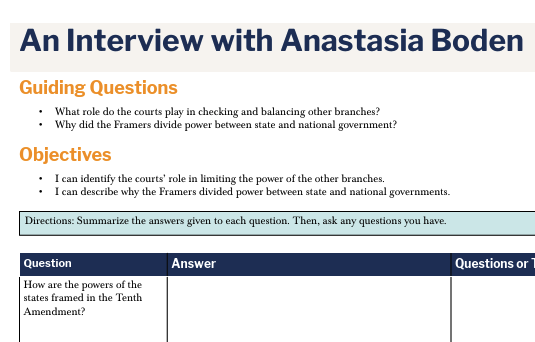
A student guide to accompany the "Federalism and the Constitution" video.

The Constitution was written in the summer of 1787 in Philadelphia, Pennsylvania, by delegates from 12 states, in order to replace the Articles of Confederation with a new form of government. It created a federal system with a national government composed of 3 separated powers, and included both reserved and concurrent powers of states.