Video
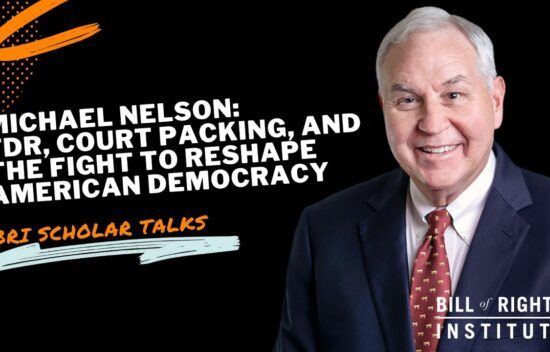
FDR, Court Packing, and Reshaping American Democracy with Michael Nelson | BRI Scholar Talks
Watch
Founding Principles
About this video
In this episode of BRI Scholar Talks, political scientist and author Michael Nelson joins host Tony Williams to explore Franklin D. Roosevelt’s court-packing plan and its significance in the history of American constitutional government.
Drawing from his book Vaulting Ambition: FDR, His Campaign to Pack the Supreme Court, Nelson examines how the proposal to expand the number of Supreme Court justices reflected a broader effort to shape the direction of federal institutions during a pivotal time in U.S. history. The conversation covers FDR’s leadership style, the reactions from Congress and the public, and the long-term impact of the plan on presidential power, party dynamics, and the balance among the three branches of government.
0:06 For this episode of Scholar Talks, the guiding question is how is FDR’s court packing plan part of an attempt to transform American constitutional politics? Our guest, Michael Nelson, is former professor of political science at Rhodes College, and he’s the author of several seminal books on the American presidency and politics, including Vaulting Ambition, FDR,
0:30 His Campaign to Pack the Supreme Court, which we will discuss today. I am Tony Williams, senior fellow at the Bill of Rights Institute, and I want to welcome you to another episode of Scholar Talks and the America to 50 series. Michael, I want to thank you very much for joining me. Oh, it’s my great pleasure, Tony, and thanks. You know, I thought I was going to get a great book on, in the University
0:55 Press of Kansas, landmark presidential decisions on court packing, under FDR. But it was really so much more than that. I mean, in about way about 87 pages or so. It looked very broadly, at FDR, and politics and the constitutionalism related to all the branches.
1:15 So just a remarkable achievement in such a short book. Well, thank you. You know, there’ve been there have been any number of excellent books about his effort to pack the Supreme Court, but very few of them sort of embed that in a larger strategy, which was essentially to, embed all of the institutions of American government and politics
1:36 into a long term commitment to his New Deal policy and into their recreation of the Democratic Party as the governing party. And, that’s what was exciting about this book, was the step back from the, all the, ins and outs of this fascinating story of court packing and embed that still fascinating story in the larger,
1:57 fascinating story of FDR, his effort to really, rewrite constitutional government without changing a word in the Constitution itself. Right. Well, that leads me to my first question, Michael. So how did FDR as career packing plan fit into his larger attempt to transform the legislative, executive and judicial branches as well as the Democratic Party?
2:20 As you mentioned, it was? And, you know, we talk about the executive branch and think about it, of that as the presidency. But obviously, the president is sits atop a very large and elaborate set of executive departments and agencies. And what FDR found was that after or after Republican presidents had been in office for 12 consecutive years, and really, most of the previous,
2:44 one third of a century, that the bureaucracy was sort of filled with with conservatives, with people who weren’t really interested in innovation. And so part of FDR, his goal, was to take over the effect, the executive branch on behalf of, of, of himself and the presidency, increasing the size of the white House staff,
3:04 making all of the independent agencies and commissions, and, and the bureaucracy accountable to the president per se. He also went after Congress, which admittedly was was overwhelmingly supportive, but he wanted to be overwhelmingly supportive over a long period of time and really wanted the
3:25 the legislative branch to be in his image, plowing in the same direction as the president. And to facilitate that meant really making his mark on the Democratic Party, which at the time was filled with a lot of conservative Southern Democrats. So FDR, his project was really to not just,
3:46 take over the courts, if you will, but to do that as part of the overall, Washington establishment. Right. Yes. Very transformative. Across the board, attempt. So FDR achieved quite a record in his first term. And so how does he see this massive
4:06 landslide in 1936 as a, as a mandate to pursue his vision of political transformation? It’s interesting because the first term was consumed with, addressing the economic despair and dislocation caused by the Great Depression, which he inherited and, and was able to
4:29 involve the government in many more aspects of economic and social policy during the first term, and was rewarded for his first term achievements with, with a, oh, a landslide of almost epic proportions. He carried 523 electoral votes compared to his opponent’s 80 electoral votes.
4:49 Congress ended up being three fourths Democratic. The thing is, though FDR, his campaign in 1936 was almost all backward looking. Meaning he was asking voters to say, how do you like the way the last four years have gone? And the vote that they gave him was an endorsement
5:09 of what he had been doing since the beginning of his first term. He really didn’t do anything in the campaign to kind of lay the groundwork for what became his agenda at the start of the second term, which was to, as I mentioned earlier, to kind of restructure the major institutions of American government and law and politics. And so when he when he launched his court packing, effort,
5:35 less than, a month into his second term, when he launched his executive reorganization effort at about the same time, it took almost everybody by surprise because this isn’t something that he even hinted at, during his first term. Right. And so I guess we should talk about, that
5:56 the topic that that plan, what was court packing? And, you know, why did why did FDR. Well, the the nine justices of the Supreme Court at that time, again, think about Republicans as having been in power for almost all of the 20th century prior to them.
6:16 And and over time, choosing a court that was, on balance, quite conservative. And so and during his first term that that court was resisting some of FDR, his legislative initiatives, he saw it as as kind of an obstacle, a barrier on the road to progress.
6:37 So what do you do if you if you feel like you’ve got a Supreme Court that is going to resist you at every step of the way? And they have life long terms and, you can’t sort of schedule vacancies. His proposal to Congress was to authorize the president him to appoint six additional justices.
6:58 So to go from 9 to 15, those six corresponding to the six justices currently on the court who were 70 years old or older. And so this in itself was was an astonishing approach to packing the court, as it soon got to be known. But it, it took everybody by surprise and, and and what,
7:20 what made it even worse politically from FDR standpoint was he said that his motive was not to remake the court in a way that would be sort of sympathetic to the New Deal. That is that really what he was motivated by? It was by a desire to sort of help these elderly justices do their work by giving them six new, colleagues, which was transparently false
7:43 and easily refuted. Chief Justice Hughes, was able to document very quickly, we are on top of our our of our agenda. We are we’re not we don’t need any help at all. In fact, more justices would, would create more sort of more logjams in, in our work, and so he launched this not
8:03 only with no groundwork having been laid during his reelection campaign, but in a way that struck people as not only unprecedentedly aggressive, but also selling it in a way that seemed transparently phony. So yeah. So he had the court had invalidated, the, the NRA, the NRA, the major industrial, reform,
8:28 you know, for, for business reform also, the Agricultural Adjustment Act. So it, so it seemed like, I think you mentioned in the book he was really worried about, major programs like Social Security, and it was and there was reason to be worried. But, some of his, advisors in the white House and in the administration and some members of Congress were saying the thing to do.
8:51 If the court has been saying that the government doesn’t have the power under the Constitution to do the things that that you want us to do, then amend the Constitution. And with three fourths of the House and three fourths of the Senate and certainly a strong majority of state legislatures, that would have been kind of the the obvious way to go.
9:15 But for FDR, he was convinced that, somehow big money would keep any amendment from being enacted. And he was also convinced that these nine justices were so determined to resist him that none of them would retire. They would they would hang in there until their last gasp.
9:35 And it was an entirely, a ridiculous thing for him to fear because no justice had retired during his first term. And certainly, you know, there was no, no, no obvious way for him to make existing justices retire or die, to be blunt.
9:57 But what he could do is sort of appoint enough new justices to outnumber the the old ones. But that turned out to be, an ineffective approach. Right. And just as a quick follow up, there’s a funny little quirk in there, too, that, I think you said that the justices maybe didn’t have a pension or didn’t have enough retirements. Oh, gosh, they couldn’t retire.
10:19 You know, the word got that there were a couple justices, Louis Brandeis, for example, who were on the court who were pretty liberal and sympathetic to the to the New Deal and kind of got word through back channels to FDR. You know, a couple of my colleagues, would love to retire, but they can’t afford to because the pension for Supreme Court justices is so pathetically low.
10:41 Why don’t you just bump up the pension and then then you’ll get enough retirements for you to appoint enough people out of without having to change the number of justices? Well, FDR had really sort of bought into the idea that these Supreme Court justices were were out to get him and, wasn’t open to anything other than just a,
11:02 a frontal assault. Gotcha gotcha. I guess this is something you alluded to, which I think is really fascinating. You seem to argue that that he did a very poor job in terms of presidential leadership, with Congress, with the American people, even with and within his own administration’s own cabinet in terms of laying the groundwork, building support for the plan.
11:25 Can you talk a little bit more about that? Well, you know, just consider the way members of leaders of Congress who were Democrats, who wanted to see him succeed. But, the first they learned, about this plan was when FDR told them about 15 minutes before saying, I have to go because I have to meet the press and tell them about the plan.
11:47 So, you know, he has Congress is Democratic. And yes, Congress wants to support the president, but to treat them as almost like a rubber stamp was insulting, unnecessarily insulting. He gained nothing from that. And then to go to the country, as I said earlier, and pretend that this plan was designed to help the justices on the Supreme Court rather than to,
12:11 marginalize those who are opposing him. It just it it just it didn’t pass the smell test. All right. So speaking of that smell test, let’s talk about that. So what was the response to, the court packing plan and what effect of this have on American politics, on American constitutionalism? You say they saw right through it?
12:32 Yeah. Well, the response was it never even came to a vote. That’s how how clear it became over time that Congress was not going to pass this. It also called into serious jeopardy his efforts to to get Congress to pass an executive reorganization bill that would enable him to extend his control over the executive
12:54 branch and also caused a lot of Democratic voters and concerns in southern states to vote for Roosevelt opponents within the Democratic Party rather than, supporters. In other words, the failure of court packing sort of undermined his entire agenda of trying to,
13:15 take control of the major institutions of American government. If we, you know, if all we had from FDR was his second term, we would think he’d been a failed president. But we do have, of course, as his first term. And then with the coming of of World War Two, his third term. And when we think about FDR as a great president, it’s because of
13:35 what happened during those terms, not the term that came in between that century. So, so seeing to, to, sort of, you know, rouse, a coalition if you are some kind of conservative, a coalition among Democrats and Republicans in that, you know, sort of the the New Deal reforms are largely over by this point.
13:56 That’s right. I mean, one of the consequences of the court packing proposal to Congress was that Republicans and conservative Democrats from the South found themselves on the same side and really stayed on the same side for decades to come, known as the conservative coalition, conservative Republicans plus conservative Democrats.
14:17 Whereas during his first term, FDR pretty much had a united Democratic Party, he no longer had that right. And another follow up unit, I think you talked about, there was even some talk at the time that like, well, this is, you know, this this sort of grab at executive power, this sort of blatant kind of tampering with the case when people, people were tossing around the term, dictator.
14:40 And not that I am, but people are no. Yeah. You’re exactly right. And, you know, and then when after our first took office in and elected in 1932, dictator was not yet a bad word. And in fact, liberal pundits like Walter Lippmann said we need the president to become a dictator to get us through this crisis of depression.
15:04 But as the 30s unfolded, the horrors of of Nazi Germany, Fascist Italy, Stalinist Russia became apparent. And so any effort by a nation’s executive, in this case the president of the United States, to, amass more power
15:25 could sort of resonate with, well, this is he trying to turn the United States into into a dictatorship like the ones that we see doing appalling things in Europe? Well, a fascinating dive into to the history, of, of the New Deal and FDR and, and these constitutional and institutional arrangements. So, Mike, I want to thank you very much for coming on to discuss your new book
15:48 with us. It’s been my pleasure to be on it. And thank you all for joining us. And please check out the other videos in our America 250 series on our channel, and please subscribe. Thanks.
Standards
Related Resources

By the end of this section, you will explain how the Great Depression and the New Deal impacted American political, social, and economic life over time.

What is bureaucracy? Explore primary sources that show how two former presidents supported the idea of the large federal bureaucracy.

What is bureaucracy? Scaffolded primary sources that show how two former presidents supported the idea of the large federal bureaucracy.