Video
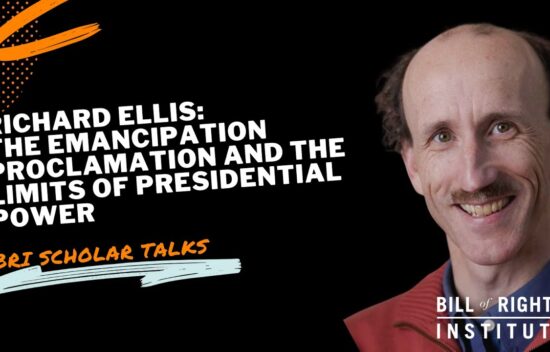
Emancipation Proclamation and Limits of Presidential Power with Richard Ellis | BRI Scholar Talks
Watch
Founding Principles
Liberty, Natural/Inalienable Rights, Due Process, Separation of Powers
About this video
How did the Emancipation Proclamation define the limits of presidential power? In this episode of Scholar Talks, Tony Williams, Senior Fellow at the Bill of Rights Institute, is joined by Richard J. Ellis, Marco Hatfield Professor of Politics at Willamette University, to explore insights from his book, Lincoln’s Last Card: The Emancipation Proclamation as a Case of Command.
0:05 In this episode of Scholar Talks, the guiding question is what did the Emancipation Proclamation reveal about the limits of presidential power? Our guest, Richard J. Ellis, the Marco Hatfield Professor of Politics at Willamette University in Salem, Oregon. He’s the author of eight books, including Lincoln’s Last Card
0:28 The Emancipation Proclamation as a Case of Command. I am Tony Williams, Senior Fellow with the Bill of Rights Institute. And I want to welcome you to another episode of Scholar Talks in Our America 250 series. Richard, I want to thank you very much for joining us. Thanks for having me. Thanks. You know, I really love your book.
0:50 It’s part of the University Press of Kansas Landmark Presidential Decisions series that just started. And it’s just this great series of books, about 80 to 100 pages or whatever. And, you know, the the, examining the Emancipation Proclamation in the way you did was, was very compelling.
1:13 I learned a lot. And, it’s just it’s just such an important topic that I’m so glad you’re on. Thank you. Thank you. It’s a great series. Mike Nelson is the series editor, and he’s done a wonderful job. Right, right. Yeah. We worked at, Mike Nelson, before on our government politics textbook that’s coming up. So,
1:33 so, let’s dive right in and, start looking at some of the, challenges, that Lincoln faced for, for emancipation. So when the Civil War started, how was Lincoln’s revocation of Fremont’s emancipation order related to Lincoln’s
1:55 view of the rule of law and presidential restraint, Congressional authority over slavery rather than what his critics accused him of dictatorship. Yeah. I guess the first thing I want to say about Lincoln’s nullification of Fremont’s emancipation order is what it reveals
2:17 about presidential weakness, which is the theme of the book. And, on paper, of course, Fremont is the commander in chief, subordinate. Yet here he is declaring, without first checking with the president or anybody else in the administration, that every slave of a disloyal owner
2:39 in Missouri was freed forever, an edict that’s at odds with the president’s own goals and congressional policy, which is laid out in the First Confiscation Act that authorized the military to confiscate but not permanently liberate
3:00 slaves, and only those slaves that are directly employed in the Confederate war effort. So despite this rather brazen act of insubordination, Lincoln doesn’t immediately fire Fremont or even countermand the order.
3:21 Instead he first tries to persuade Fremont to reverse the order, and only when Fremont refuses does Lincoln finally command that the order be modified. To comply with congressional policy.
3:43 And even then, he doesn’t fire him. He waits several months before firing him and fires him for different reasons. Lincoln’s directive comes at an enormous political cost. Command comes with a cost. And that’s one of the themes of the book. We don’t have polling data from the 1860s, of course, but
4:08 the White House mailbag overflowed with condemnation, denunciations. And those criticisms came from a broad array within the Republican Party who were really wanting to stick it to the rebels and the traitors. And so, given the popularity of Fremont’s order and the huge political hit
4:32 Lincoln takes for reversing it, the puzzle is why. Why does he reverse the order? And I think this gets us to your question, and I think the answer is Lincoln’s reasons for doing it, or a combination of strategy and principle. The strategic part is well known. He’s worried about losing the border states, especially Kentucky.
4:57 Which had well over 200,000 slaves. And it’s the nation’s ninth most populous state, the only state in the Confederacy that has more people than Kentucky is Virginia. And at this moment in time, Kentucky’s legislature seems ready to side with the union,
5:17 after months of, neutrality policy. And so, in Lincoln’s view, losing Kentucky is, as as he put it, nearly the same as losing the whole game. And Lincoln calculated that Fremont’s order was less likely to punish the rebels than ensure their victory.
5:40 And the other reason this gets even closer to your question was principled. At the time. Lincoln believed that while military necessity could justify the seizure of property, including slaves, for military purposes.
6:01 The question of permanent emancipation was what he called a purely political question. And that could not be made by proclamation, but had to be dealt with through the legislative process. And Lincoln told his friend, Illinois Senator
6:24 Orville Browning, who was among those sharply critical of the of the reversal, that allowing Fremont’s order to stand would be itself the surrender of government. It would be tantamount to dictatorship and a betrayal of the principles
6:46 of democratic government that the nation was fighting to uphold in the civil war. Right? Yeah. And you mentioned the border states, Kentucky and, you know, in early 1862, why why is Lincoln so concerned about the border states and why does he he push on them and offer
7:08 this gradual, compensated emancipation to them? Yeah, the short the short answer to that first part of the question, as I’ve already indicated, is that at this stage he believed, rightly or wrongly, that if he lost the border states, Kentucky, Missouri, Maryland, the North would lose the war.
7:28 And he believed that with the border states, it was possible to bring about a quick end to the war about that he was wrong. But I don’t think the fear of losing the border states, or even the hope of bringing a speedy end to the war fully explains his offer of gradual, compensated emancipation.
7:52 Instead, that offer reflects what I think was in fact Lincoln’s preferred plan of action, which was gradual, compensated emancipation with voluntary colonization of blacks, that is, self emigration. As the chaser
8:12 Lincoln preferred gradual emancipation because he genuinely believed that it would be better for the nation in the short term and in the long term, if the end of slavery was achieved gradually and through persuasion, rather than suddenly and by force or unilateral edict.
8:34 And he preferred compensated emancipation, involuntary colonization, because he believed that without those pieces, the slave owners weren’t going to accept gradual emancipation. And relying on this kind of grand bargain. Also sidestepped the thorny constitutional question,
8:55 and potential court challenges that could come with more precipitate actions. For me, though, the most striking thing about Lincoln’s plan is how little headway it made. Indeed, the more the president tried to persuade the border states, the stiffer their opposition became.
9:18 And despite all of his famed eloquence and careful argumentation, Lincoln was unable to get the border state representatives to do what he wanted them to do, and which he sincerely believe was in their best interest.
9:39 He first floated the idea of gradual, compensated emancipation in November 1861, in Delaware, a state with relatively few states, few slaves, less than 1800,
10:00 in a state of over 100,000 people. If it was going to work anywhere, it would be in Delaware, in a state that 15 years earlier had come within a single vote of providing for the gradual emancipation
10:21 of slaves. So Lincoln assured his Delaware allies that he was very flexible about time frame for phasing out slavery. He preferred 30 years. He would take five. They ended up on ten. But that plan went nowhere, because even in Delaware,
10:47 people that were opposed to slavery didn’t want freed blacks as neighbors. And really, that plan failed as early as February of 1862, and that should have been assigned to Lincoln, that it wasn’t going to be successful. But he continued to try to press
11:08 the border states to adopt his plan. And while I suppose it’s hard to fault Lincoln for trying, I think it is fair to say that he was stubbornly slow to recognize that border state representatives
11:28 just weren’t going to accept this policy, no matter how persuasive, no matter how persuasive Lincoln was or thought he was. Right right. So speaking of, persuasive, you question the view that Lincoln had this methodical approach where he laid out the groundwork
11:49 carefully for emancipation by preparing public opinion. And so, why don’t you call it that failure to persuade and you even call it right in the title of your book, Lincoln’s last card. Right right right. Well, it was Lincoln himself who called the proclamation his last card.
12:12 By that, I take him to mean that he recognized that his efforts at persuasion had fallen on deaf ears, and falling back on the power of command was a recognition that his persuasive efforts had failed. I think it’s tempting to
12:33 remember our greatest presidents as somehow playing four dimensional chess. You know, running rings around the heads, of lesser politicians. But the reality is that during the first two years of the war, Lincoln engaged in a lot of unhelpful wishful thinking.
12:57 Not only about the border states willingness to accept gradual emancipation, but also the receptivity of blacks to his ideas about colonized nation and the extent of Unionist sentiment in the South. Lincoln’s timing in issuing the preliminary proclamation wasn’t great.
13:20 In September of 1862, just two days before he’s going to, announce the proclamation suspending the writ of habeas corpus, which allowed it to be framed in terms of dictatorial despotic rule.
13:41 And, of course, it was also just right before the fall elections in October and November, and the Republican Party got beat pretty badly. The Emancipation Proclamation was not the only reason for that, obviously.
14:03 But it was a factor in that. And I think in general, I think it could be said that Lincoln’s public statements, often confused the public and other political elites about his position on slavery.
14:25 And it did more it did more to confuse them than really prepare the ground. Let me give you one example. The state of the Union message that Lincoln delivers right at the beginning of December 1862, which is just a month before he’s going to unveil the final proclamation on January 1st, 1863. That message barely references the proclamation,
14:47 and instead it doubles down on his often rejected plan of compensated emancipation. And he does it in the form of three constitutional amendments. One is, pledges, compensation for slave holders. The second says that
15:11 slaves, freed by the chances of war, what he called the chances of war would be emancipated. And, if they belong to disloyal slave owners. And the third was funding voluntary colonization of freed blacks. Almost every member of Congress had the speech.
15:34 They hated the ideas. And Lincoln’s professional reputation in Washington took a real hit then. That was it was already in bad shape after the fall elections. And lots of people were wondering, is Lincoln going to not, in fact, announce the Emancipation Proclamation?
15:57 And in any event, the most important factor in preparing the ground for the Emancipation Proclamation was not what Lincoln said or didn’t say, but how the Union Army fared. And the worst the Union Army did. And the longer the war dragged on,
16:17 the more receptive people were to the argument that emancipation, by depriving the South of the labor force on which its economy depended, was the only way to win the war. So I think events, more than anything, Lincoln said,
16:39 was what moved public opinion. And I do want to say, I don’t want to minimize the meticulous attention that Lincoln did pay, to how his unilateral order, the Emancipation Proclamation, would be received by the public and by political elites.
17:01 He remained profoundly unsure whether the people, as he put it, were educated up to accepting the proclamation. And indeed, it’s a major part of the argument of the book that Lincoln understood that simply issuing an Emancipation Proclamation order was not sufficient.
17:21 Unlike some anti-slavery advocates who just wanted Lincoln to say the right words and that that would somehow rally all the forces of righteousness, I think perhaps better than anyone, Lincoln understood that it didn’t do any good to command if people wouldn’t follow.
17:43 And so, even in the case of unilateral action, Lincoln understood that public opinion was, as he said, everything. And as Richard knew that, the political scientist who sort of inspired the approach I’ve taken in this book said that command is but a method of persuasion,
18:06 not a substitute for persuasion. Okay great. That is a great segue to my next question, because Lincoln had to deal with, a lot of criticism from a lot of different angles. And just there were a lot of complexities to creating the emancipation Proclamation. So why did Lincoln frame the preliminary
18:28 and the final Emancipation Proclamation in the way that he did? Yeah. To to critics, one of the most striking aspects of the framing of the proclamation, in both its preliminary and final form was its
18:51 narrowly legalistic language. Richard Hofstadter famously criticized the proclamation for having all the moral grandeur of a bill of lading. And so why did Lincoln do that? Obviously, Lincoln was perfectly capable of soaring rhetoric when the occasion demanded it.
19:13 I think the Gettysburg Address or the Second inaugural. Yet in the proclamation, he avoided that kind of rhetoric almost entirely. He did at the very last minute, with the greatest reluctance, consent to add Salmon Chase’s language about it being an act of justice.
19:36 But Lincoln strongly believed that the proclamation should not rest on the idea of justice, which he feared the courts might reject, but on the grounds of military necessity. And the constitutional power vested in him as commander in chief.
19:57 That reliance on military necessity, ironically, was rooted in an acknowledgment or anticipation of the vulnerability of the president’s position vis a vis the judiciary. Another aspect,
20:18 that’s often criticized about the presidents proclamations final framing by Hofstadter, among others, is the limitations on where it applied. Specifically, that applied only to those areas of the country that were beyond the Union Army’s reach.
20:42 And, Lincoln exempted the border states for obvious reasons. Really? Nobody except for, some abolitionists were really believed that Congress had the authority to abolish slavery in states that had never seceded, so that was really never, you know, an option.
21:03 But there were a lot of gray areas that Lincoln had to decide on in the final proclamation. Take Tennessee, for instance, where the Union Army controlled much of the state. Confederates controlled other parts of the state. And in the preliminary proclamation issued in September,
21:28 which followed on Congress’s instructions in the second Confiscation Act, Lincoln stipulated that states would no longer be considered in rebellion if they held congressional elections, and thus they would be exempt from the Emancipation Proclamation. But in Tennessee,
21:50 only about a quarter of the state had elected congressional representatives. Yet Lincoln chose to bow to the wishes of Tennessee Unionists, and most importantly, the military governor, Andrew Johnson, and exempt the entire state.
22:10 So Lincoln’s emancipation Proclamation chose to keep Tennessee’s 275,000 slaves enslaved, and that he did so. It is a reminder that the Emancipation Proclamation was not a magic wand that wiped away
22:33 the need for political bargaining and compromise. Yes, the proclamation was about emancipation, but it was also about doing what the president deemed necessary to build support for the proclamation and to advance the Union war effort.
22:56 Yeah. Wow. There’s a lot in there. So, the final question is, relates back to the guiding question is what did the Emancipation Proclamation reveal about the limits of presidential power? Okay. Yeah. One of the things I tried to show is that the proclamation was not really Lincoln’s alone.
23:20 The president wielded the pen, but the proclamation was also a product. Of the input of cabinet members, concerns about the court pressure, campaigns from politicians and groups, public opinion,
23:42 the actions of slaves themselves, freeing, fleeing to Union lines, and especially in Congress, notably the Second Confiscation Act, which was passed in the summer of 1862, which declares that any Confederate slave who came within the Union Army’s control would be forever free.
24:06 That those are the words they used. So it was in many ways Congress and not the president, certainly not the president. Acting alone, that made universal emancipation in the rebel states the government’s de facto policy. In issuing the proclamation, Lincoln is in many ways complying with the will of Congress
24:31 more than he is asserting his own policy. I think among the most interesting limits of presidential power are revealed in what happens after the president, issues the proclamation. For starters, there was not instantly full compliance
24:55 with the proclamation in every theater of the war. And even when generals and soldiers wanted to implement the order, as they mostly did. The problem was that the Union Army, and this is something that historian Jim Oakes has emphasized. They lacked enough soldiers to physically reach
25:18 and emancipate more than a fraction of the huge numbers of slaves across the South. It really is a vast empire of slavery. 10,000 freed slaves marched with Sherman’s army, but that touched only
25:39 a sliver of Georgia’s half million slaves. When Robert E Lee surrenders in April 1865, around 86% of the Confederacy’s 3.5 million slaves are still enslaved. There really isn’t
26:00 this irrevocable logic that led from the Emancipation Proclamation to the end of slavery. Without Republican victories in the presidential and congressional elections of 1864, and obviously without the union’s defeat of the rebels, slavery
26:22 would have remained entrenched throughout the South, and many of those supposedly freed by the proclamation would have been enslaved. Again, the proclamation is, of course, a vital part of the story. But it wasn’t the beginning, and nor was it the culmination of the wartime effort
26:44 to end slavery. It wasn’t the proclamation, or at least it wasn’t the proclamation alone that made Lincoln the Great Emancipator, but rather it was his subsequent work which involved lots of persuade, union, and bargaining
27:05 that ensured that the proclamations words didn’t just remain words. Lincoln instinctively grasped new starts, teaching that issuing a command is not the end of polity, but the beginning of it,
27:26 and that proclaiming slaves, as Lincoln told some visitors on the eve of announcing the proclamation proclaiming slaves free didn’t make them free. To me, the most important punch line, is that
27:47 Deifying Lincoln as the Great Emancipator and canonizing the Emancipation Proclamation does a civic disservice by training citizens to look to the president and his unilateral powers for easy solutions
28:10 cast in bold, dramatic strokes. It’s a myth that nurtures, presidency centric view of our politics. And one that stokes unreasonable expectations
28:32 about what can be achieved through unilateral presidential action. I think it invites across his cycle of disillusionment, as especially as contemporary presidents fail to measure up to this myth of unilateral deliverance.
28:55 And maybe most dangerously, is it encourages presidents to believe that rule by edict can take the place of genuinely democratic leadership. I think ironic, Lee, it’s
29:15 this mythology of Lincoln obscures what Lincoln himself knew. Well, that unilateral action isn’t a substitute for the hard work of political leadership, of winning elections, mobilizing supporters, cajoling doubters,
29:37 bargaining with peers. I think the punch line for me is that Lincoln understood that presidential power, as Richard knew that famously put it, is the power to persuade. Right. Well, that is a great note
29:58 to end on something we’ve addressed with many scholars like Mark Rozell and Steve Not and Jeremy Surry and many others. Right on this show. So, Richard, I want to thank you very much for joining us to discuss this important and relevant topic. And congratulations on the book. Thank you very much. And thanks for having me.
30:19 I really appreciate having the time to talk with you. Thanks. And I’d be remiss if we didn’t, say happy birthday to Mr. Lincoln, because this will air, on his birthday. So so happy Lincoln’s birthday and Presidents Day coming up. So very good. Great. And thank you all for joining us on this episode of scholar Talks.
30:39 Please check out the other interviews in our America 250 series.