Video
Documenting Disaster: Dorothea Lange’s Photographs of the Dust Bowl | BRIdge from the Past
Watch
Founding Principles
About this video
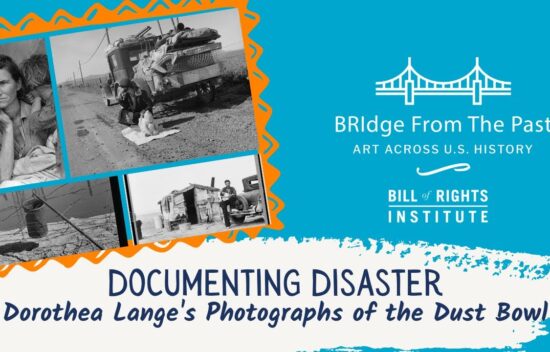
Starting in 1931, a long drought and high temperatures in the Great Plains triggered a disaster commonly referred to as The Dust Bowl. In this video, Mary looks at photographs by photographer Dorothea Lange documenting this challenging time. How can images give us an understanding not only of an event but of the men and women who lived through it?
0:04 Hi everybody. Welcome to another episode of Bridge from the Past. Art Across US history. I’m your host, Mary, and today we’re looking at the Great Depression through the lens of the photographer Dorothea Lange. What can her images tell us not only about this time, but the men and women who lived through it? Let’s jump in. Typically, the 1920s referred to as the Roaring 20s when we talk about US.
0:27 History. But for many small farmers this wasn’t the case. The 1920s was actually a time of struggle. And when the Great Depression hits, it only exacerbates a difficult situation. In the Great Plains, decades of intensive farming, a long drought and record high temperatures set off another disaster known as the Dust Bowl. What I have on the screen here are clippings from newspapers dating from 1935
0:52 to 1942 that talk about the destruction of this Dust Bowl. So you can see they’re deferring to dust storms going from Kansas all the way to California. I see black blizzard planes are making forced landings. I see that it’s putting people in the hospital. So it’s a terrible disaster that’s affecting a pretty large area of the country.
1:14 So just by way of background, the Great Plains is this area west of the Mississippi River and east of the Rocky Mountains. And it’s a prairie. So it has native prairie grass that hold the soil down. So these decades of intense farming pulled up the grass so the soil was loose. So the winds that naturally occur on the prairie, coupled with the high
1:34 temperatures, coupled with the drought meant that these storms of dust were really becoming more frequent and increasingly deadly. So we have here a picture of one of these dust storms in 1936 in Oklahoma. And right away I’m struck by I can kind of see a fence here in the background, so I can tell that the visibility is really poor.
1:57 The other thing that’s pretty remarkable about this picture to me is that this building right here, I don’t know if it’s a house, I’m assuming it’s a house, but it’s pretty poorly made. So it clearly reflects the fact that this family doesn’t have a lot of money. And the other thing is that unless these people are hobbits, this house
2:18 has a pretty small door and it’s submerged in the dust. So these dust storms were so severe that the dust would pile up like snow drifts. So it affected, it could bury houses. It got into and clogged up farm machinery. Animals were affected and could even be suffocated. It was in the air that everyone was breathing. It’s in your lungs, it’s in your face, it’s in your ears.
2:40 It’s causing a huge, huge mess. And again, this is happening in the Great Plains. But some of these storms are so severe that they actually go all the way out to the Eastern Seaboard. And one especially large storm in 1934 even shut down Manhattan for 6 hours because just basically no one could see in this black blizzard.
3:02 So a lot of these small farmers living in the Great Plains have no choice but to pack up and head west. They have to leave their land and hope for something better. And a lot of these families are going to end up in California, but not all of them. And what you have here is a picture of a family of five from Missouri, actually, and it looks like they’re broken down along the road.
3:25 So I am struck by, again, sort of the bleak, dry landscape. And the car doesn’t look like a great car, if I think about it. These families, they don’t have a lot of money. They’ve had years of hardship, and now this final. The Dust Bowl is sort of straw that breaks the camel’s back. They’re leaving with all of their possessions tied down on the back of this car.
3:48 And then there’s the five of them in the car. So the car is not going to be a great car to make a big trip in. And the road itself looks pretty crappy. There’s no such thing as an interstate highway system in the 1930s, so this is kind of a long journey to take. It’s a difficult journey to take, let alone having all of your stuff and your whole family crammed in the car.
4:10 The other thing that’s striking to me is this baby on the side of the road. Now I have a baby. Well, I guess he’s not technically a baby. He’s a toddler. And I can tell you, I hate going anywhere in the car with him because it is such a pain in the butt. And this is in 2021. So to think about what this mother must be thinking as her car looks like it’s broken down, or maybe it’s stalled out
4:31 on the side of the road as she’s uprooting her life into the unknown, that’s something that’s really kind of interesting to think about. So once these families reached their destination, which for some was California, but it could also be other places where they could look for work on farms. They didn’t really find the promised land that they were looking for.
4:53 So most of the farms in California especially, are owned by corporations or large landowners, so there’s no land to be had. They’re only looking for work if you can find it. And it’s pretty difficult, not dangerous, but sort of tedious. It could be dangerous work that doesn’t pay very much. So there’s not much work, there’s not much money.
5:14 There’s really nowhere for a lot of these places to go. And they end up settling in what are called ditchback camps. And they’re called that because they’re settling along these irrigation ditches because that’s their water source. So here’s another picture of basically an open container that’s going to gather rain for these families. And I can see tents, I can see cars.
5:35 These people basically set up in these camps. No running water, no electricity. Pretty squalid living conditions for all of these migrants sort of pouring in, looking for work. Work was difficult to find for a lot of these families because there are existing migrant workers already in California doing a lot of these jobs.
5:57 So this picture on the left here is a Filipino migrant workers that are harvesting lettuce. So this work, the work of migrant workers was basically called stoop labor. And you can kind of see why in this picture, you’re stooped over all day picking whatever needs to be harvested. So it’s difficult work.
6:18 It’s hard on you physically and it doesn’t pay well. So this picture here is of a Mexican migrant worker in his family. And again, I can see the living conditions. It’s not a tent. It looks like a sort of shanty. It doesn’t look like a place that I would like to live. And the other thing that’s striking, again, he’s holding a baby. And I can see another little one sort
6:39 of peering out at the photographer, at Dorothea Lange through the door. So this is a difficult life for anyone to leave. But to think about young people growing up like this, it really gives you pause. The final picture that we’re going to be looking at is probably the photograph for which Dorothea Lange is most well known.
7:00 And it’s commonly referred to as the Migrant Mother. But the full title that Dorothea Lange gave it is Destitute Pea pickers in California. Mother of seven children aged 32. I’ve seen this picture many times. It’s almost like the classic picture of America during the Great Depression.
7:20 And the mother is front and center. Her name is Francis, she is 32 and she looks worried, she looks tired, she looks older than 32. But again, if you are living in this life, caring for seven children, that’s going to show on your face. Her children, to me, they’re almost an afterthought because I
7:42 can see these two little ones right with their heads on their mother’s shoulder. They’re worried or they’re scared or they just want to be close to their mom. But she’s also holding a baby down here and the baby is really difficult to see. I know. I didn’t even notice the baby the first I don’t know how many times I saw this picture. So I think what Dorothea Lange captures
8:04 here is just sort of the heartache and the hardship of it’s. One thing to say it’s a Great Depression and people are struggling, but it’s another thing to look at the face of the men and the women and the children. Even though we can hardly see their faces, we can kind of imagine what they might be thinking during this time period. So you can see they have dirty fingers.
8:26 In her notes that Dorothea Lange talked about talking with this woman and she said that they were surviving on frozen peas. So they’re pea pickers. They picked peas. That was their job. And the crop had frozen. So they were basically like scavenging peas from the field and eating any birds that the children could kill. So real poverty, real hardship and real
8:48 struggle that Dorothea Lange has captured here in this image. Why is Dorothea Lange taking all of these photographs? Well, here is Dorothea Lange sitting on top of her her car on assignment in California in the 1930s with her camera, which is kind of a fun thing to look at, even very different from the camera that we were used to in the present day.
9:13 But Dorothea Lange was actually she was a government employee. She was part of the Farm Security Administration, which was created by FDR in 1937 to help farmers and migrant workers. So the FSA was a New Deal program and it actually grew out of an earlier New Deal agency called the Resettlement Administration, or RA.
9:34 So the RA and the FSA were meant to help farmers and migrant workers in a variety of ways. And these particular programs were pretty controversial parts of the New Deal. The New Deal was controversial in and of itself at the time and even in the present day. It’s something that scholars debate. But because of the controversy, a publicity department was created within
9:58 the FSA to document the poverty, to document the lives of these migrant workers, and to show how the government could address their living conditions. So, for instance, they could create better camps for these people to live in that had a water supply or that weren’t unsanitary. So Dorothea Lange and other photographers are hired by the FSA for this assignment.
10:22 And between 1935 and 1943, she and other photographers working alongside here produced nearly 80,000 pictures, which is a lot of pictures. It’s a lot of primary sources for this time in history. What’s interesting to me is that a lot of these pictures weren’t seen by the public right away. So again, this is they’re basically government property.
10:45 And today, if you think about, again, the migrant mother image, it’s such an iconic picture of the time. But if you were living in 1937 when the picture was taken, you wouldn’t have seen this. It’s only sort of in hindsight. The picture has become so popular, and Dorothea Lange really wanted people to see her pictures. She was pushing for magazines like Life to publish these pictures,
11:09 and some were published, but some are kind of taken out of context. So it’s an interesting thing to think about. Just because a picture is taken doesn’t necessarily mean that someone at the time could see it. We, of course, benefit it from it because there’s such a rich source for this period in time. So now I’m going to take you back to our initial question.
11:31 How can images give us a sense of the men and women who lived in the past? This is something that I would love to hear your thoughts on, so you can let us know in the comments if you learned something. Be sure to like this video and subscribe to our channel. We’re back every other Thursday with a new primary source. You can also find us on Facebook, Instagram and Twitter for updates
11:52 on student prizes and other ways to get involved. We’d love to hear from you, so until next time, take care.
Standards
Related Resources

BRIdge from the Past: Art Across U.S. History is a new YouTube series for students that explores an important historic image every episode to gain insights into the culture, politics, and society of a particular time in U.S. history. Host Mary Patterson will explain how each primary source is its own “window to the past,” revealing new areas for contemplation and discussion.

Use this primary source imagery to analyze major events in history.