Video
Constitutional Convention Mini Documentary | Constitution Day
Watch
Founding Principles
Virtues
About this video
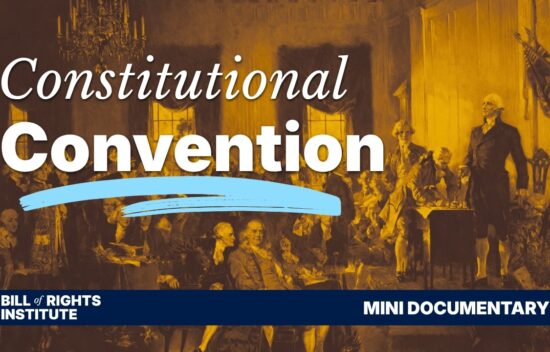
This mini documentary tells the story of the Constitutional Convention in Philadelphia, where delegates debated fiercely over representation, executive power, and the protection of liberty. From the Virginia and New Jersey Plans to the Great Compromise and the creation of the presidency, discover how disagreement, debate, and compromise produced a Constitution built on natural rights, popular sovereignty, and the promise of limited government.
0:04 In the spring of 1787, Americans faced a terrible dilemma. Although they had won their independence four years before, they faced numerous problems. They attempted to erect a national government under the Articles of Confederation to fulfill the principles of self-government outlined in the Declaration of Independence,
0:27 but it failed to govern the country effectively. Americans had an important decision to make about how to protect the future of the country. Success was not guaranteed. Many leaders were deeply concerned about the future of the Republic and saw impending collapse. Virginia and George Washington feared that the problems
0:49 exhibit a melancholy proof that mankind left to themselves, are unfit for their own government. I am mortified beyond description. When I view the clouds which have spread over the brightest morn that ever dawned upon any country. In 1786, some of the leaders had met to discuss the economic problems
1:13 at the failed Annapolis Convention and called for a convention to meet in Philadelphia the following May to revise the Articles of Confederation. The Virginia and Pennsylvania delegations arrived in Philadelphia early, plotted strategy, and developed a plan of government to propose. When the convention opened, the delegates assembled on May 25th
1:38 after agreeing to conduct their business in secret to allow for free and open discussion, and to give each state one vote. Edmund Randolph rose to introduce the Virginia plan that essentially scrapped the articles for a new government. The plan called for a bicameral Congress, an independent executive, and a national judiciary.
2:01 It proposed to send the final work of the convention to popular ratifying conventions in the states, rather than state legislatures, to be an act of the sovereign people, which intense debate began, especially over representation. Large states wanted representation to be proportional based upon population
2:22 and small states wanted equal representation for each state and related sectional to be occurred between North and South. Over counting, enslaved people on June 15th, William Patterson introduced the new Jersey plan, mostly keeping power in the States. It proposed to revise the articles with some greater
2:43 powers for the national government, but keep a one house Congress with equal representation and a weak executive. Over the next few weeks, the delegates made little headway debating the rival plans. Indeed, soon they were completely deadlocked. Many despaired of the outcome. After a short recess for the 4th of July holiday soothed tensions.
3:07 They agreed to the Great Compromise, creating a House of Representatives based on population, and a Senate with equal representation of the state’s enslaved people would count for 3/5 of a person for purposes of representation. The South demanded 5/5, but lost.
3:30 The convention kept coming back to discussing the executive branch. They had to decide if it would be a single or plural executive. The term of office, and whether the executive would be eligible for reelection because of the experience under the British King. They deliberated at length about this important subject through the long, hot summer.
3:53 By late August, they decided upon a single president who would serve a four year term and was eligible for reelection. The Electoral College would elect the president by state because of the principle of federalism. In September, a committee of style drafted the document, which was largely
4:13 the work of Gouverneur Morris, and the convention finalized the wording. At that point, Virginia’s George Mason argued strenuously for a bill of rights to protect essential liberties. While he thought he could dry it up in a few hours. The delegates unanimously rejected the proposal. They thought the Constitution itself acted as a bill of rights,
4:36 protecting individual liberty, and really just wanted to go home. For that reason, then others Mason Randolph and Elbridge Gerry refused to sign the Constitution. Mason announced he would sooner chop off his right hand, then put it to the Constitution as it now stands.
4:57 On September 17th, 39, delegates from 12 states signed the Constitution. Ben Franklin used the occasion to point to the president’s chair, which had a sun on it, and mused, I have the happiness to know that it is a rising and not a setting sun. The Constitution creating this new order for the ages would
5:20 first have to be debated and ratified by the sovereign people and popular ratifying conventions. The new republican government they formed was predicated upon the principles of natural rights, popular sovereignty, separation of powers, checks, and balances, federalism and bicameral wisdom
5:41 to limit the government and protect the natural rights and liberties of the people and the Declaration of Independence. The Constitutional Convention was a great deliberative moment in which consensus was successfully achieved through debate and compromise. The Constitution proved that the American people could achieve a free
6:03 government by reflection and choice, rather than accident, and force.
Viewing Guides
Standards
Related Resources
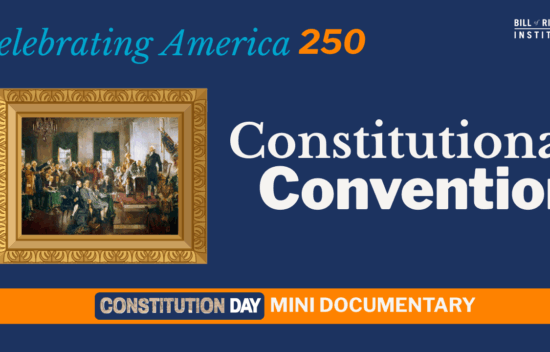
A lesson plan to pair with the the "Constitutional Convention Mini-Documentary" video.
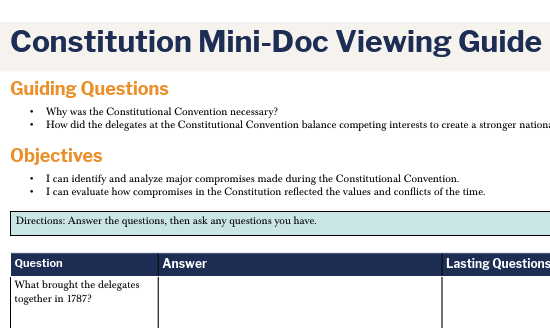
A student guide to accompany the "Constitutional Convention" Mini-Documentary video.