Video
Civil War Middle School Video
Watch
About this video
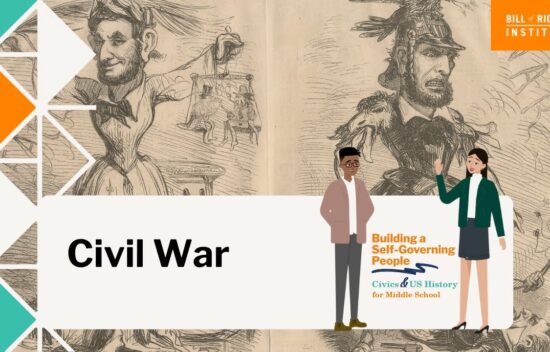
In this middle school history lesson, step into the years surrounding Abraham Lincoln’s 1860 election to explore how the nation fractured over slavery and its expansion. Using Thomas Nast’s political cartoon The President’s Inaugural, students analyze how one powerful image captured the sharply divided perspectives of the North and South on the Civil War.
Through the VIEW method, Voice, Intent, Environment, and Who, students uncover how differing interpretations of Lincoln’s leadership reflected deeper tensions about freedom, justice, and national unity. By examining historical context, symbolism, and audience, students develop historical thinking skills that guide them in crafting a thesis and supporting it with evidence for the unit’s Document-Based Question (DBQ) assessment.
0:02 Welcome to the museum. Today you’ll see how a single image can reveal deep divisions and powerful emotions from a time when the country was on the brink of war. These powerful perspectives come from one of the most challenging times in American history, the Civil War. Let’s uncover how disagreements over slavery and its expansion led to a conflict that changed the nation forever.
0:24 The source will help us answer the question how did fundamental disagreements over slavery and its expansion lead to a devastating civil war that transformed the United States? This is a political cartoon from just after the election of 1860. Abraham Lincoln won the election, and shortly after an 1861, southern states began to secede from the Union.
0:47 Let’s take a close look at this cartoon by Thomas Nast as on the left, Abraham Lincoln is shown as a woman holding an olive branch, a symbol of peace and scales representing justice. This represents how many in the North hoped Lincoln would keep the country together, balancing different interests for calm reflection and discussion.
1:10 Now look to the right side here. Lincoln appears dressed as a soldier, ready for war. This shows how the South saw Lincoln not as a peacemaker, but as a threat. Someone preparing for battle and stomping on his enemies. The cartoons caption reads the president’s inaugural. This is the way the North receives it, and this is the way the South receives it.
1:33 These two reactions demonstrate the deep divide over slavery and the future of the Union. They represent differing perceptions and perspectives.
1:56 Now that we understand the historical context and symbolism in the cartoon, let’s analyze this cartoon using the view method. First, the voice who created this. Thomas Nass is the artist. He is expressing the divided opinions of the North and South toward Lincoln. Next I intend.
2:17 Why? Don’t ask. Create this. What was he trying to do? His goal is to show how Lincoln’s presidency was interpreted very differently by two sides, the North and the South, into each environment. What events in the wider world is this source responding to? The United States in 1861 was deeply split,
2:39 with growing tensions over slavery and the power of the states. Finally W who? What is the audience for this source? Who is making this for? The two main groups are northerners who want peace but worry about weakness in Southerners who fear losing their way of life and are willing to fight because of a perceived threat to it.
3:01 We can summarize this in a few sentence. In the first column of our organizer, the President’s Inaugural, a political cartoon by Thomas Nast. Response to the election of 1860. By illustrating differing interpretations of his election by the North and the South.
3:21 Now, let’s think about our question. How did fundamental disagreements over slavery and its expansion lead to a devastating civil war that transformed the United States? Slavery and its expansion West was the key issue dividing the North and South in the years leading up to the election of 1860, which Lincoln won. Now we can add this to the context column
3:44 for the document column. We should add some details from the political cartoon to accompany our view sentence. The North sees Lincoln’s inaugural as the hope for peace and unity, symbolized by the olive branch. But they also fear Lincoln may be too soft on the rebellious South. This is symbolized by the womanly portrayal. The South, on the other hand, sees Lincoln
4:05 as warmongering and threatening, signaling they expect conflict. This is symbolized by the soldier patriot now in the final column. We need to explain how this all connects to our DV, q question and thesis with a statement like the president’s Inaugural by Thomas Nash illustrates fundamental disagreements that led to civil war by showing how
4:25 the North and South viewed the election of Abraham Lincoln differently. Understanding these disagreements helps us to see why the Civil War was so devastating. It wasn’t just about politics, but about people’s lives, families and communities being divided over these issues. And even today, we face conflicts and disagreements in our own lives,
4:47 especially when people interpret the same thing differently. What matters is how we listen carefully, provide evidence to support our views, and try to understand others, even if we still disagree with them.
Standards
Related Resources

How did fundamental disagreements over slavery and its expansion lead to a devastating civil war that transformed the United States?

Use historical analysis skills to answer a document based question.

How have Americans worked to create and sustain a self-governing, free society?