Video
Civics on the Street | Exploring the Constitution with Matt Green
Watch
Founding Principles
Separation of Powers, Due Process, Natural/Inalienable Rights, Liberty
About this video
In this episode of Civics on the Street, Professor Matthew Green of the Catholic University of America answers real questions from students about the U.S. Constitution. From why it was written to the compromises made at the Constitutional Convention, the structure of government, the protection of rights, and the role of the Supreme Court.
As part of our Constitution Day Live programming, celebrating “Democracy in Your Backyard”, this video dives into why the Constitution was written, the compromises that made it possible, and how its structure continues to shape our government.
0:00 I’m Matthew Green. I’m a professor of politics at the Catholic University of America in Washington, D.C.. And let’s get to your questions. Hi, my name is Taylor. I’m from Long Island, New York. And my question to you guys is, why was the Constitution written and what problems were so trying to solve after the Articles of Confederation? Well, the Constitution was written in response
0:21 to a number of flaws in our country’s first governing document. The Articles of Confederation. The Articles of Confederation created a weak national government with very limited powers. And if that government wanted to carry out the basic tasks of any national government, like raise an army or coin money or appropriate funds,
0:42 a supermajority of states had to agree to that. The articles were really more like a treaty between independent countries than a unifying set of rules and procedures. As a result, our government couldn’t solve conflicts between states. It couldn’t raise enough revenue, and it had trouble dealing with domestic unrest. So the Constitution was written to try to fix these problems.
1:04 Hi I’m Albert from Barrington, Illinois, and my question for you is what compromises were made during the Constitutional Convention and why were they necessary? Well, the Constitution was very much a product of compromise because delegates to the Constitutional Convention disagreed about a lot of things. For example, there was disagreement over whether the legislative branch
1:26 should represent every state equally, which is what delegates from smaller states wanted, or if it should be based on population size. So states with more people would get more representatives, which is what delegates from larger states preferred. As a compromise, the delegates created a two chamber legislature, a house where representation is based on the number of people in a state
1:49 and a Senate, which gives states equal representation. Another conflict was over how to count enslaved persons, whether it’s part of a state’s population, which would mean that slave states would get more representatives in the House, or as property, meaning they would not count as people for purposes of representation. The compromise that the delegates reached resulted in the so-called 3/5 clause,
2:11 which counted slaves as 3/5 of a person for purposes of both representation which aided slave states, and taxation, which was a penalty on slave states. Now, to be sure, some of these compromises were better than others, but in general, without compromise, we likely would not have had a constitution at all.
2:32 How is the Constitution structured and what are the main functions of each article? So the Constitution has seven articles. The first three discuss the powers and structure of the three branches of government the legislative, executive and judicial branches. The fourth article deals with states, the responsibilities they have to each other, and the national government’s obligations to and powers over states.
2:55 Article five discusses how the Constitution can be amended. Now the six article has three important provisions. One is that the U.S. will remain obligated to pay its debts if it adopts the Constitution. Another requires national and state officers to affirm that they will uphold the Constitution, but not be subject to a religious test.
3:16 And third of all, this article says that national law trumps state law. If there’s a conflict between them known as the Supremacy Clause. Finally, article seven explains how the Constitution is to be ratified. How has the interpretation of the Constitution changed over time? Well the the way we interpret the Constitution has changed in many ways.
3:37 In 1789, as society’s values have developed and judge’s views of constitutional law have changed. Now it helps that parts of the Constitution are pretty vague, which allows for greater interpretation of what it means. For example, the Constitution gives Congress the power to regulate commerce between states, but it doesn’t say what commerce is.
3:57 Now, from the mid 1930s through the 1980s, the Supreme Court interpreted the Commerce Clause pretty broadly so it could apply to Congress, saying, for example, how much wheat a person could grow on their property, or whether Congress could prohibit a hotel owner from racially discriminating against patrons. Since the 1990s, however, the court has interpreted the Commerce Clause more narrowly,
4:19 saying, for example, that Congress cannot ban guns on school property. This is just one example of the many ways that interpretations of the Constitution have changed over time, and will likely continue to change in the future. Hi everyone. My question for you all is how does the Constitution protect individual rights beyond the Bill of rights?
4:41 Well, there are some specific rights that are protected in the Constitution outside the Bill of rights. For example, article one protects the right of habeas corpus, which is the right of anyone detained by the government because they’ve been accused of a crime, to require that the government justify their detainment before a judge. Article one also prevents Congress from passing bills
5:02 that punish individuals known as bills of attainder. In addition, article three protects the right to a trial by jury. What this should remind us is that even before the Bill of rights were added to the Constitution, the framers were aware of the need to protect the rights of individuals from the danger of a tyrannical national government.
5:22 My question is, what is the Supreme Court’s role in interpreting the Constitution? Well, the Supreme Court plays a very important role in interpreting the Constitution. This is partly by design, since a core function of an independent judicial branch is to interpret the law. It’s also a power the court gave itself explicitly in the 1803 Marbury versus Madison decision.
5:46 In that decision, the court declared that it had the power of judicial review to review and potentially overturn any law that it deems to be in violation of its interpretation of the Constitution. But the central role of the Supreme Court in interpreting the Constitution also developed through custom. The Founding Fathers actually expected all three branches legislative, executive,
6:09 and judicial, to faithfully interpret the Constitution when making decisions. What’s happened over the course of our history, however, is that the executive and legislative branches have deferred to the federal court system, including the Supreme Court, as the primary interpreter of the Constitution. Well, I want to thank you all for these excellent questions
6:30 about the Constitution, and I want to encourage you to continue to study the Constitution, a document which is in many ways the heart of American democracy.
Viewing Guides
Standards
Related Resources
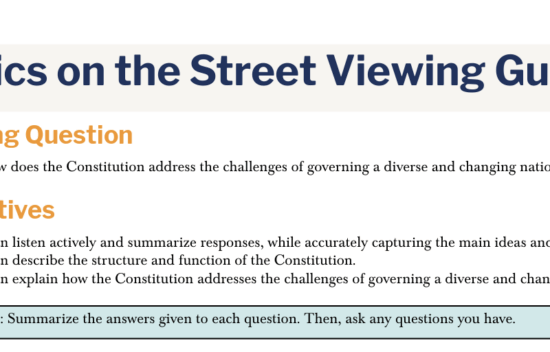
A student guide to accompany the "Civics on the Street" video.
In this episode of Civics on the Street, Mark Rozell, Dean of the Schar School of Policy and Government at George Mason University, responds to questions from student fellows of the Bill of Rights Institute. Discover how landmark Supreme Court cases have shaped our interpretation of the Bill of Rights, the influence of grassroots movements and special interest groups, and the importance of civic education in protecting individual freedoms.

The Constitution was written in the summer of 1787 in Philadelphia, Pennsylvania, by delegates from 12 states, in order to replace the Articles of Confederation with a new form of government. It created a federal system with a national government composed of 3 separated powers, and included both reserved and concurrent powers of states.
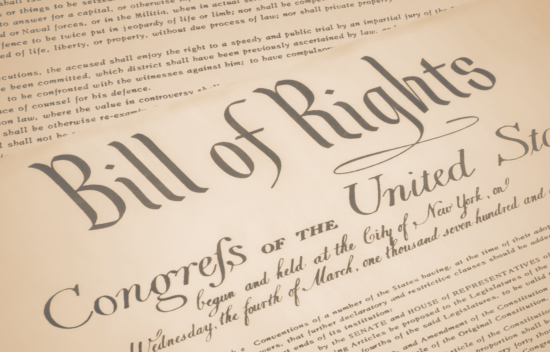
The first 10 amendments to the Constitution make up the Bill of Rights. James Madison wrote the amendments, which list specific prohibitions on governmental power, in response to calls from several states for greater constitutional protection for individual liberties.