Video
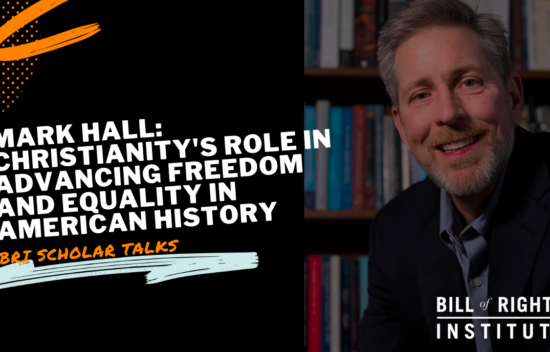
Christianity’s Role in Advancing Freedom and Equality in American History w/ Mark Hall
Watch
Founding Principles
Liberty, Equality, Natural/Inalienable Rights, Freedom of Religion
About this video
How has Christianity advanced freedom and equality in American History? In this episode of Scholar Talks, BRI Senior Fellow Tony Williams is joined by Mark David Hall, the Herbert Hoover Distinguished Professor of Politics at George Fox University, to discuss his latest book ‘Throughout All the Land: How Christianity Has Advanced Freedom and Equality for All Americans.’ Together, they converse on topics such as the Second Great Awakening, the role of Christianity and republican ideals in the extinction of slavery, and the proper role of religion and politics in the public square.
0:00 I think all Americans should be concerned with these sorts of evils and Christians should join with others in trying to advance Liberty Inequality For All citizens and let me do emphasize all citizens and part of my book I talk about the importance of religious liberty and I’m highly critical of some of my fellow Christians who say things like the first amendment doesn’t apply to Muslims that’s nonsense the first
0:21 amendment applies to everyone and Christians should be at the Forefront of protecting religious liberty for all Protestants Catholics Muslims Jews Hindu Sikhs everyone enjoys what the founders called The Sacred right of conscience [Music] for this episode of scholar talks The
0:42 Guiding question is how has Christianity Advanced freedom and equality throughout American history Mark David Hall is a professor in Regent University’s Robertson School of government and a senior fellow with the center for religion culture and democracy he’s an expert on religion and politics and that has authored or edited
1:03 a dozen books on the subject his latest is proclaimed Liberty throughout all the land how Christianity has advanced freedom and equality for all Americans I am Tony Williams Senior fellow at the Bill of Rights Institute and I am pleased to bring you another episode of scholar talks in our series Topics in
1:24 American history Mark I want to thank you very much for joining us thank you so much for having me Tony well we’ll Dive Right In so in your book uh you take issue with the belief that Christianity might be a force of division or even oppression throughout American history and argue something very different why is this the case and what led you to
1:46 write your book yeah thank you in the early 19th century it really was indisputable that Christianity was an important Force for Liberty inequality throughout all America people like Daniel Webster Alexis tocqueville recognized this into the 19th century though you began to get some popular words like Nathaniel Hawthorne’s Scarlet Letter The Crucible
2:08 in the 20th century Arthur Miller’s Crucible and then so many academics in the 20th century have been fairly secular and fairly Progressive and so you see a pretty powerful line that says well actually Christianity has been a force of repression and what we’ve had to do is overcome Christianity Maybe by rejecting it all together or at least by
2:28 embracing very Progressive forms of Christianity um this is reflected very well in the 1619 project a series of essays with the New York Times that says really it’s slavery in racism that defines America and to the extent to which that project talks about Christianity it’s almost always in a negative sense that it was Christians appealing to the Bible people who defended slavery now in my book I
2:50 recognize as I must that in fact some Christians in America appeal to the Bible to defend slavery poverty sexism we have to recognize that we want an honest account of American history but I think there’s another set of stories that deserve to be told very oftentimes it’s been Christians appealing to their faith appealing to the Bible that have advanced Liberty and equality for all
3:12 Americans and so in this book I attempt to tell some of those Tales great now many historians such as Bernard Balin Gordon Wood have noted the influence of of ancient thought of John Locke and the enlightenment of the English tradition the colonial experience and shaping the ideas of the American Revolution
3:33 so overall the Protestant Christianity specifically play in contributing and shaping those political ideals so any serious student of the founding has to recognize that there are in fact a variety of strains of thought as you point out the classical Republican tradition the enlightenment the common law tradition the Scottish School moral
3:55 sense yeah there’s a whole variety of influence floating around and one of my arguments is that we have to take Christianity seriously as one of those influences and then also to think in a serious way about how these how Christianity interacts with some of these other influences to name one very prominent debate among historians and political scientists some political
4:15 theorists let’s say read John Locke as if he’s Thomas Hobbs you know a very secular thinker a very individualistic thinker and I I can read and I can see how they arrive that that sort of conclusion on the other hand there’s ways of reading lock as being thoroughly compatible with Christianity and one of the things I’ve argued in my scholarship on Roger Sherman and in other books is
4:36 that really Christianity is one of many influences but it’s a particularly power full influence and so I contend that for instance in the late 18th century when Americans are reading and appealing to Locke they’re understanding him as a figure who’s very compatible with Orthodox Christianity not as someone who utterly rejects it and so they don’t have to choose between John Locke and
4:58 their faith they’re able to bring both together right and as a follow-up you know a lot of Calvinists thought a lot of protestant uh resistance theory if you will the civil and religious tyranny uh you point out a lot of examples uh from the Reformation forward of the kinds of thinkers that that the founders are appealing to in
5:19 part yeah thank you let me take a big step back to the Protestant Reformation and give you a little mathematical equation that the Protestant reformers believed in in Solo scripture the scripture alone they also believed in the doctrine of the priesthood of all believers well when you put those things together you have a recipe for widespread reliteracy and what we see in Protestant countries is that literacy
5:40 rates Skyrocket you have almost Universal male literacy in in puritan New England as well these reformers are leveling things you know the Roman Catholic Church it’s a very straightforward hierarchy right the Pope the Cardinals the archbishops the Bishops in America we have a congregationalist where the church ran itself
6:01 um with the members of the church ran itself right the congregation would come together and debate things and vote on things even are we going to hire this Minister are we going to fire that Minister that sounds awfully Democratic right and in fact this ecclesiastical government spilled over into Political government and so pure to New England was the most Republican Society the
6:22 world had ever seen almost any male who wanted to could vote and it might seem you know very oppressive to say only males could vote but of course nowhere else in the world um did you have more people able to vote and they believe that civil government should be limited as a matter of law the Massachusetts body of Liberties contains almost every right we find today in the
6:42 Bill of Rights the Puritans are even more tolerant with respect to religious liberty because of their Christian convictions and so yeah I think Protestant thought had a profound and positive impact on pure to New England and this continued through to the founding era which is one reason Americans reacted so violently when they perceived Parliament and the King as infringing upon their Liberties as you
7:04 suggest the Protestants developed a resistance theology unlike anything ever seen on a widespread level you have some Catholic thinkers like John Salisbury who fools around with the doctor at tyrannoside it really doesn’t go very far with the Roman Catholic Church in that era but John Calvin Knox Pony good men Buchanan you know these guys
7:26 are coming to the conclusion that the Bible actually requires civil leaders to resist a ruler who becomes a tyrant and some like John Knox were saying the people themselves if the inferior magistrates don’t act the people themselves may rise up and overthrow a tyrant and again this explains why the British North American colonies reacted
7:47 to what Parliament and the King were doing were doing when many British colonies throughout the world I think there’s something like 50 British colonies at the time many of them just Shrugged but in America you have this long experiment experience in self-government in this Protestant political theology that said no we’re not going to take it we’re going to rise up and defend our rights you know a lot
8:08 of has sounded awfully consistent with the Declaration of Independence for example but so so my next question so what role does Christianity and Republican ideals play in in perhaps a more controversial subject uh the emancipation of slaves uh and uh the question of whether slavery was put on the road to Extinction during
8:30 and after the American Revolution certainly uh there is a a great deal of ink being spilled these days on on this very important topic yeah thank you for that question because you’re exactly right it is incredibly common to say the authors of the Declaration of Independence were simply Hypocrites because they wrote and approved of these wonderful words we hold these truths to
8:51 be self-evident that all men are created equal and yet they own slaves well as you know Tony the vast majority of Americans and white Americans never owned an enslaved person um Civic leaders tended to be a bit more wealthy so more of them did in fact own slaves only like 25 of the 55 men in the Philadelphia Constitutional Convention for instance owned at some point a slave
9:14 but that’s an important qualification because some Founders were coming to recognize that slavery was an evil horrible institution that had to be ended so John Dickinson at one time the largest slave owner in Delaware freed his slaves John Jay the nation’s first Chief Justice owned a few slaves throughout his lifetime freed them signed a law putting slavery on the road
9:34 to Extinction in New York John Adams never owned a slave Ben Franklin owned five slaves throughout his lifetime eventually freed the last of them went on to become president of the Pennsylvania abolitionist Society James Wilson owned one slave whom he frayed and so many Founders were coming to recognize and take personal and expensive steps to to separate
9:55 themselves from this evil horrible institution you have Founders like George Washington James Madison Patrick Henry who owned slaves and yet they recognized it was an evil institution and they were very very critical of it Washington of course freed his slaves and his will Jefferson and Madison did not in some cases the law made it difficult to do so especially if you’re
10:17 in a debt just like today if if I was going through bankruptcy I couldn’t just give away my cars right I would be required to keep those as part of my estate um I I jumped ahead Dimension Adams let me do point out a lot of prominent Founders never owned slaves John Adams Roger Sherman Oliver Ellsworth and a number of these Founders took very concrete steps to end slavery John Adams
10:38 for instance wrote Massachusetts constitution in 1780 which was interpreted I think it was one or two years later to prohibit slavery in the state and so Massachusetts just abolished slavery altogether by 1782 and I could keep going on and on but I just want to make the point no one in the founding era defended slavery is a positive good many Founders never owned
10:59 slaves and many Founders were taking concrete steps to end slavery right and and you talk a little bit in the book about uh Christianity and and the Bible and slavery and and how it was used or misused can you dial in a little bit on that sure I think it’s important you know it’s real tempting as a as a follower of Christ today who has a high
11:20 view of the Bible I I wish the Bible just clearly and unequivocally condemned slavery but you read through the Old Testament and it seems to be a permissible practice and oftentimes the Old Testament or the Hebrew Scriptures it really is is ameliorating slavery you know maybe you can’t do this you can’t do that you have free your slaves after this much time but still it seems to be
11:40 a permissible institution in the New Testament all right the Apostle Paul tells slaves to obey their master um and the Apostle Paul sends anissimus an escaped slave back to his master albeit with a a very strong hint that the slave be freed and so I do think you know we need to be humble we shouldn’t be present to this and say well just
12:00 obviously the Bible condemns slavery you could be a serious Christian and think slavery is permissible but let me hasten to say that beginning with the Quakers in the mid-18th century some Christians and eventually many Christians would come to the conclusion that well these biblical passages don’t apply to American race-based chattel slavery or
12:21 principles of the Bible such as those found in Genesis all human beings are created in the Mago day the image of God and therefore should be treated with respect and dignity and that that principle is incompatible with slavery finally let me mention one other real important verse see in the late 18th century you began to have European scientists who said well maybe whites
12:43 and blacks are separate races American Christians and really Orthodox Christians everywhere never had anything to do with with that idea believing that all descended from Adam and appealing to passages such as acts 17 25 I think it is that says of one blood God made them all so they were absolutely insistent no
13:03 African-Americans whites are both humans and I think the the sword of dynamic that began in the 18th century took off in the 19th century and let me just give you one statistic I know you know this but by 1787 Six States had put slavery on the road to Extinction or banned it all together by 1804 eight states had done so the Northwest Ordinance
13:25 prohibited the spread of slavery into the old Northwest in the states carved out of it Ohio Michigan Indiana Illinois Wisconsin um slavery was on the road to Extinction everyone thought that was a good thing in the founding era right so bringing the story forward a little bit uh how did the Second Great Awakening uh that great religious revival helped to shape
13:47 the Contours of Antebellum social reforms yeah thank you let me let me first add that the invention of the contingent gave slavery a new lease on life in the American South slavery became integrated with the Southern economy in a way that it had never been before even in the South and so by the time you get to the 1820s you have
14:08 Southern Civic leaders defending slavery it’s a positive good but I do want to emphasize that came Generations after the founders but you also had the Second Great Awakening these great ways of Revival that swept America especially New England the Mid-Atlantic States and the Midwest and this is where basically a lot of Christians and almost everyone
14:28 in the late 18th century of European descent would have identified themselves as a Christian in fact 98 Protestant two percent Roman Catholic maybe 2 500 Jews and 4 or five American cities but the Second Great Awakening is really an Evangelical movement and a lot of people who probably would have considered themselves as Christians were convicted that maybe I’m not a Christian they had
14:50 a conversion experience and became on fire followers of Christ this oftentimes led to missionary Endeavors as you might imagine the founding of the American Bible Society missionary societies and so forth for our purposes it also led to a number of reform movements the idea that we need to we as Christians need to create orphanages and reform prisons and
15:12 address a scourge of alcoholism which really was more of a Scourge in the 19th century than it is today but again for our purposes it led to the the the the it underlie the Abolitionist Movement again a movement especially of people in states where there wasn’t slavery or slavery was petering out in almost non-existent and so he had these these
15:34 White Citizens and of course they’re joined by Sojourner Truth and Frederick Douglass and we shouldn’t um neglect they’re very important in influence but I emphasize white Americans because you cannot explain their action in terms of self-interest they aren’t slaves their relatives aren’t slaves and yet why are they spending all this time effort and money opposing slavery it’s because they
15:56 came to recognize it was evil and we needed to certainly stop the expansion of Slavery to the territories in ideal ideally work towards ending it in the southern states one other reform movement I particularly like is these evangelicals who are thoroughly behind the Native Americans in Georgia the Cherokees the choctaws and others the so-called Five Civilized Tribes as
16:17 Andrew Jackson was trying to force them out of their homes to the state of Oklahoma what you saw is the first mass movement of women in America circulating and signing petitions sending them to Washington D.C saying you can’t do this this is unjust it’s immoral um let them enjoy the lands to which they clearly have treaty rights and again how can you explain a movement
16:37 like that in terms of self-interest I don’t think you can I think the best explanation is these are Christians motivated by their faith to fight societal evils right great uh so last question so if Christianity has helped to advance freedom and equality uh what is the proper role what is the proper relationship of religion and politics in
16:58 America of religion as they say in the Public Square in the United States oh that’s a great question thank you let me hasten to say what I’m talking about here is a historical explanation I’m certainly not saying that you need to be a Christian in order to believe in Liberty inequality there’s all sorts of good philosophical reasons I think from
17:19 other religious Traditions Judaism Islam and whatnot you can come up with excellent reasons for advancing freedom and equality for all in the American context so we’re virtually 100 of Americans of European descent are Christians well into the 20th century um oftentimes it’s Christianity that is leading the charge I would say today we should not pretend that we have
17:40 abolished the evils of slavery and well I suppose we have slavery but racism and sexism in power poverty we obviously still have grave evils today and I think it’s entirely proper for Christians to be motivated by their faith to go into the Public Square and combat these evils the Reverend Dr Martin Luther King is perhaps the best example of that
18:01 um over the last 60 years or so but again I want to emphasize this it’s not a rah-rah Christian Movement that I’m suggesting I I think all Americans should be concerned with these sorts of evils and Christians should join with others in trying to advance Liberty Inequality For All citizens and let me do emphasize all citizens and part of my book I talk about the importance of
18:22 religious liberty and I’m highly critical of some of my fellow Christians who say things like the first amendment doesn’t apply to Muslims that’s nonsense the first amendment applies to everyone and Christians should be at the Forefront of protecting religious liberty for all Protestants Catholics Muslims Jews Hindu Sikhs everyone enjoys what the founders called The Sacred
18:43 right of conscience Mark David holle congratulations on new book and for adding your voice to this conversation and I want to thank you for joining us thank you so much Tony it’s always a pleasure and thank you very much for joining us on this episode of scholar talks please check out our previous conversation on Founder Roger Sherman and other interviews in this series on
19:05 topics in American history
Standards
Related Resources


BRI staff members Kirk Higgins and Tony Williams explore two intriguing 17th-century works that shed light on why colonial America was an appealing destination for European settlers in different ways. The seminal “Modell of Christian Charity” sermon delivered by John Winthrop in 1630 viewed the New World as an opportunity for Puritans to worship freely and escape the religious oppression of the corrupt Church of England. In a letter from 1683, William Penn painted an idyllic picture of Pennsylvania – including its beautiful land and bountiful natural resources – to entice people to immigrate to the new colony.
