Video
Calling For Change: Violence or Nonviolence? Images of Bloody Sunday, 1965
Watch
About this video
Which is more effective in calling for change and pursuing the virtue of justice: violence or nonviolence? In this episode of BRIdge from the Past, Mary examines images from Bloody Sunday in Selma, Alabama in 1965 and the 54-mile march organized by activist groups in their pursuit of civil rights and justice for all. What lessons can be learned from these images of peaceful protest and violent opposition? What do they reveal about effective ways to pursue justice in America today?
0:00 Hey everybody. Welcome back to another episode of Bridge from the Past art across US history. I’m your host Mary, and this series is for students like you to get ahead in your US history class by using images as a starting point to think about important topics in American history. Nonviolent activists in the civil rights movement frequently encountered violent resistance.
0:22 One example of this is a protest march from Selma to Montgomery, Alabama that took place in March of 1965. This raises for me a fascinating and timeless question about protest and calling for change. Is violence or nonviolence more effective? Let’s jump in and see.
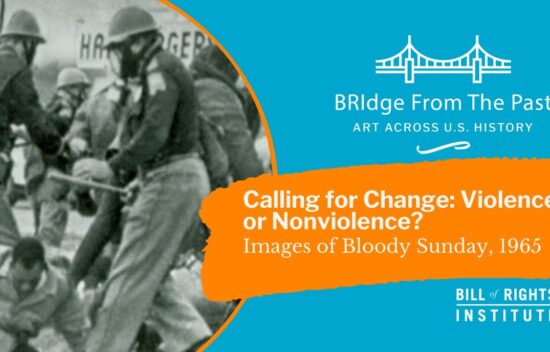
0:46 Here is our starting image. So this is an image of a march that was dubbed Bloody Sunday that took place on March 7, 1965. And again, we’re thinking about this question of violence and nonviolence and what’s more effective if you’re calling for change. So right off the bat, if I’m looking at this image, I can see that there’s clearly some sort of violent altercation taking place.
1:08 So there are these men in what appear to be uniforms. I can see sort of insignia, a badge. They’re wearing helmets. They have looked like guns. So policemen perhaps, or state troopers. This guy looks like he’s carrying a club. And I can see there’s people on the ground.
1:30 This man looks like he’s been knocked down. I can see that there are people running. So there’s a lot of commotion going on in this picture. And it seems like this is I don’t know what’s happening here. So I have a lot of questions. Who are these people? Who is this man on the ground? Why is he being attacked? Why are these people running? There’s lots of questions come to mind
1:51 just by taking a minute to pause and look at this primary source image. With any primary source, it’s important to have historical context before you can really dive into your analysis. So what do we need to know about this event before we can go any further? First of all, we are once again in the civil rights movement. So approximately 1955 to 1965,
2:14 and in 1965, despite the passage of the 15th Amendment and the 19th Amendment and the Civil Rights Act of 1964, many African Americans in the south aren’t able to vote. Now, why can’t they vote? The 15th Amendment makes any citizen able to vote. The 19th Amendment says the right to vote
2:35 cannot be taken from you because of your sex. And then you have the Civil Rights Act of 1964 ensuring that, trying to ensure equality in our country. So we have all this legislation and constitutional amendments protecting this idea of equality and the right to vote, but it’s still not happening. Well, why is that? That is because in many places in the south, African Americans would face
2:58 violent backlash if they even registered to vote. And this is still happening despite the passage of this legislation and despite these constitutional amendments. Now Selma Alabama which is where this image, that first image came from, was especially bad. So African Americans in Selma, Alabama, which is sort of in central Alabama in 1963
3:21 made up approximately half of the city’s population. Yet less than 1% of African Americans were registered to vote because they faced, because they were afraid of the repercussions that they would experience if they actually decided to register to vote, let alone actually voting. So because of this,
3:41 the Student Nonviolent Coordinating Committee, or SNCC, specifically targets Selma, Alabama for a voter registration campaign. So SNCC activists, which we’ve seen before, their student group, they’re playing a leading role in the civil rights movement. They’re going to go down and they’re going to organize a campaign. So they’re talking to people. They’re listening to them. They’re trying to get them together to see
4:02 that this is something that they have to do. So there’s a lot of work and a lot of convincing that needs to happen. And they’re facing a lot of violent backlashes. Ministers within the African American community were afraid to even host, like, conversations in their churches because they were afraid of the repercussions. So there was a lot of fear to overcome and a lot of work to be done.
4:23 The Southern Christian Leadership Conference, this is the organization of which Martin Luther King is the president, and he has just won the Nobel Prize in 1964. They’re going to join the campaign in 1965. And the plan is to march from Selma to Montgomery, Alabama, the capital of Alabama, to protest this fact
4:44 that African Americans are not allowed to register to vote. It’s a 54 miles march, so they’re going to walk peacefully, men, women, children, just as a peaceful nonviolent protest. The goal of SNCC and the SCLC is that this nonviolent demonstration is going to arouse a violent backlash.
5:06 And they know it will, because they’ve experienced violent backlashes at every step of the way. Ever since SNCC has been down in Selma organizing people. They’re met with resistance, they’re harassed, they’re chased with nightclubs. Even a young activist named Jimmy Lee Johnson has been murdered. So they know they’re going to get a violent reaction. They know they have pressed attention, so they’re going to provoke the US.
5:28 Government into action. That is the goal of this campaign. Now let’s return to our image. So when the march begins, the marchers have to cross the Edmund Petis Bridge. And again, this is a planned event. Everyone in the town in the area knows it’s happening. So the police and state troopers, so these guys here are ready to meet the nonviolent protesters.
5:51 And you can see this guy can see that they’re wearing masks because they use tear gas on the protesters. You can see that they’re attacking them with clubs. They had dogs, which you don’t see in this picture, but they were there. And this man on the ground right here, this is actually John Lewis. So John Lewis was the leader of SNCC at the time, so he was one of the very
6:13 first front and center in the march of crossing the bridge. And he’s actually struck in the head and has such a terrible blow, he has to go to the hospital. And it was unsure if he would recover. He does, in fact, recover and he comes back after all of this to continue the march. But you can see this just like horrific organized violence. So it’s police, state troopers and deputized locals.
6:35 So people who aren’t affiliated with the law at all have basically been tasked with beating these people up. So it’s this horrific display of racism and violence when these people are trying to peacefully cross over the bridge. So the press is there, right? I have a picture of this. I can show it to you. I can talk about it. You can watch the actual press footage.
6:56 People are going to see this on their TV at night and just like, what is this, right? Is this America, the land of the free and the home of the brave? And this is going on? People across the world are going to see this. And the public outcry over this is something that is very high, which, again, was part of the goal is to bring attention to the government has to act.
7:18 I love this image because after the events of Bloody Sunday, it doesn’t stop there. So these people, these men and women, they knew they were going to be attacked. They were there anyway. They put themselves out there anyway. They don’t fight back. Many of them are hurt and they come back. And not only do they come back, but more people join them. And this man’s poster right here is so powerful, right?
7:41 It’s Catholic, Jews, and Protestants marching. So this isn’t an African American thing. This is a mankind thing for dignity and brotherhood of all men under God. And you can see all different men in this picture. You don’t actually see any women in this picture, but there were women there, too, and children, which you can see in this picture.
8:03 And I love this picture so much because I think this looks like a child here, but you can see only more people are joining this march. And it’s people sort of from all walks of life. I can see African Americans, I can see white people. It’s everybody. And what I love so much is that they’re carrying the American flag. So what does America mean to you?
8:24 Is almost what I think these people are saying. By having these flags with them, we have these principles of liberty, inequality and justice, and they’re not being applied here. And it needs to be addressed, it needs to be fixed. This is our First Amendment in action, right? This is freedom of speech, freedom of assembly, freedom of petition. Say government. This isn’t right.
8:45 It needs to be fixed. So here it is in action. It’s such a beautiful example of a nonviolent protest. And how powerful, too, especially coming on the heels of this violence, that this is able to go on. Before I leave this image, I have to share this amazing Martin Luther King quote on here,
9:07 which goes back to this idea of the power of nonviolence. Quote we shall match your capacity to inflict suffering by our capacity to endure suffering due to us what you will and we will still love you. How powerful is that? I like to think of that quote and think about if I were here and I were being beaten for doing nothing wrong,
9:31 for protesting a wrong, would I have the strength to do that, to endure that suffering and still love the person attacking me? That’s pretty powerful stuff. I started by asking you, what do you think is more effective in calling for change, violence or nonviolence? This really is a timeless question,
9:53 and I use the example of marches from Selma to Montgomery, Alabama in 1965. But there are countless other examples we could have used to think about this question. Now, in this instance, in August of 1965, Lyndon B. Johnson did sign the Voting Rights Act into action. So it did prompt a federal response, which, if you remember, was one of the goals of this campaign.
10:16 But is that always the case? Right? This is just one example, and there’s so much more to the story. So now I’m going to turn it over to you. What questions do you have? What’s our next topic in our conversation? I’d love to know your thoughts in the comments below. If you like this video, if you learned something, please be sure to subscribe to our channel.
10:36 Go ahead and like this video. Leave me your comments, leave me your questions. I want to hear from you. I’ll be back soon with another topic to explore using images in American history. So until then, everybody keep asking questions. Always look at the pictures and take care.
Standards
Related Resources

BRIdge from the Past: Art Across U.S. History is a new YouTube series for students that explores an important historic image every episode to gain insights into the culture, politics, and society of a particular time in U.S. history. Host Mary Patterson will explain how each primary source is its own “window to the past,” revealing new areas for contemplation and discussion.


How did the Civil Rights marchers from Selma to Montgomery, Alabama in 1965 demonstrate diligence?

Gary, Mary, and Eryn reflect on a particularly important moment in the civil rights movement, the march from Selma to Montgomery, Alabama in 1965. They'll explore how the events of Selma fit into the bigger picture of the civil rights movement and the passage of the Voting Rights Act. What can this march teach us about the significance of turning points in a movement? And what lessons from it are still very relevant today?