Video
American Westward Expansion Middle School Video
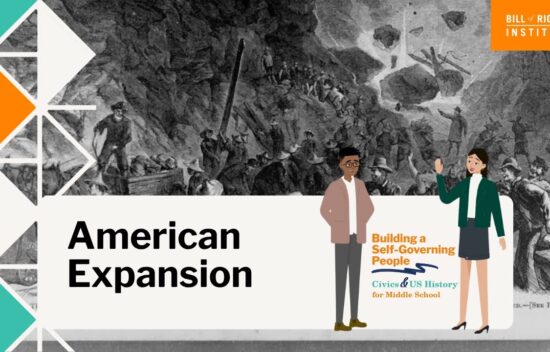
Watch
Founding Principles
About this video
Guiding Question:
How did the drive for territorial expansion shape the nation’s identity and create new challenges for the United States?
About the Video Series:
Our video resources in the Building a Self-Governing People middle school curriculum integrate primary source analysis with Document-Based Question (DBQ) skills to deepen student learning. Use them to launch your assessment lesson or to support students who need a refresher on DBQ strategies.
Each video features two young professionals: a museum curator leading a gallery tour and an educator accompanying students on a field trip. The curator models how to analyze primary sources such as historical documents and artwork. Then, the educator demonstrates how to use that analysis to answer a compelling historical question.
For guidance on how to use the videos within your lessons, refer to the unit’s Deconstructed DBQ Lesson Plan.
0:02 Welcome to the museum. Today we’re stepping into one of the most transformative moments in American history. Westward expansion. In front of us is Alfred Rudolph Rhodes work on the last Mile of the Pacific Railroad, created in 1869. This powerful image captures a turning point. The completion of the transcontinental railroad,
0:23 which stretched from coast to coast, linking the nation in ways that were once unimaginable. It will help us answer the question how did the drive for territorial expansion shape the nation’s identity and create new challenges for the United States? Quote A renowned illustrator of the time often captured scenes that defined America’s growth and challenges.
0:44 In this image, we see workers, many of whom are immigrants, particularly Chinese and Irish laborers, enduring harsh conditions to complete the railroad. Their labor was essential but often dangerous, and they faced discrimination. Despite their contributions. Let’s look at some of these challenges depicted in the artwork.
1:05 There are minimal tools in this scene, although there’s major work being done. Some men are even working without shoes. There’s a large explosion happening in the background, but no one seems to be wearing safety equipment. One man’s long braid is being pulled. It looks like he may be being bullied. This artwork symbolizes both progress and hardship.
1:27 It represents the nation’s ambition to expand westward, fulfilling the idea of manifest destiny and rapid continental economic prosperity. But it also hints at the costs, human labor, and environmental impact, among others. Won’t work helps us understand how expansion wasn’t just about opportunity.
1:48 It was also about sacrifice and struggle. Now that we understand the historical context of world’s illustration, let’s talk about how we can use this source to provide evidence for our dark question.
2:10 How did the drive for territorial expansion shaped the nation’s identity and create new challenges for the United States? The first step is to summarize the source with a few sentence. Like Walt’s artwork shows the completion of the transcontinental railroad, as well as the challenges that immigrant workers faced in the mid 1800s. Where do we see this in the source?
2:31 If we were using a text, we would select a quote. But since we are working with art, we want to choose a specific item or theme from the scene. The explosion in the background clearly illustrates the danger the workers are facing. Next, we ground our understanding and what else was happening at the time. This is historical context. For example, you might say world’s illustration highlights
2:54 the dangerous labor conditions faced by immigrant workers who were crucial to the railroad’s completion. This helps us remember the rapid changes occurring around the time the source was created. The country was growing economically, politically and culturally, and those changes created new challenges. Finally, let’s create a thesis statement
3:15 grounded in this evidence that answers the question. Here’s an example. The drive for a territorial expansion not only symbolized American progress and prosperity, but also exposed deep societal challenges, particularly for immigrant communities whose labor was essential. But dangerous worlds. Illustration. It’s just one piece of evidence, but it’s powerful when you choose evidence.
3:38 Think about how it supports your thesis, but also let it inform your opinions. That’s the work that historians really do. Providing evidence isn’t just for writing essays. It’s important in your everyday life. When you support your ideas with facts, whether you’re talking with friends, parents, or teachers, you’re more likely to communicate clearly and be understood.
4:00 Exactly. History is full of evidence, and when you can point to that evidence, you not only understand the past better, you understand your own arguments better to. So next time you make a claim. Think about what you can use to back it up, just like we did with world’s illustration, providing evidence makes your voice stronger.
Standards
Related Resources

How did the drive for territorial expansion shape the nation’s identity and create new challenges for the United States?

How did the drive for territorial expansion shape the nation’s identity and create new challenges for the United States?

How have Americans worked to create and sustain a self-governing, free society?