Video
Alexander Stephens’ Cornerstone Speech | Primary Source Essential
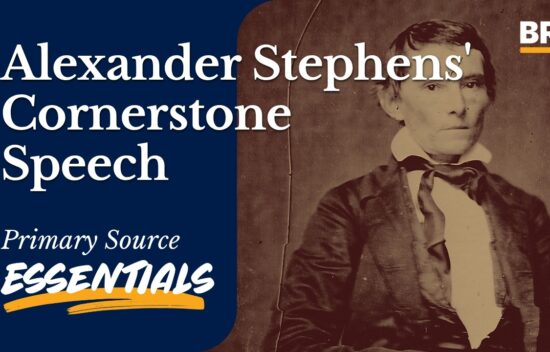
Watch
Founding Principles
About this video
In this episode of Primary Source Essentials, examine Alexander Stephens’s Cornerstone Speech and its stark rejection of the principle that all men are created equal in the Declaration of Independence. Delivered in 1861 after the secession of Southern states and the formation of the Confederate States of America, Stephens’s speech laid out the ideological foundation of the Confederacy, arguing that racial inequality and slavery were not temporary conditions, but fundamental truths on which the new government was built.
Stephens directly challenged the Founders’ belief in natural equality, claiming those ideas were mistaken and that the Confederacy was founded on the opposite principle. As the Civil War unfolded, this conflict over slavery and equality led to immense loss of life but ultimately resulted in Union victory and the reaffirmation of the Declaration’s ideals through measures like the Emancipation Proclamation and the 13th Amendment, advancing freedom and equality in the United States.
0:00 Welcome to Primary Source Essentials.
0:02 In this episode, we are going to briefly examine Alexander Stephens
0:06 Cornerstone speech and the Confederacy’s rejection of the principle
0:10 that all men are created equal in the Declaration of Independence.
0:16 When Abraham Lincoln was elected president in 1860,
0:19 South Carolina and six other states refused to accept the election
0:23 results and passed secession ordinances.
0:27 The Confederate States of America formed
0:30 in February 1861 and elected Jefferson Davis
0:34 as its president, and then Alexander Stephens, vice president.
0:38 Stephens was a former representative in Congress from Georgia
0:42 and a Unionist until he joined the Confederacy in March 1861.
0:47 He delivered his famous Cornerstone Speech, which laid out the rationale
0:52 for secession and the doctrines of the Confederacy.
0:56 One of them, the cornerstone, he thought,
1:00 was the in equality of the races.
1:03 In this speech, Stephens provided
1:05 an extended commentary on the Declaration of Independence.
1:10 Stephens admitted that Thomas Jefferson and the other founders believed
1:14 that all men are created equal, apply
1:17 to everyone as a universal principle.
1:21 They believe that slavery was a violation of the laws of nature, he said.
1:26 But slavery was an evil.
1:29 They knew not well how to deal with, so it endured.
1:34 Stephens said that those ideas were based upon the equality of the races
1:38 and were therefore fundamentally wrong.
1:43 The Confederacy, he states, was founded upon exactly the opposite idea.
1:48 Its foundations are laid, its cornerstone rests upon the great truth
1:54 that the Negro is not equal to the white man, that slavery
1:58 subordination to the superior race is his natural and normal condition.
2:04 This, our new government, is the first in the history of the world
2:08 based upon this great physical, philosophical and moral truth.
2:14 Over the next four years, the Civil War
2:16 was fought over the question of slavery and natural equality.
2:20 It resulted in the deaths of more than 700,000 American soldiers.
2:25 The Union would triumph, and with it the principles of freedom
2:28 and equality in the Declaration of Independence.
2:32 These principles shaped the Emancipation Proclamation and 13th Amendment,
2:37 which put an end to the evils of slavery and advanced the true ideals
2:42 of the Declaration of Independence.
2:44 Thanks for watching and check out the other videos in Primary Source Essentials.
Standards
Related Resources

On June 7, 1776, Richard Henry Lee brought what came to be called the Lee Resolution before the Continental Congress. This resolution stated “these United Colonies are, and of right ought to be, free and independent states ...” Congress debated independence for several days.

By the end of this section, you will explain how Lincoln’s leadership during the Civil War impacted American ideals over the course of the war

What were Abraham Lincoln’s views on race and freedom and equality for Black Americans? In this episode of Scholar Talks, Jon White, associate professor of American Studies at Christopher Newport University and prize-winning historian and author, joins BRI Senior Teaching Fellow Tony Williams to discuss his two books, "A House Built by Slaves: African American Visitors to the Lincoln White House" and "To Address You as My Friend: African Americans’ Letters to Abraham Lincoln." Together, they talk about Lincoln’s policies and personal relationships with African Americans during his time in office. How did Lincoln’s views shape his presidency and his relationship with African Americans?