Building Strong Children: My PDJ Reflection
<p><em>By Mary Patterson</em></p>
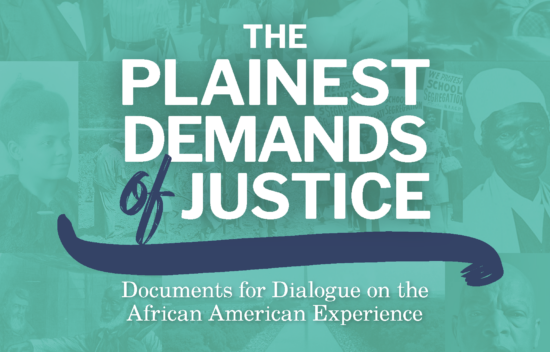
<p><a href="https://www.billofrightsinstitute.org/curricula/the-plainest-demands-of-justice-documents-for-dialogue-on-the-african-american-experience">The Plainest Demands of Justice</a> is a resource from the Bill of Rights Institute that is very near and dear to me. In a way, I think of it as my baby, since I wrote much of it before and after having my actual human baby.</p>
<p>This curriculum explores really dark episodes in our nation’s past. In fact, there were times when I was working on it when I had to step away because it weighed on me very deeply. The saving grace for me, with many of the historical actors whose words and actions I compiled, was that there was always an agitator demanding better, calling for change, and returning to the Founding principles of liberty, equality, and justice.</p>
<p>For me personally, two curriculum anchors are <a href="https://billofrightsinstitute.org/activities/correspondence-between-benjamin-banneker-and-thomas-jefferson-1791">Benjamin Banneker’s letter to Thomas Jefferson (1791)</a> and <a href="https://billofrightsinstitute.org/activities/john-lewis-together-you-can-redeem-the-soul-of-our-nation-2020">Congressman John Lewis’ final words (2020).</a> Though written over 200 years apart, the arguments are very similar. I would call them each a bookend or a rallying cry, but the whole point is there is no “end “ and the work to faithfully apply the principles of the Declaration of Independence is ongoing for all of us. Students can see this for themselves with the final project for this curriculum,<a href="https://billofrightsinstitute.org/lessons/lesson-7-the-work-continues-final-project"> The Work Continues</a>.</p>
<p>I would encourage you to explore the curriculum when you can. Free time is precious if you are lucky to have it. But there is a treasure trove of sources appropriate for any U.S. history class, not just during Black History Month. This resource has more than 90 primary sources, but we have abbreviated playlists for each lesson to help you manage this library. On top of that, I pulled out my top 10 favorites below from across the resource.</p>
<p>I hope you will take some time to explore this resource and use some of these primary sources with your students. If you do or if you have any questions or comments, please reach out to me at <a href="mailto:mpatterson@mybri.org">mpatterson@mybri.org</a>. I’m always eager to hear from you about how BRI’s materials can best support you.</p>
<p>I’ll leave you with one of my favorite quotes that sums up not only this resource, but the work we do:</p>
<p>“It is better to build strong children than to repair broken men.” – Frederick Douglass</p>
<p><strong>A Sampling of My PDJ Favorites</strong></p>
- Correspondence between Benjamin Banneker and Thomas Jefferson, 1791: https://billofrightsinstitute.org/activities/correspondence-between-benjamin-banneker-and-thomas-jefferson-1791
- Petition from the Pennsylvania Society for the Abolition of Slavery, 1790: https://billofrightsinstitute.org/activities/petition-from-the-pennsylvania-society-for-the-abolition-of-slavery-1790
- Congressman James T. Rapier’s Speech in Support of the Civil Rights Act, February 1875: https://billofrightsinstitute.org/activities/congressman-james-t-rapiers-speech-in-support-of-the-civil-rights-act-february-1875
- Frederick Douglass, The Blessings of Liberty and Education, 1894: https://billofrightsinstitute.org/activities/frederick-douglass-the-blessings-of-liberty-and-education-1894
- “Lift Every Voice and Sing” by James Weldon Johnson, 1900: https://billofrightsinstitute.org/activities/lift-every-voice-and-sing-james-weldon-johnson-1900
- Images from the Silent Parade, 1917: https://billofrightsinstitute.org/activities/images-of-the-silent-parade-july-28-1917
- How it Feels to be Colored Me by Zora Neale Hurston, 1928: https://billofrightsinstitute.org/activities/zora-neale-hurston-how-it-feels-to-be-colored-me-1928
- SNCC logo, 1961: https://billofrightsinstitute.org/activities/student-nonviolent-coordinating-committee-logo-1961
- John Lewis, Speech at the March on Washington, August 28, 1963: https://billofrightsinstitute.org/activities/john-lewis-speech-at-the-march-on-washington-august-28-1963
- John Lewis, “Together, You Can Redeem the Soul of Our Nation”, 2020: https://billofrightsinstitute.org/activities/john-lewis-together-you-can-redeem-the-soul-of-our-nation-2020
<p><em>Mary Patterson is a Senior Content Specialist at the Bill of Rights Institute. She is also a former history and government teacher.</em></p>