(K-3) Mini-Lesson Reading Skill – Sequencing Eckford’s Story
Lesson Components

Guiding Question:
- What is courage?
- How did Elizabeth Eckford show courage by going to a new school?
Objectives
- Students will…
- Read and engage with a text using repeated reading strategies.
- Define courage as a civic virtue and explain its meaning in their own words.
- Describe how Elizabeth Eckford demonstrated courage.
- Sequence key events from Elizabeth’s story to show understanding of text structure.
- Share examples of courage from their own lives through discussion and reflection.
Facilitation Notes
- This mini-lesson is intended to be implemented in a short 20-30-minute class period.
- This lesson is intended to follow Franklin’s Fantastic Civic Virtues lesson. It can follow or precede any version of Armstrong’s Amazing Courage.
- This lesson is intended for younger learners, from kindergarten to 3rd grade. Several modifications, such as different levels of texts and scaffolding notes, are available to span this large range of ages and developments.
- This lesson requires advanced preparation, including collecting and printing materials. See the Teacher and Student Materials list.
Resources
Teacher Materials
- Eckford’s Epic Courage Song Courage to Stand Tall
- Chart paper for creating an anchor chart
- Optional: Modes of Reading Teacher Support Document
Student Materials
- Sequencing Worksheet
- Eckford’s Epic Courage Mini-book
- Two versions of the mini-book are available based on the lexile level of your learners. Option A features clear, simple sentences, large easy‑to-read print, and a dedicated reflective writing page. With fewer total pages, it’s an ideal choice for younger learners or those who benefit from a streamlined, accessible format. Option B features more complex sentence structures and a longer page format. Skills boxes appear throughout to reinforce key literacy concepts including phonic spelling patterns (sounds), Fluency and Vocabulary practice words, and targeted phonemic awareness skills. This option offers a more robust challenge for developing readers who are ready for increased rigor.
- Option A (K-1)
- Print double-sided, along the short edge. Fold along center line and staple to create a book.
- Print-Ready Option B (2-3)
- Print single-sided, staple on left side where indicated, then cut on the dotted line to create books.
- Digital Option B (2-3) – meant to be accessed via a device
- Option A (K-1)
- Two versions of the mini-book are available based on the lexile level of your learners. Option A features clear, simple sentences, large easy‑to-read print, and a dedicated reflective writing page. With fewer total pages, it’s an ideal choice for younger learners or those who benefit from a streamlined, accessible format. Option B features more complex sentence structures and a longer page format. Skills boxes appear throughout to reinforce key literacy concepts including phonic spelling patterns (sounds), Fluency and Vocabulary practice words, and targeted phonemic awareness skills. This option offers a more robust challenge for developing readers who are ready for increased rigor.
- Group Assessment
- Two options of the assessment are available to choose from based on the needs of your learners.
Engage
Courage Song
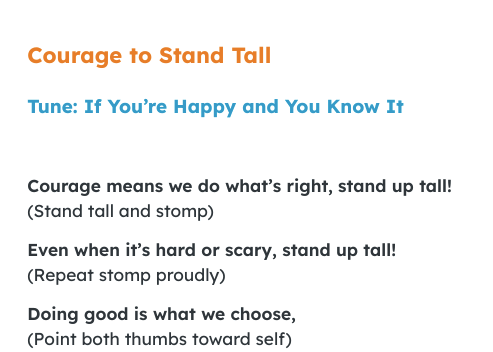
- Tell students: “Today I am going to teach you a song called Courage to Stand Tall. It is going to help us remember some important ideas that we will be learning about.”
- Teach students the words and motions for the song, one line at a time.
- Sing the full song at least two times with students.
- Repeat the song throughout the day, singing with students during transitions, play time, or during periods of waiting.
Scaffolding notes: This song complements the song about Courage from Armstrong’s Amazing Courage. If students already know that song, discuss the differences between the songs and how courage can look different in different situations.
- For instance, it can be courageous to jump from a tall rock, and it can be courageous to speak in front of a large crowd.
Explore
Repeated Reading
- Transition: Distribute copies of the mini-book to students.
- Tell students: “We are going to read a book called Eckford’s Epic Courage. Based on our courage song and what you know, what do you think courage is?
- Guide students to the idea that courage is when you do good things, even if it is hard or scary.
- Brainstorm with students: “Who are some people or characters that you think are courageous? How were they courageous?”
- Student-friendly examples could include superheroes, community helpers, or sports players.
Scaffolding Note: If students have experienced the Armstong’s Amazing Courage lesson, this is a good time to bring back out the anchor chart from that lesson and activate student prior knowledge.
- Tell students: “Next, we will read a story about a girl in high school that had to be very courageous going to a new school. Her name was Elizabeth Eckford.”
- Read the book with students twice.
- First, read the book aloud to students as they follow along with pointing to each word with a finger as you read. Model appropriate speed and expression as you read to your students.
Anchor Chart Creation
- Create an anchor chart with students that will hang in the classroom during the rest of the lesson. You can also use or add to the anchor chart from Armstrong’s Amazing Courage with additional images of Eckford and examples of courage.
- The anchor chart should include:
- Courage is doing good things even if it is hard or scary.
- Elizabeth Eckford practiced this civic virtue by attending a new school, even though some people didn’t want her there.
- Courage icon:
- Courage – lion– the ability to take helpful action in the face of fear or danger.
- Examples of Courage in action:
- Add to the chart as student share examples. This will vary based on your class. You could include: trying something new, joining a new sports team even if you’ve never played before, speaking up in class to answer a question when you’re nervous, admitting you made a mistake instead of hiding it, returning a lost toy to its owner even if you wanted to keep it, going to the doctor even though you’re scared of shots or learning to ride a bike even after falling a few times.
- Send student mini-books home at the conclusion of the lesson to encourage family engagement. Families and students will benefit from a shared understanding around classroom activities.
Continue Repeated Reading
- Transition: Ask students to return to the beginning of their mini-books to continue with the Repeated Reading.
- Next, read the book in a teacher think-aloud reading style.
- In a think-aloud, you pause at strategic points to highlight important information, summarize, and model skilled thinking about reading for your students. Prepare these pause points before the lesson based on your students grade and skill level. You can also utilize the skills boxes in mini-book Option B to inspire your pause points.
- For example, on page 2 of the mini-book Option B the text says: “Some people did not want her at school. They did not like the new rule that let her go.”
- A teacher could say: It is important to know why people did not want Elizabeth to go to this school. In the 1950s, many schools were divided by skin color. This was called “separate but equal.” A new law said this was not fair. It said all kids should be able to go to the school closest to them, regardless of skin color. Some people were angry about this change. They wanted Elizabeth to stay at her old school instead of going to the school that had been for white students only.
- This kind of connection helps students fill gaps in their knowledge of the world or remind them of the history they may have forgotten.
Scaffolding note: If reading with more advanced or older students, additional reading styles are available to choose from in our Modes of Reading Teacher Support Document.
Assess
Group Assessment
- Facilitate a whole group assessment. There are two options available based on the needs of your classroom.
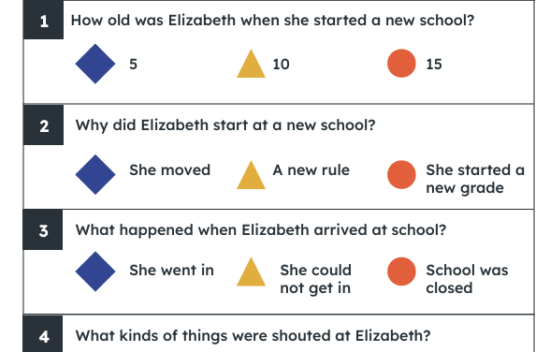
- Option 1: For K-1
- 5 multiple choice questions, shapes distinguish options
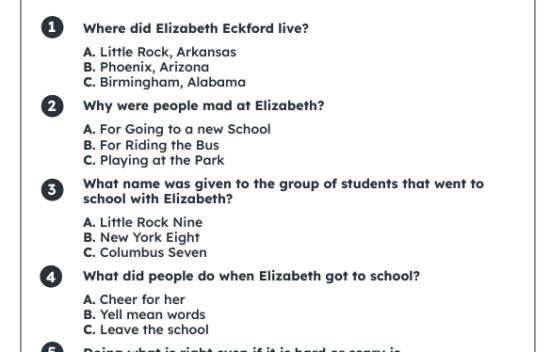
- Option 2: For 2-3
- 10 multiple choice questions, letters distinguish options
- Option 1: For K-1
- To facilitate a whole-group assessment:
- Print a copy of your chosen assessment option for each student in the class and project a copy of the assessment if possible.
- Ask students to point to the number 1 on their page, then follow along as you read aloud. Perhaps pointing to each word as you read.
- Read the question, pointing to each word.
- Read each answer choice, pointing to the choice indicator (letter or shape)
- Repeat the question-and-answer choices if needed.
- Prompt students to choose their answer by circling their choice.
- Repeat with the remaining questions to complete the assessment.
Extend
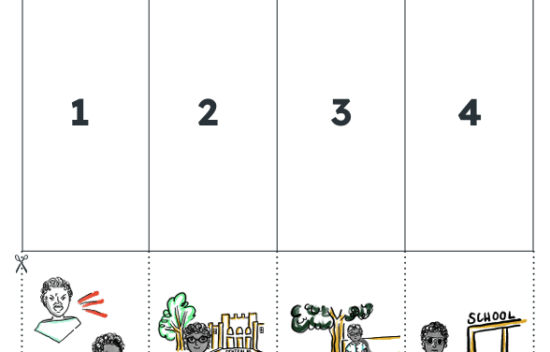
Sequencing Worksheet
- Transition: Distribute the Sequencing Worksheet to students along with scissors and glue.
- Overview the worksheet with students as a whole group including:
- Reading aloud each sequencing piece as a whole group
- Where to cut on the worksheet
- Where to glue on the worksheet
- Using their mini-book for reference to determine sequence
- Depending on your group of learners, release your students to complete the worksheet independently or in partners.
- Ask a few students to explain or defend their sequencing order.
- Bring the class back together to debrief the task.
- Ask students:
- Which part was the hardest to sequence and why?
- How do you think she was feeling? How do you know?
- Return to the mini-book and use a think-aloud to show students the correct order of the events using a pencil or marker.
- Allow students time to correct their worksheets before moving on to the assessment.
- Re-teach, if needed, using the stations materials or other items from our resource bank.