BRI Teacher Council Member Immerses His Students In The Supreme Court
<p><em>Note: May 6-10 is Teacher Appreciation Week. The Bill of Rights Institute is sharing the perspective of some of its National Teacher Council members and how they teach civics in their classroom.</em></p>
<p><em>By Patrick Sprinkle</em></p>
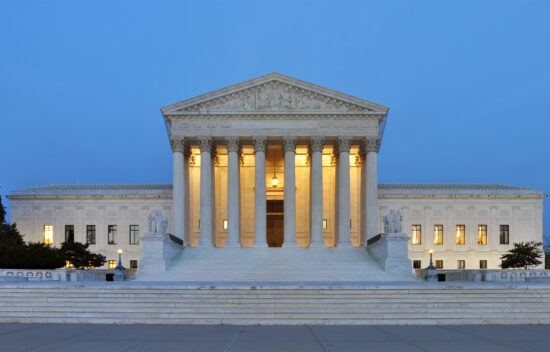
<p>The Supreme Court of the United States is often seen as the most distant and befuddling branch for my students. Whether it is misunderstanding their unelected status, difficulty in discerning legal language, or simply confusion about how the federal courts function, students are often left with a disjointed understanding of the role of the Supreme Court in the policymaking process. While students may be familiar with the Supreme Court justices individually, they often struggle to critically evaluate the Court as an institution and their jurisprudence.</p>
<p>I use a special activity to allow students to make sense of the Supreme Court as a pillar of our democracy in the context of an ongoing case. I use this activity every school year and identify one case that is particularly relevant to the lives of students. Relevance is the cornerstone of student learning.</p>
<p>Students will eagerly jump into the case, looking at case law, amicus curiae briefs, transcripts from the court, and prior judicial behavior to get into the minds of the justices. By asking students to predict how both the courts and individual justices will rule, students can arrive at how the court functions and how the circumstances of each justice help shape their judicial behavior.</p>
<p>Students also enjoy the competitive aspect of trying to accurately determine the behavior of the Court. For the 2023-2024 school year, I chose the Supreme Court case <em>United States v. Rahimi</em>, which evaluates the Second Amendment and the rights of those who have restraining orders placed on them related to domestic abuse. </p>
<p>When teaching this project, it may be important to model how to analyze judicial behavior. Whether it is taking excerpts from the transcript, observing past judicial behavior, or simply providing a background into the justices, this moment of direct instruction can go a long way to help students better understand how legal scholars make sense of the Supreme Court.</p>
<p>Prior to this project, I will spend multiple days on Miller, Heller, Bruen, and McDonald to give students an appreciation for how the courts evolved on gun rights. Historical interpretations are also useful for students to examine the Second Amendment from an originalist lens.</p>
<p>My students soared on this project as they made predictions about what the court would use. What I find to be most joyful was how students interpreted the types of questions the justices asked and what this meant for what side they might fall upon in this case. While we do not know how the court will rule yet, my classroom will certainly be abuzz when the decision is released. After all, our number one goal as educators is to help create an informed, engaged citizenry. This project helps to lay the foundation by which our young people will stay engaged with the interworking of the Supreme Court for a lifetime.</p>
<p>Ultimately, our goal is to better prepare our students for their lives as citizens in a complex democracy. This student-centered project allows students to evaluate challenging materials using an issue they care deeply about. While the outcome of the case is unsettled and is seen by some legal experts as quite predictable given the solid conservative majority, this still holds a relevance to the lives of students and should be a case taught in the upcoming school year.</p>
<p><em>Patrick Sprinkle teaches civics, government, and AP government and history at the NYC Lab School for Collaboration Studies. He is also a member of the Bill of Rights Institute National Teacher Council.</em></p>