3-5 Elementary Causes of the American Revolution Video
Get ready to travel back in time to the early days of America and discover the thrilling events that led to the American Revolution! In this elementary lesson, we explore the key moments that paved the road to independence—from the end of the French and Indian War to the fiery debates over "taxation without representation."
Our elementary lessons are primary source-based that focus on content-area literacy instruction and performance-based assessments. Designed for grades 3-5, these lessons use a modular approach for all learners and are ideal for helping elementary students explore American history and citizenship.
0:00 Hey there, young historians. Today we’re going on a journey back in time to explore the road to independence. In the early days of America with battles, a strongly worded letter to the King, and a Tea party. This story has it all. Let’s dive in. Our story begins with the end of the French and Indian War.
0:22 France and Britain had just ended a war for control over the lands of central North America. The British colonists were enlisted to support the British war effort. Native American tribes chose sides based on their own views and interests. The conflict, which involved a young George Washington, lasted seven years.
0:46 Fighting took place across the continent. When the war ended, Britain had won, gaining huge areas of land in what is now Canada and the central United States. However, success came at a high cost in terms of lives and money lost.
1:06 The British were now in debt after the war ended in 1763. The British needed money to pay off their debts to raise this money. They imposed taxes on the colonies like the Stamp Act and the Townshend Acts. The Stamp Act taxed items made of paper
1:27 like playing cards and documents. The Townshend Acts created taxes on more items like tea, glass and paint. The British saw this as the colonists paying their fair share for their own protection in the war. The colonists disagreed, and they argued that they were being taxed
1:50 by British Parliament where they had no representation, no vote. They cried taxation without representation.
2:11 England had a long history of common law and citizens rights, which the colonists argued this taxation violated. The colonists wanted their rights and liberties within the British Empire restored. As time went on, a new American identity emerged and the colonists demands for liberty and self-government grew.
2:35 However, most colonists still wanted to stay in the British Empire. Then came the Boston Tea Party in 1773, when a group of colonists dumped a whole load of tea, over 90,000 pounds of a ship into the Boston Harbor to protest taxes and the rules on tea.
2:59 This was followed by the Coercive Acts punishing Massachusetts for the Boston Tea Party. One of the acts blocked Boston Harbor until the citizens paid for the tea that was destroyed. Another put Boston under British rule. The colonists hated these laws so much
3:19 they called them the Intolerable Acts. As tensions mounted, the colonies knew they needed to coordinate their actions. So the First Continental Congress met in 1774 to discuss a united response to the taxes imposed by the British Parliament.
3:40 Some colonists now supported a total separation or independence from Britain. The Second Continental Congress
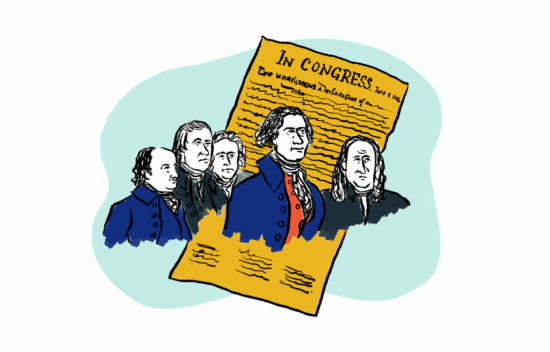
4:01 debated the idea of independence. On June 7th, 1776, Richard Henry Lee proposed a resolution for independence and a committee was formed to draft a declaration. Thomas Jefferson was tasked with writing a Declaration of Independence.
4:24 He had thought a lot about the principles that went into the document. With the help of Benjamin Franklin and John Adams. Jefferson penned a document expressing the natural rights principles of a new American Republic. In it, Congress declared American rights to life, liberty, and the pursuit
4:47 of happiness and a government based upon the consent of the people. The declaration started by explaining why the colonists were separating from Great Britain, asserting that they were entitled to natural rights. It stated that all are created
5:08 equal and have unalienable rights to life, liberty, and the pursuit of happiness. The declaration accused King George the Third of leading a government that threatened these rights. This meant the government was tyrannical and unjust.
5:28 For that reason, the colonies were declaring their independence. And there you have it. Our story for today ends here. But the story of history is still being written by us. The Declaration of Independence marked the birth of a new nation where people stood up for their rights and the rights
5:49 of their neighbors in opposition to tyranny. It is our responsibility to continually stand for justice and natural rights for all Americans.