Lesson
The History of Immigration Law in the United States

Founding Principles
Learning objectives
- Students will learn about the debates over immigration during the Founding era, and how Founders differed on the benefits and drawbacks of unrestricted immigration.
- Students will understand the basic process of immigration into the country in the 1700s and 1800s and come to understand naturalization.
- Students will understand the contested nature of the meaning of the Fourteenth Amendment, and how it applies to ongoing immigration controversies in the 2000s.
- Students will understand how strict immigration controls in the decades before and after 1900 favored certain ethnic and national groups over others.
- Students will understand the nature of anti-immigrant backlash in the first half of the 1900s, and how it manifested itself in federal policy and on the home front in both World Wars.
- Students will understand how immigration policy radically changed after World War II and learn more about the reasoning for this transformation.
Materials
- Handout A: Background Essay—The History of Immigration Law in the United States
- Handout B-1: Debating Immigration in the Founding Era
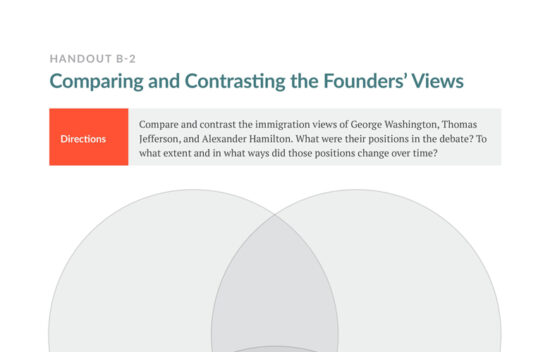
- Handout B-2: Comparing and Contrasting the Founders’ Views
- Handout C: Cartoons on Immigration in the 1800s
- Handout D: Transforming Immigration Policy in the 1900s
Lesson Components




Lesson plan
Key Terms
- Naturalization
- Naturalization Act of 1790
- Fourteenth Amendment
- Natural-born citizen
- 1882 Chinese Exclusion Act
Standards
Related materials

Use this primary source text to explore key historical events.

Use this lesson toward the end of the unit with the Barack Obama, Keynote Address at the Democratic National Convention, July 27, 2004 Primary Source to discuss the idea of the "American Dream" and its impact on immigration.

The late nineteenth century experienced one of the largest mass migrations in history, tens of millions of immigrants came to America from Europe, Asia, and North America. Immigrants settled in the United States primarily for economic opportunity afforded by the growing industrial economy and faced challenges upon arriving. The influx of so many immigrants changed American culture and presented unique tensions in American society, leading to a debate over immigration, citizenship, and the restriction of immigration.

Introduce students to the push and pull factors that led to high levels of immigration from Germany and Ireland from 1830 to 1860. Facilitation Notes: This activity is designed for groups of five students. The activity works best if each student only sees their printed primary source. The students should have some background knowledge on the European industrial revolution and its impact on urban growth and immigration in the United States.This lesson targets the foundational skills of analyzing documents, grouping documents, and constructing a thesis as required of the DBQ essay on the AP exam.

Use this Lesson with the Cartoon Analysis: Immigration in the Gilded Age, 1882–1896 Primary Source to highlight the way immigrants were regarded and treated during the Gilded Age.

What is importance of immigration to the American story? Trace the history of immigration in the United States from its Founding to the first half of the twentieth century. Help students gain an understanding of the experience of immigrants in the 1800s, the factors that brought them to the United States, and the challenges they faced upon their arrival. Equip students to engage in the modern conversation on immigration in the United States.

Tony Williams is joined by Dr. Stephanie Hinnershitz, author and assistant professor of history at Cleveland State University, as they discuss her thought-provoking essay on the Chinese Exclusion Act of 1882 in BRI’s new digital textbook, Life, Liberty, and the Pursuit of Happiness. She chronicles the social, economic, and political factors that compelled many people to immigrate to the United States from China in the late 19th century, as well as the tragic violence and xenophobia that Chinese laborers routinely suffered. How did these tensions culminate in the passage of the Chinese Exclusion Act in 1882, and what impact did this discriminatory law have on society?

The rise in immigration to the United States in the 1840's altered the economic, cultural, and political climate of the nation in the first half of the 19th century.

Have American views on immigration changed over time? In this episode, Mary walks through "The Anti-Chinese Wall" cartoon by Friedrich Graetz to understand the discriminatory reasons why many Americans objected to Chinese immigration in the late 19th century, and what they revealed about many Americans' beliefs during the time. How did the debate against Chinese immigration turn into the Chinese Exclusion Act?